IC Markets





































Why the Rand Is One of the World's Most Volatile Currencies
Deep liquidity, open capital flows, foreign bond holdings, commodities and politics make the rand swing more than its peers. What it means for traders.
 WriterAbir KhanWriterWrites the guides · checks every figure against primary sources View profileAbout Abir →
 Market analysisTanbir Habib RiyadForex & Crypto AnalystForex and crypto analyst · technical and fundamental analysis View profileAbout Tanbir →
 Fact-checking & riskJannatul FerdaushFact-Checker & Risk AnalystFact-checks every figure · risk analysis · Applied Statistics, University of Dhaka View profileAbout Jannatul →
 Trading reviewJowel RanaCo-Founder & Forex TraderCo-founder · forex trader · reviews guides from a trader's view View profileAbout Jowel →
 Final approvalRanjan NiskrityFounder, Owner & Forex TraderFounder and owner · forex trader · signs off every guide View profileAbout Ranjan →
The rand regularly appears near the top of lists of the most volatile currencies, sometimes the most volatile of the major emerging-market units. That is not an accident or a sign of a broken economy. It comes from a specific set of structural features, and understanding them helps a trader size positions and set expectations correctly. Here is why the rand moves the way it does.
It is very liquid and freely traded
Paradoxically, part of the rand's volatility is that it is easy to trade. It is one of the most liquid emerging-market currencies, traded around the clock in large size in London and New York, not just South Africa. That means global funds use it as a quick, cheap way to express a view on emerging markets generally. When they want to add or cut EM risk fast, they trade the rand, and those flows are large relative to South Africa's economy.
The capital account is open
Money can move in and out of South African assets with few restrictions. Foreigners hold a large share of South African government bonds. When global conditions turn, that money can leave quickly, and selling bonds means selling rand. A currency with a more closed capital account does not have this pressure valve, so it moves less day to day but can break more violently when controls fail.
Commodity and twin-deficit exposure
South Africa runs current-account and fiscal deficits that need foreign funding, and its export earnings swing with commodity prices. That combination means the currency is sensitive both to global risk appetite (will foreigners keep funding the deficit?) and to commodity cycles (are export earnings rising or falling?). Both can turn quickly.
Political and institutional risk
Budget surprises, ratings reviews, coalition politics, and the health of state-owned enterprises all feed into how much risk premium investors demand to hold rand assets. That premium is not stable, so the currency reprices as the political picture changes, sometimes sharply around a single announcement.
| Feature | Effect on volatility |
|---|---|
| High liquidity, global trading | Large EM-proxy flows relative to the economy |
| Open capital account | Fast foreign inflows and outflows, especially in bonds |
| Current-account and fiscal deficits | Reliance on foreign funding, sensitive to sentiment |
| Commodity export exposure | Swings with global metals and mineral prices |
| Political and SOE risk | Repricing of risk premium around events |
What a volatile day means in rand
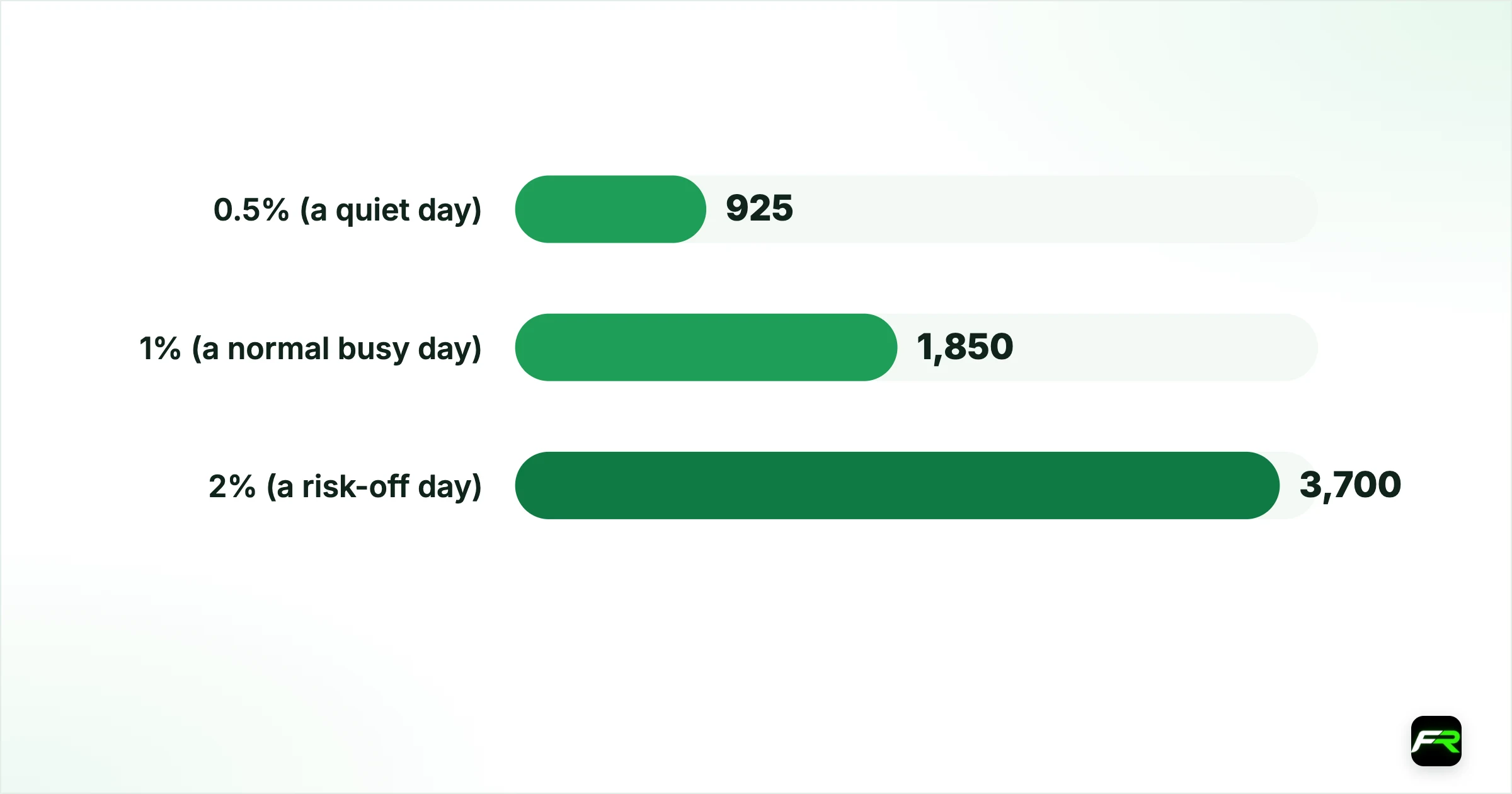
Percentages hide how large rand moves are on a trading account. With USD/ZAR at 18.50, a 1 per cent move is 18.5 cents, or 1,850 pips. On a rand account, where a pip is worth R10 per standard lot, that becomes:
| USD/ZAR move | Pips | 0.01 lot | 0.10 lot | 1.00 lot |
|---|---|---|---|---|
| 0.5% (a quiet day) | 925 | R93 | R925 | R9,250 |
| 1% (a normal busy day) | 1,850 | R185 | R1,850 | R18,500 |
| 2% (a risk-off day) | 3,700 | R370 | R3,700 | R37,000 |
A trader with R10,000 holding one mini lot through a risk-off day could lose more than a third of the account without doing anything unusual. Nothing about that is a broker trick. It is simply the size of the rand's ordinary range set against a position sized for a calmer pair.
Measuring it yourself with ATR
You do not need to rely on anyone's description of the rand's volatility. Both MT4 and MT5 include the Average True Range indicator, which shows the average size of each candle over a set number of periods. Add ATR(14) to a daily USD/ZAR chart and you can read the typical daily range in rand directly.
- Use the daily ATR to set realistic stop distances; a stop well inside one day's ATR will be hit by noise.
- Compare ATR on USD/ZAR with EUR/USD to see how much smaller your rand position needs to be.
- Watch for ATR rising sharply, which tells you volatility has changed and your sizing should change with it.
Re-check the daily ATR once a week. When it rises, cut position size so that your rand risk per trade stays at 1 per cent.
What it means for a trader
- Position sizes on rand pairs should be smaller than on major pairs, because the same account risk buys you less room.
- Stops need to sit outside normal daily noise, which on USD/ZAR is wide, so the position is smaller still.
- Overnight and weekend gaps are more likely and larger. Be deliberate about what you hold.
- The pair can trend hard for weeks on a sentiment shift, then reverse quickly. Do not marry a direction.
Johan came to USD/ZAR from trading EUR/USD and used the same stop distances and position sizes. He was stopped out repeatedly by moves that would have been unremarkable on a major pair. Once he accepted that the rand's daily range is structurally wider and cut his position size on it by more than half, his win rate on the same strategy recovered. The strategy was fine; the sizing had not adjusted for the pair.
The rand's volatility is a permanent feature, not a temporary condition. Any strategy or position size you bring from the major pairs needs to be recalibrated for a wider daily range and a higher chance of gaps.
People treat the rand's volatility as a bug. For a trader it is just the operating environment: bigger ranges, faster reversals, more gap risk. Respect it by trading smaller, and it is perfectly workable. Ignore it and size like it is EUR/USD, and it will take your account apart.
Frequently asked
Why is the South African rand so volatile?
A combination of high liquidity and global EM-proxy trading, an open capital account with heavy foreign bond ownership, current-account and fiscal deficits that rely on foreign funding, commodity export exposure, and political and institutional risk that reprices around events.
Is the rand's volatility a sign of a weak economy?
Not directly. Much of it comes from the rand being easy to trade and freely accessible, so global funds use it to express emerging-market views. A less liquid, more controlled currency moves less day to day but can break harder.
How should volatility change how I trade the rand?
Use smaller position sizes than on major pairs, set stops outside the wider daily noise, be deliberate about overnight and weekend exposure, and do not commit hard to a direction because reversals can be fast.
Does the rand trend or range?
Both. It can trend strongly for weeks on a sentiment or rate shift, then reverse a large part of the move quickly. Trend-following works, but managing the reversal risk matters.
Is the rand more volatile than other emerging-market currencies?
It is consistently among the most volatile, often more so than peers, because of its liquidity and openness combined with the fiscal and political risk premium.
How much is a 1 per cent USD/ZAR move in rand?
With USD/ZAR at 18.50, a 1 per cent move is 18.5 cents, or 1,850 pips. That is about R185 on a micro lot, R1,850 on a mini lot and R18,500 on a standard lot, which is why rand positions need to be small.
What is ATR and how does it help with the rand?
Average True Range is a built-in indicator in MT4 and MT5 that measures the average size of price bars over a set period, usually 14. On a daily USD/ZAR chart it shows the typical day's range, which helps you set stops outside normal noise and size positions to match.
Related reading
The team behind this guide
Researched, checked and approved by five forex specialists
Every guide is written, fact-checked and edited before it goes live, and updated when the facts change. Spotted an error? Tell us.