IC Markets































What Actually Moves the Rand: The USD/ZAR Drivers
Global risk sentiment, the Fed, the SARB, commodities and politics, in roughly that order of day-to-day importance. A trader's guide to what to watch and when.
 WriterAbir KhanWriterWrites the guides · checks every figure against primary sources View profileAbout Abir →
 Market analysisTanbir Habib RiyadForex & Crypto AnalystForex and crypto analyst · technical and fundamental analysis View profileAbout Tanbir →
 Fact-checking & riskJannatul FerdaushFact-Checker & Risk AnalystFact-checks every figure · risk analysis · Applied Statistics, University of Dhaka View profileAbout Jannatul →
 Trading reviewJowel RanaCo-Founder & Forex TraderCo-founder · forex trader · reviews guides from a trader's view View profileAbout Jowel →
 Final approvalRanjan NiskrityFounder, Owner & Forex TraderFounder and owner · forex trader · signs off every guide View profileAbout Ranjan →
If you trade USD/ZAR you need a working model of what moves it, so you know whether today's move is noise or something you should respect. The rand has a handful of consistent drivers. On most days the offshore ones matter more than the local ones, which surprises new South African traders. Here they are, in order of how often they set the tone.
1. Global risk sentiment
The rand is one of the most traded emerging-market currencies and functions as a proxy for EM risk generally. When global markets are optimistic, capital flows into higher-yielding assets including South African bonds and equities, and the rand strengthens. In a fearful moment, a US recession scare, a banking wobble, a geopolitical shock, that capital leaves fast and the rand sells off, often more than the fundamentals justify. A day when US equities are down sharply and the VIX is up is usually a weak-rand day regardless of South African news.
2. The US Federal Reserve and US data
USD/ZAR has a dollar leg, so anything that moves the dollar moves the pair. US CPI, the jobs report, and FOMC decisions are the highest-impact scheduled events for a USD/ZAR position. A hotter-than-expected US inflation print strengthens the dollar and pushes USD/ZAR up; a dovish Fed does the opposite. The interest-rate gap matters too: with the SARB repo rate at 7.25 per cent and the US federal funds target range at 3.75 to 4 per cent, the spread favours the rand and supports carry-trade demand for it.
3. The SARB
The Reserve Bank's rate decision is the domestic event that moves the rand most, and it can do 1.5 per cent or more in minutes. Markets care about the decision itself, the vote split, and the Governor's tone on inflation. Monthly CPI and the trade balance also matter. Our SARB decision guide covers trading around it.
4. Commodity prices
South Africa exports gold, platinum group metals, coal and iron ore, so the rand tends to strengthen when those prices rise and weaken when they fall. Gold is the one to watch most, and platinum and palladium matter because South Africa dominates their supply. A strong metals week is usually a supportive backdrop for the rand; a commodity slump is a headwind.
5. Politics and fiscal news
The Budget in February, ratings-agency reviews, coalition stability, and news on state-owned enterprises like Eskom and Transnet all reprice South African sovereign risk and move the rand independently of monetary policy. A credible Budget or a positive ratings action strengthens the rand; a fiscal slip or a downgrade weakens it, sometimes sharply because some funds are forced to sell on a rating change.
| Driver | Day-to-day weight | Watch |
|---|---|---|
| Global risk sentiment | Highest | US equities, VIX, EM sentiment |
| Fed and US data | High | US CPI, jobs report, FOMC |
| SARB | High on decision days | Rate decision, CPI, trade balance |
| Commodities | Medium | Gold, platinum, palladium |
| Politics and fiscal | Episodic, can be large | Budget, ratings reviews, SOE news |
Karin kept trying to explain each USD/ZAR move with South African headlines and kept getting it wrong. A mentor pointed out that on the days she was confused, the driver was almost always offshore: a US inflation surprise, a risk-off session in New York. Once she started checking US equities and the dollar index first and South African news second, the pair's behaviour made far more sense and she stopped fighting moves that had nothing to do with local factors.
Before you take a USD/ZAR trade, glance at three things: US equity futures and the dollar index for the risk backdrop, the economic calendar for US and SA releases in the next few hours, and whether a SARB or Fed meeting is imminent.
The mistake South Africans make with the rand is assuming it is driven by South African news. Most days it is driven by New York. Build the habit of checking the global risk picture first, then the Fed calendar, then the SARB, then commodities, then politics. That order is roughly how often each one is the reason the pair is moving.
The data calendar that moves the rand
The drivers are half the job; when they land is the other half. These are the scheduled releases that most often move USD/ZAR, with times in South African Standard Time. US times are for the northern summer; add an hour from early November to mid-March, when the US is on standard time.
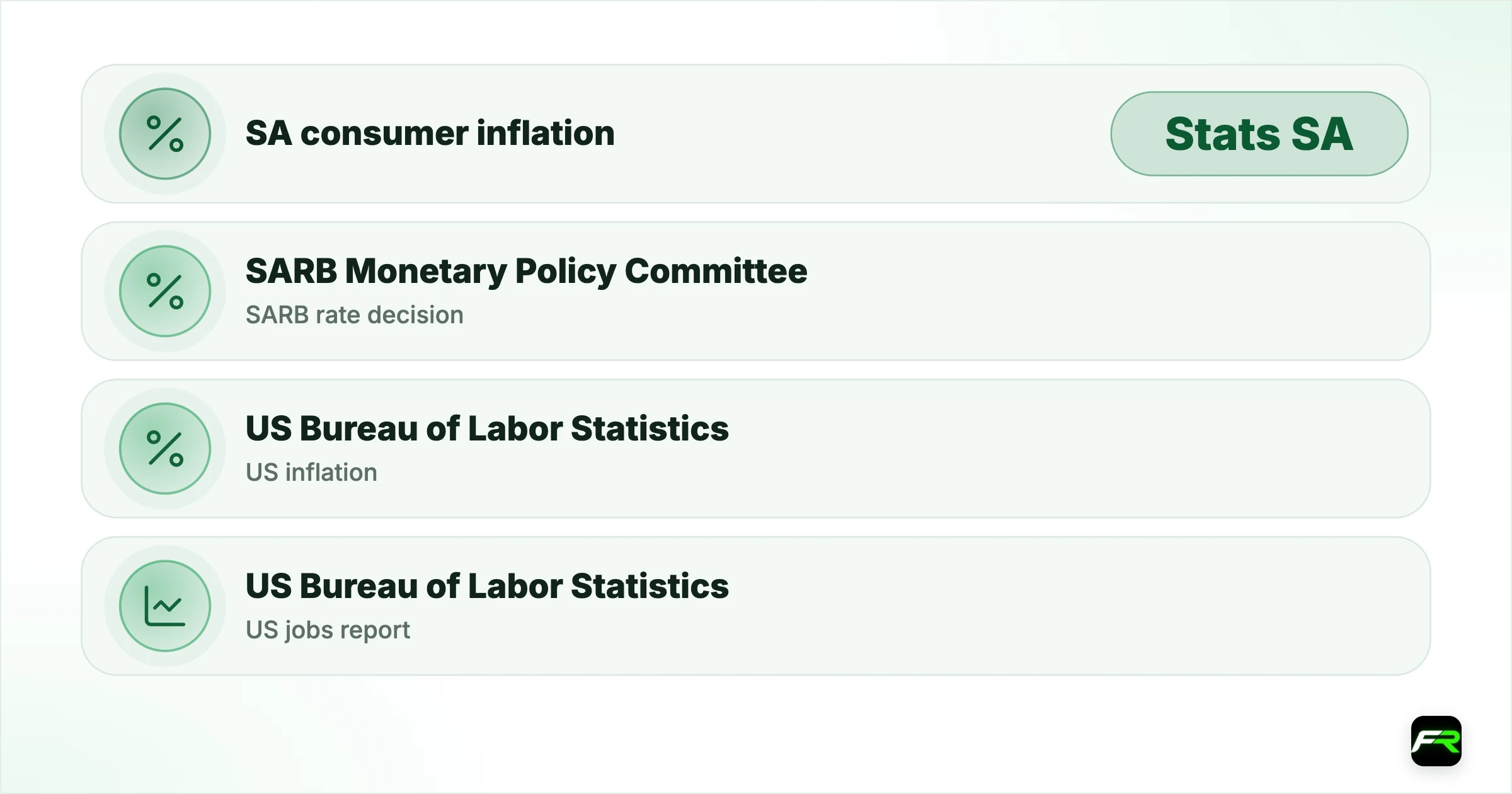
| Release | Published by | When (SAST) | How often |
|---|---|---|---|
| SA consumer inflation (CPI) | Stats SA | 10:00 | Monthly, usually a Wednesday |
| SARB rate decision | SARB Monetary Policy Committee | Afternoon | Six times a year |
| US inflation (CPI) | US Bureau of Labor Statistics | 14:30 | Monthly |
| US jobs report | US Bureau of Labor Statistics | 14:30 | Monthly, usually the first Friday |
| Fed rate decision | Federal Open Market Committee | 20:00 | Eight times a year |
| SA Budget | National Treasury | Afternoon | February, with a medium-term update later in the year |
Stats SA's published schedule shows the next CPI releases on 21 October and 18 November 2026, both at 10:00. The next SARB decision is on 19 November 2026. Put these in your calendar along with the US dates before the month starts.
When the drivers pull in opposite directions
Real days are rarely tidy. Gold may be rising, which helps the rand, while US equities sell off, which hurts it. In that kind of tug-of-war the faster-moving driver usually wins in the short run, and that is nearly always global risk sentiment or the dollar. Commodities and local politics tend to show up over weeks rather than hours.
- Risk-off plus a strong dollar: the clearest weak-rand day. Avoid fighting it.
- Risk-on plus a weak dollar: the clearest strong-rand day.
- Risk-off but firm metals: rand usually weakens, though less than its peers.
- Quiet global markets: local news, CPI or the SARB, gets the stage.
Frequently asked
What is the biggest driver of the rand?
Global risk sentiment. The rand is a proxy for emerging-market risk, so it strengthens when world markets are optimistic and sells off hard when there is fear, often regardless of South African news.
Does the Fed affect USD/ZAR?
Yes, strongly. USD/ZAR has a dollar leg, so US inflation data, the jobs report and Fed decisions are the highest-impact scheduled events for the pair. The rate gap between the SARB and the Fed also drives carry-trade demand.
How much does the SARB decision move the rand?
It can move USD/ZAR 1.5 per cent or more within minutes. The market reacts to the decision, the vote split and the Governor's tone on inflation.
Why does gold affect the rand?
South Africa is a major exporter of gold and platinum group metals, so higher metals prices improve the trade picture and tend to strengthen the rand. A commodity slump weakens it.
Can South African politics move the rand on its own?
Yes. The Budget, ratings-agency reviews and news on state-owned enterprises reprice sovereign risk and can move the rand sharply, sometimes because rating-constrained funds are forced to sell on a downgrade.
What time is South African CPI released?
Stats SA publishes consumer inflation at 10:00 SAST, usually on a Wednesday in the second half of the month. Its schedule shows releases on 21 October and 18 November 2026. The figure can move USD/ZAR, especially when it changes expectations for the next SARB decision.
Related reading
The team behind this guide
Researched, checked and approved by five forex specialists
Every guide is written, fact-checked and edited before it goes live, and updated when the facts change. Spotted an error? Tell us.