IC Markets





































The Rand as a Risk-Sentiment Currency
The rand is a global proxy for emerging-market risk appetite. It rallies when the world is confident and sells off hard when it is afraid, often more than South African fundamentals justify.
 WriterAbir KhanWriterWrites the guides · checks every figure against primary sources View profileAbout Abir →
 Market analysisTanbir Habib RiyadForex & Crypto AnalystForex and crypto analyst · technical and fundamental analysis View profileAbout Tanbir →
 Fact-checking & riskJannatul FerdaushFact-Checker & Risk AnalystFact-checks every figure · risk analysis · Applied Statistics, University of Dhaka View profileAbout Jannatul →
 Trading reviewJowel RanaCo-Founder & Forex TraderCo-founder · forex trader · reviews guides from a trader's view View profileAbout Jowel →
 Final approvalRanjan NiskrityFounder, Owner & Forex TraderFounder and owner · forex trader · signs off every guide View profileAbout Ranjan →
More than most currencies, the rand trades on mood. When global investors are willing to take risk, the rand strengthens; when they retreat to safety, it weakens, and the moves are often larger than anything happening in South Africa would explain. Understanding the rand as a risk-sentiment currency is one of the most useful things a South African trader can internalise.
Why the rand is a risk proxy
The rand is liquid, freely tradeable around the clock, and backed by a market where foreigners hold a large share of local bonds. That makes it the instrument global funds reach for when they want to add or reduce emerging-market exposure quickly. Buying rand assets is a way of saying "I am comfortable taking risk"; selling them is a way of saying "I want to be safe". Because those flows are large relative to South Africa's economy, the currency amplifies global sentiment.
What risk-on and risk-off look like
| Condition | Signs | Rand |
|---|---|---|
| Risk-on | US and global equities up, VIX low, credit spreads tight, commodities firm | Strengthens (USD/ZAR down) |
| Risk-off | Equities down sharply, VIX spiking, flight to US Treasuries and the dollar, gold bid on fear | Weakens, often sharply (USD/ZAR up) |
| Neutral | Mixed signals, low volatility | Trades on local factors and the dollar |
How to use it
- Check the global risk backdrop before every rand trade: US equity futures, the dollar index, and a volatility gauge like the VIX.
- In a clear risk-off session, be very cautious about being short USD/ZAR (long rand), because the move can extend fast.
- In a calm, risk-on environment, rand strength can persist, and counter-trend shorts on the rand get run over.
- Treat sudden, news-free rand weakness as a possible early signal of a broader risk-off move that has not hit the headlines yet.
The overshoot
Because the rand amplifies sentiment, it frequently overshoots in both directions. A risk-off panic can push USD/ZAR well beyond where fundamentals sit, and then it retraces a large part of the move when calm returns. This creates opportunity for traders who can identify sentiment extremes, and danger for traders who chase the move at its peak. The overshoot is a feature to trade carefully, not a reason to assume every spike will reverse on your timeframe.
Sipho was long the rand into a week when a US regional-bank scare hit global markets. There was no South African news, but USD/ZAR jumped 3 per cent in two days as funds cut emerging-market risk across the board. He held, expecting a quick reversal, and the position kept moving against him until he closed it near the top. The lesson was that when global risk turns, the rand goes with it, and a local-news-free move is often the most dangerous kind.
A rand move with no South African catalyst is usually a global risk move, and those can extend much further than a local story would. Do not assume a news-free spike is noise that will reverse quickly.
The carry trade and the rand
Part of why the rand is a risk-sentiment currency is the carry trade. Because South African interest rates are higher than those in the US, Europe or Japan, investors borrow in a low-rate currency and hold rand assets to earn the difference. This works in calm conditions and adds to rand demand. When volatility spikes, those positions are unwound quickly, borrowed money is repaid and rand is sold, which is a big part of why the currency falls so fast in a panic. A wide rate gap supports the rand in good times and makes the sell-offs sharper in bad ones.
A 60-second risk check before a rand trade
The ideas above only help if you use them before you trade. This routine takes about a minute in your platform and a browser tab, and it tells you which way the wind is blowing for the rand today.
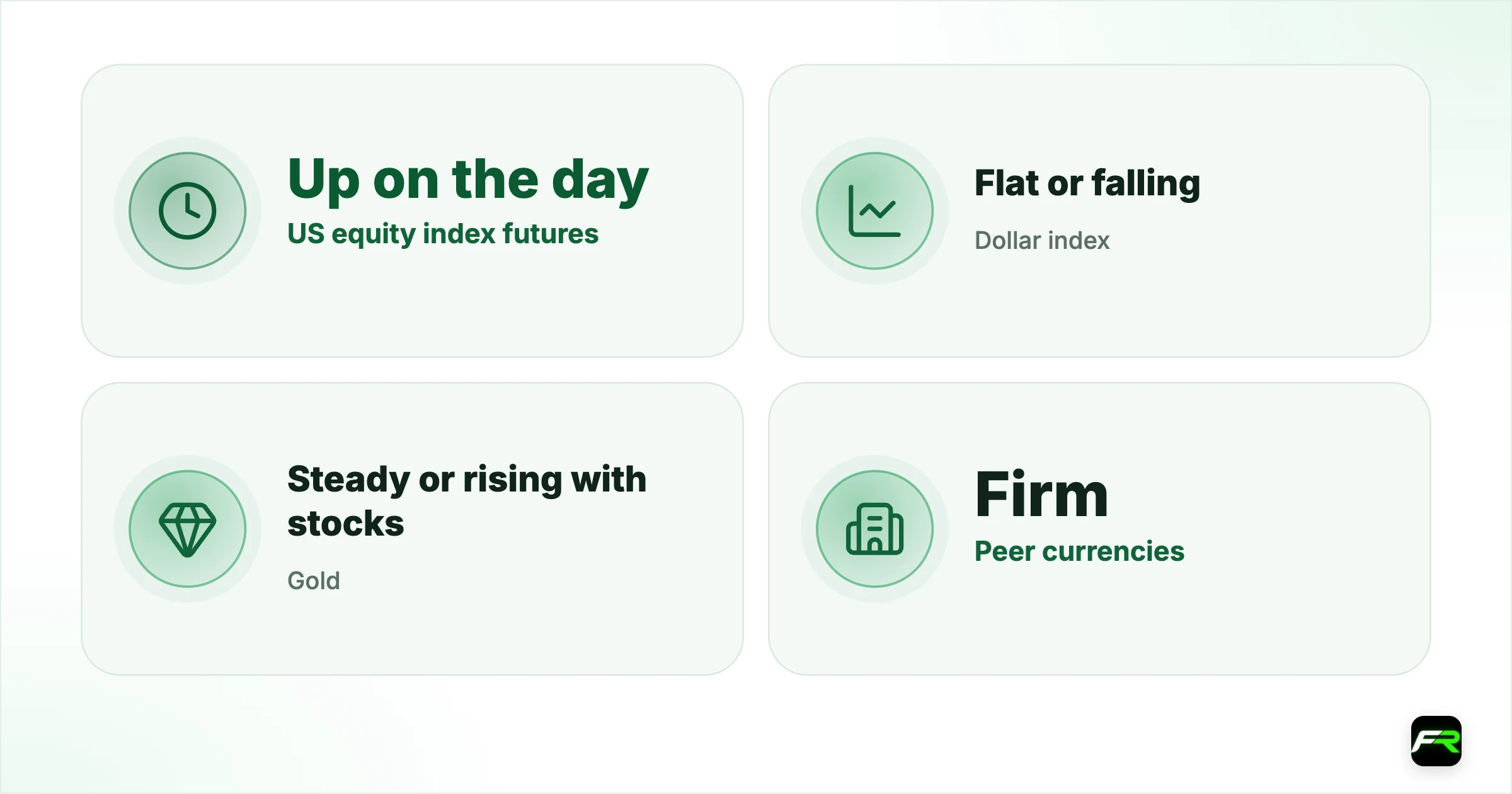
| Look at | Risk-on reading | Risk-off reading | What to do |
|---|---|---|---|
| US equity index futures | Up on the day | Down 1% or more | Risk-off: avoid new long-rand trades |
| Dollar index (DXY) | Flat or falling | Rising strongly | Strong dollar: expect USD/ZAR higher |
| Gold | Steady or rising with stocks | Rising while stocks fall | Fear bid: a warning for the rand |
| Peer currencies (MXN, BRL) | Firm | Weak with the rand | EM-wide move: do not expect a quick reversal |
If three of the four point the same way, take that as the backdrop and only trade setups that agree with it. Where they conflict, the rand is more likely to trade on local news and its own levels, and a smaller position is sensible.
Why carry trades unwind so fast
The carry trade described above has a sting in its tail. Investors who borrowed in a low-rate currency to hold rand often use leverage, and they tend to hold similar positions at the same time. When volatility jumps, they all head for the exit together, and each sale pushes the rand lower, forcing more selling. That is why the rand's worst days are often clusters of two or three sessions rather than one.
After a sharp rand sell-off, wait for the volatility to settle before buying the rand back. Catching the bottom of a carry unwind is one of the most common ways a rand trader loses a month's profit in an afternoon.
Using a risk gauge in practice
- The VIX, the US equity volatility index, is the most-watched fear gauge. Below about 15 is calm and rand-friendly; a spike above 25 signals stress and rand weakness.
- Emerging-market currency indices and the performance of peers like the Mexican peso and Brazilian real tell you whether a rand move is rand-specific or an EM-wide move.
- The US dollar index (DXY) rising broadly usually means USD/ZAR is rising on the dollar leg, not on rand news.
- Credit spreads widening (the extra yield investors demand to hold risky bonds) is an early risk-off signal that often precedes a rand move.
If you trade the rand, you are trading global risk appetite whether you mean to or not. The single best habit is to look at world equities and the dollar before you look at anything South African. On most days that tells you which way the wind is blowing for the rand.
Frequently asked
What is a risk-sentiment currency?
A currency that strengthens when global investors are willing to take risk and weakens when they retreat to safety. The rand is a leading example, used by global funds as a fast proxy for emerging-market risk appetite.
Why does the rand weaken when US stocks fall?
A falling US equity market signals risk-off sentiment. Global funds cut emerging-market exposure, which means selling rand-denominated bonds and equities, and the rand weakens even without any South African news.
How do I check the risk backdrop before trading the rand?
Look at US equity futures, the US dollar index, and a volatility gauge such as the VIX. Rising equities and a low VIX are risk-on and rand-supportive; falling equities and a spiking VIX are risk-off and rand-negative.
Does the rand overshoot?
Yes, in both directions. Because it amplifies sentiment, it often moves beyond where fundamentals sit during a panic or a euphoric run, then retraces part of the move. This is an opportunity for careful traders and a trap for those chasing the extreme.
Is a news-free rand move safe to fade?
Not necessarily. A rand move with no South African catalyst is usually a global risk move, and those can extend much further than a local story. Treat it with more caution, not less.
Which currencies move with the rand?
Other liquid emerging-market currencies, especially the Mexican peso and Brazilian real, often move with the rand when global risk sentiment shifts. If they weaken alongside it, the move is EM-wide rather than South African, and it can run further than a local story.
Related reading
The team behind this guide
Researched, checked and approved by five forex specialists
Every guide is written, fact-checked and edited before it goes live, and updated when the facts change. Spotted an error? Tell us.