IC Markets





































Position Sizing on a Rand-Denominated Forex Account
The exact calculation for a ZAR account: how to turn a 1 per cent risk rule and a stop distance into a lot size, worked through for EUR/USD and USD/ZAR.
 WriterAbir KhanWriterWrites the guides · checks every figure against primary sources View profileAbout Abir →
 Market analysisTanbir Habib RiyadForex & Crypto AnalystForex and crypto analyst · technical and fundamental analysis View profileAbout Tanbir →
 Fact-checking & riskJannatul FerdaushFact-Checker & Risk AnalystFact-checks every figure · risk analysis · Applied Statistics, University of Dhaka View profileAbout Jannatul →
 Trading reviewJowel RanaCo-Founder & Forex TraderCo-founder · forex trader · reviews guides from a trader's view View profileAbout Jowel →
 Final approvalRanjan NiskrityFounder, Owner & Forex TraderFounder and owner · forex trader · signs off every guide View profileAbout Ranjan →
Position sizing is the one piece of trading maths you cannot skip. It is how you make sure a losing trade costs you a small, planned amount rather than a large, random one. On a rand-denominated account the calculation has one extra step for pairs not quoted in rand, but it is still arithmetic you can do in your head with practice. This guide works it through.
The rule
Risk a fixed small percentage of your account on each trade, most commonly 1 per cent. On a R10,000 account that is R100 per trade. This is the amount you lose if the price hits your stop-loss. It is not the size of the position; it is the size of the loss you are willing to accept. Keeping it fixed and small is what lets you survive a losing streak, which every trader has.
The calculation
- Decide your risk in rand: 1 per cent of the account. R10,000 account, R100 risk.
- Measure your stop distance in pips: the gap between your entry and your stop-loss.
- Work out the pip value you can afford: risk in rand divided by stop distance in pips.
- Convert that pip value into a lot size using the pair's pip value per lot.
Worked example: EUR/USD
Account R10,000, risk 1 per cent = R100. Your setup has a 20-pip stop. Affordable pip value = R100 / 20 = R5 per pip. On EUR/USD, one standard lot is worth about USD 10 per pip, which at roughly R18.50 per dollar is about R185 per pip; that works out to roughly R18.50 per pip for a mini lot (0.1) and R1.85 per pip for a micro lot (0.01). To get close to R5 per pip you trade about 0.03 lots (roughly R5.55 per pip), and your maximum loss if stopped is about R111, close to your R100 target.
| Input | Value |
|---|---|
| Account | R10,000 |
| Risk per trade (1%) | R100 |
| Stop distance | 20 pips |
| Affordable pip value | R5 per pip |
| EUR/USD micro lot pip value | ~R1.85 |
| Position size | ~0.03 lots |
| Loss if stopped | ~R111 |
Worked example: USD/ZAR
USD/ZAR is quoted in rand, which makes the pip value simpler, but the pair moves further so your stop is usually wider. Account R10,000, risk R100. On USD/ZAR one standard lot is USD 100,000, and a pip (0.0001 of the rate) is worth about R10 per lot. A micro lot (0.01) is about R0.10 per pip. Because a one-cent move is 100 pips on this pair, stops are measured in hundreds of pips. Say your setup needs a 10-cent stop, from 18.50 to 18.40, which is 1,000 pips. Affordable pip value = R100 / 1,000 = R0.10 per pip. That is 0.01 lots, a single micro lot. The wider stop forces a much smaller position than the EUR/USD trade, which is correct: the pair is riskier per unit.
A ready reckoner for a R10,000 account
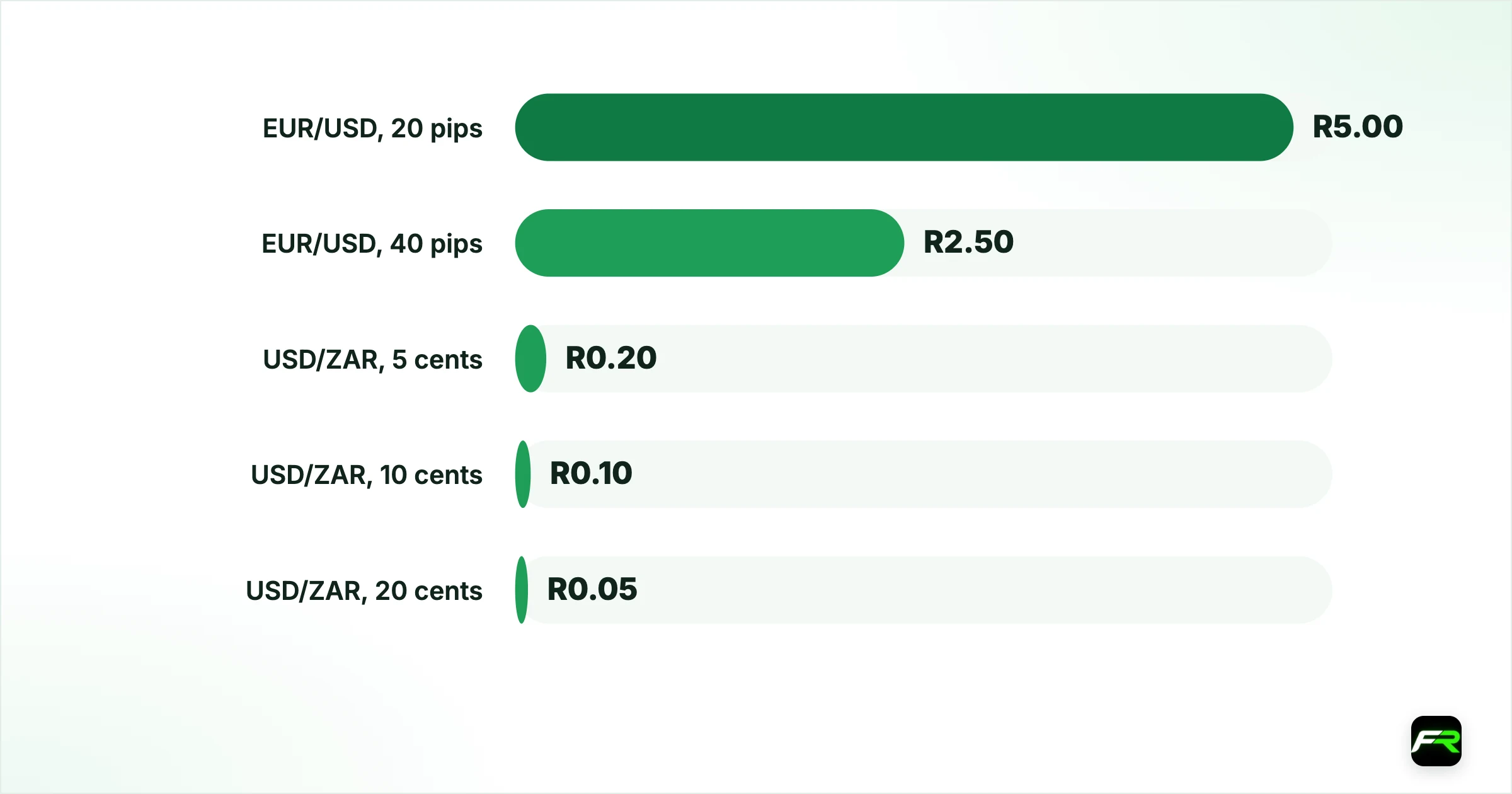
Working the sum before every trade becomes quick with practice, but a reference table helps while you learn. All rows risk R100, 1 per cent of R10,000, with USD/ZAR at 18.50:
| Pair and stop | Rand per pip you can afford | Position | Note |
|---|---|---|---|
| EUR/USD, 20 pips | R5.00 | About 0.027 lots | Round down to 0.02 |
| EUR/USD, 40 pips | R2.50 | About 0.013 lots | 0.01 lots |
| USD/ZAR, 5 cents (500 pips) | R0.20 | 0.02 lots | Two micro lots |
| USD/ZAR, 10 cents (1,000 pips) | R0.10 | 0.01 lots | One micro lot |
| USD/ZAR, 20 cents (2,000 pips) | R0.05 | 0.005 lots | Below the 0.01 minimum: use a cent account or skip |
The last row is a useful warning. A wide, sensible stop on USD/ZAR can call for a position smaller than a standard account allows. When that happens the honest choices are a cent account, a setup with a tighter stop, or no trade. Rounding up to 0.01 lots doubles your risk on that trade.
Adjusting as the balance changes
Base your 1 per cent on the current balance, not the starting one. After a drawdown from R10,000 to R9,000 your risk drops to R90 a trade, which slows losses when you are trading badly. Growth to R12,000 lifts it to R120, which lets gains compound. Many traders recalculate on the first of each month rather than before every trade, which is close enough and easier to stick to.
Always round lot sizes down, never up. Rounding down keeps every loss at or below the amount you planned.
Why the rand pair needs a smaller position
USD/ZAR's daily range is structurally wider than a major pair's, so a sensible stop is wider, so the position is smaller for the same 1 per cent risk. Traders who carry a major-pair lot size over to USD/ZAR are risking several per cent per trade without realising it. Always recalculate for the pair. The rand volatility guide explains why the range is wider.
Ayanda built a one-line calculator in her notes app: risk rand divided by stop pips gives pip value, then she looks up the lot size. It takes her ten seconds before every trade. In 18 months of trading, no single loss has exceeded about 1.2 per cent of her account, which is why a run of four losing trades is an eight rand-percent drawdown she recovers from, not an account-ending event.
If working out the position size feels like too much effort before a trade, you are not ready to place the trade. The sizing calculation is not optional. It is the difference between a business and a gamble.
Every blown account I have seen was a position-sizing failure at heart, not a bad-strategy failure. Fix your risk at 1 per cent, calculate the lot size from your stop every single time, and use a smaller size on USD/ZAR than on the majors. Do that and a losing streak is survivable. Skip it and one bad week ends you.
Frequently asked
How do I calculate position size on a rand account?
Take 1 per cent of your account as your risk in rand, divide it by your stop distance in pips to get the pip value you can afford, then convert that to a lot size using the pair's pip value per lot. On a R10,000 account with a 20-pip stop, that is R100 / 20 = R5 per pip.
How much should I risk per trade?
One per cent of your account is the common standard. It is the loss you accept if the stop is hit, not the position size. Keeping it fixed and small lets you survive the losing streaks every trader has.
Why is the position size smaller on USD/ZAR?
USD/ZAR has a wider daily range than major pairs, so a sensible stop is wider, which forces a smaller position for the same 1 per cent risk. Carrying a major-pair lot size to USD/ZAR risks several per cent per trade.
What is a pip worth on USD/ZAR?
About R10 per standard lot, so roughly R1 per mini lot and R0.10 per micro lot. Because the pair is quoted in rand, the pip value does not need a currency conversion the way EUR/USD does on a rand account.
Do I need to recalculate for every trade?
Yes, because your stop distance changes with each setup and your account balance changes over time. It takes seconds once you have a simple formula, and it is the core discipline of risk management.
What if my calculated position is smaller than 0.01 lots?
Then the trade is too big for your account with that stop. Use a cent or micro account where smaller sizes are possible, look for a setup with a tighter stop, or skip it. Rounding up to 0.01 lots means risking more than 1 per cent.
Related reading
The team behind this guide
Researched, checked and approved by five forex specialists
Every guide is written, fact-checked and edited before it goes live, and updated when the facts change. Spotted an error? Tell us.