IC Markets


































The Rand, Gold and Platinum: The Commodity Link
South Africa dominates world platinum-group-metal supply and exports significant gold, so metals prices feed the rand through the trade account. How strong the link is and when it breaks.
 WriterAbir KhanWriterWrites the guides · checks every figure against primary sources View profileAbout Abir →
 Market analysisTanbir Habib RiyadForex & Crypto AnalystForex and crypto analyst · technical and fundamental analysis View profileAbout Tanbir →
 Fact-checking & riskJannatul FerdaushFact-Checker & Risk AnalystFact-checks every figure · risk analysis · Applied Statistics, University of Dhaka View profileAbout Jannatul →
 Trading reviewJowel RanaCo-Founder & Forex TraderCo-founder · forex trader · reviews guides from a trader's view View profileAbout Jowel →
 Final approvalRanjan NiskrityFounder, Owner & Forex TraderFounder and owner · forex trader · signs off every guide View profileAbout Ranjan →
South Africa is a mining economy. It produces the large majority of the world's platinum and a big share of palladium and rhodium, exports gold, chrome, manganese, coal and iron ore, and those exports are a major source of the foreign currency the country earns. So commodity prices, metals especially, feed into the rand. This guide covers how the link works and when it does not hold.
The mechanism
When metals prices rise, South African mining companies earn more foreign currency, the trade balance improves, and there is more demand to convert export earnings into rand, which supports the currency. In a downcycle the reverse happens: weaker export earnings, a worse trade balance, and less support for the rand. The link runs through the current account and through sentiment about South African growth, since mining is a large employer and taxpayer.
Which commodities matter most
| Commodity | South Africa's position | Rand sensitivity |
|---|---|---|
| Platinum group metals | Dominant global supplier | High: PGM price swings move the trade account materially |
| Gold | Major producer and exporter | High, and gold also acts as a global risk barometer |
| Coal | Large exporter | Moderate, affected by logistics constraints |
| Iron ore, manganese, chrome | Significant exporter | Moderate |
Gold plays a double role
Gold is unusual because it affects the rand two ways at once. As a South African export, a higher gold price improves the trade picture and supports the rand. But gold is also a global safe-haven asset, and it often rises when investors are fearful, which is exactly when the rand tends to weaken as a risk currency. So a gold rally driven by risk-off sentiment can coincide with a weaker rand, while a gold rally driven by a weak dollar or strong physical demand is more cleanly rand-supportive. Read why gold is moving before assuming what it means for the rand.
When the link breaks
- During a global risk-off episode, sentiment overwhelms the commodity link and the rand weakens even if metals are up.
- When domestic logistics fail, mines can be producing but unable to export, so a good price does not translate into earnings.
- When the dollar is the dominant story, USD/ZAR moves on the dollar leg regardless of metals.
- Over short intraday windows, the commodity link is background, not a trade trigger.
Nadia shorted USD/ZAR expecting the rand to strengthen because platinum had rallied 6 per cent that week. Instead the rand weakened, because the same week brought a US inflation shock and a broad emerging-market sell-off. The commodity link was real but it was outweighed by the global risk move. She now treats metals as a slow tailwind or headwind for her directional bias, not as a same-day signal.
Use the commodity link to lean a multi-day or multi-week bias, not to time entries. If PGMs and gold are in a strong uptrend and the dollar is soft, that is a supportive backdrop for the rand; it is not a reason to buy or sell USD/ZAR this hour.
Where to watch the commodity signals
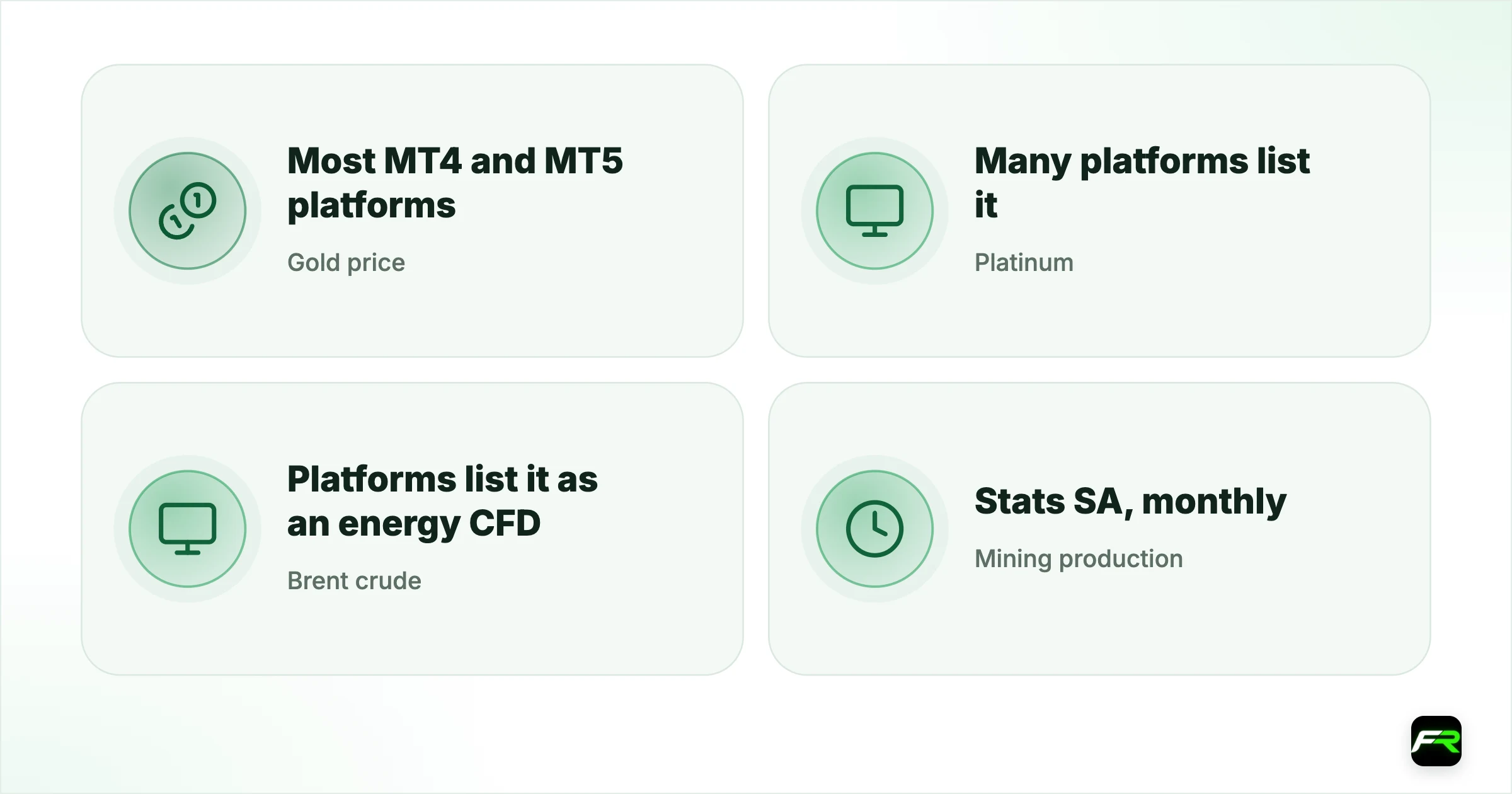
You can follow the commodity side of the rand from your trading platform and two official monthly releases. None of these is a trade signal on its own; together they tell you whether the backdrop is helping or hurting the currency.
| Signal | Where to find it | What it tells you |
|---|---|---|
| Gold price (XAU/USD) | Most MT4 and MT5 platforms | Export earnings, and whether the market is fearful |
| Platinum (XPT/USD) | Many platforms list it | South Africa's most distinctive export |
| Brent crude | Platforms list it as an energy CFD | South Africa's import bill; a rising oil price usually hurts |
| Mining production | Stats SA, monthly | Whether mines are turning prices into output |
| Trade balance | SARS, monthly trade statistics | Whether export earnings exceed imports |
A useful habit is to note, each Monday, whether gold and platinum rose or fell over the previous month and whether oil did the opposite. Two minutes of that gives you a slow-moving bias for the rand that you can check against the faster drivers each day.
A worked example of the commodity lean
Annelie trades USD/ZAR on the 4-hour chart. Over a month in which gold rose about 6 per cent, platinum firmed and oil drifted lower, she leaned towards trades that favoured the rand, taking short USD/ZAR setups and passing on most long ones. On two days when US equities fell sharply she stood aside altogether, because risk sentiment overrides the commodity backdrop in the short run. The lean did not choose her entries; it decided which of her setups she took.
The terms of trade, in plain terms
Economists talk about South Africa's "terms of trade", which is the ratio of what the country earns for its exports to what it pays for its imports. When metals prices rise and oil is stable or falling, the terms of trade improve: South Africa earns more dollars per unit exported and spends fewer on imports, the trade balance strengthens, and the rand tends to follow. In the opposite mix, metals falling while oil rises, the terms of trade worsen and the rand weakens. This is why an oil price spike is usually rand-negative even though South Africa is a metals story: the country is a net oil importer.
Mining production, not just price
A high commodity price only helps if the mines can actually produce and export. South Africa has had periods where good prices coincided with weak rand support because rail and port constraints meant coal and iron ore could not reach buyers, or because electricity and labour problems cut output. When you assess the commodity backdrop for the rand, look at export volumes and logistics news, not only the price screen. A record platinum price with mines on strike is not the tailwind it looks like.
The rand-commodity link is genuine over weeks and months and almost useless over hours. Traders get burned when they treat a metals headline as an intraday rand signal. Use it to understand the tide, then let the price action and the global risk picture tell you about the waves.
Frequently asked
How do commodity prices affect the rand?
Higher metals prices improve South Africa's export earnings and trade balance, increasing demand to convert foreign currency into rand and supporting the currency. Lower prices weaken it. The link runs through the current account and growth sentiment.
Which commodities matter most for the rand?
Platinum group metals, where South Africa is the dominant global supplier, and gold, which is both a major export and a global risk barometer. Coal, iron ore, manganese and chrome matter to a lesser degree.
Why does gold affect the rand in two directions?
As a South African export, a higher gold price supports the rand. As a safe-haven asset, gold often rises when investors are fearful, which is when the rand tends to weaken. The net effect depends on why gold is moving.
Can I trade USD/ZAR off a commodity headline?
Not reliably intraday. The commodity link works over weeks and months and is often outweighed in the short term by global risk sentiment and the dollar. Use it to lean a bias, not to time trades.
When does the rand-commodity link break down?
During global risk-off episodes, when domestic export logistics fail, and when the dollar is the dominant driver. In those cases the rand can move opposite to what the commodity picture suggests.
Where can I see the gold and platinum prices while trading?
Most MT4 and MT5 platforms list gold as XAU/USD, and many list platinum as XPT/USD and Brent crude as an energy CFD. For the slower-moving view, Stats SA publishes monthly mining production and SARS publishes monthly trade statistics.
Related reading
The team behind this guide
Researched, checked and approved by five forex specialists
Every guide is written, fact-checked and edited before it goes live, and updated when the facts change. Spotted an error? Tell us.