IC Markets






























Leverage Limits for South African Forex Traders
South Africa has no single retail leverage cap; brokers set 1:30 to 1:2000. What leverage really does and the level a sensible trader uses.
 WriterAbir KhanWriterWrites the guides · checks every figure against primary sources View profileAbout Abir →
 Market analysisTanbir Habib RiyadForex & Crypto AnalystForex and crypto analyst · technical and fundamental analysis View profileAbout Tanbir →
 Fact-checking & riskJannatul FerdaushFact-Checker & Risk AnalystFact-checks every figure · risk analysis · Applied Statistics, University of Dhaka View profileAbout Jannatul →
 Trading reviewJowel RanaCo-Founder & Forex TraderCo-founder · forex trader · reviews guides from a trader's view View profileAbout Jowel →
 Final approvalRanjan NiskrityFounder, Owner & Forex TraderFounder and owner · forex trader · signs off every guide View profileAbout Ranjan →
In the European Union and the United Kingdom, regulators cap retail forex leverage at 1:30 for major pairs. South Africa has no equivalent blanket retail cap, so leverage depends on the broker and the entity you are with, ranging from a conservative 1:30 up to 1:2000 at some offshore firms. This guide explains what leverage is, what it does to your risk, and the level to actually use.
What leverage is
Leverage lets you control a position larger than your account balance. At 1:100, R1,000 of your money controls a R100,000 position. The broker is not lending you money to keep; it is letting you post a small margin against a larger notional trade. Your profit and loss is calculated on the full position size, so a 1 per cent move on that R100,000 position is R1,000, your entire margin, either way.
Leverage does not change your risk, position size does
This is the key point beginners miss. Your risk on a trade is set by your position size and your stop distance, not by the leverage number. If you risk 1 per cent of your account on a trade with a 20-pip stop, your risk is 1 per cent whether your account leverage is 1:30 or 1:500. Higher leverage does not force you to risk more. What it does is remove the guardrail: at 1:2000 you can build a position 40 times too large without running out of margin, so a moment of poor judgement is not stopped by the broker.
| Leverage | Margin for a R100,000 position | What it enables |
|---|---|---|
| 1:30 | R3,333 | Hard to accidentally over-size a small account |
| 1:100 | R1,000 | Comfortable for sensible position sizing |
| 1:500 | R200 | Fine if disciplined; dangerous if not |
| 1:2000 | R50 | Enables account-ending position sizes; a red flag on the broker |
Margin level, margin calls and stop-outs
Leverage decides how much margin a position ties up, and margin decides how close you are to a forced close. Platforms show this as the margin level: your equity divided by the margin in use, as a percentage. Brokers set their own trigger points; the example below uses a margin call at 100 per cent and a stop-out at 50 per cent, which are common but not universal.
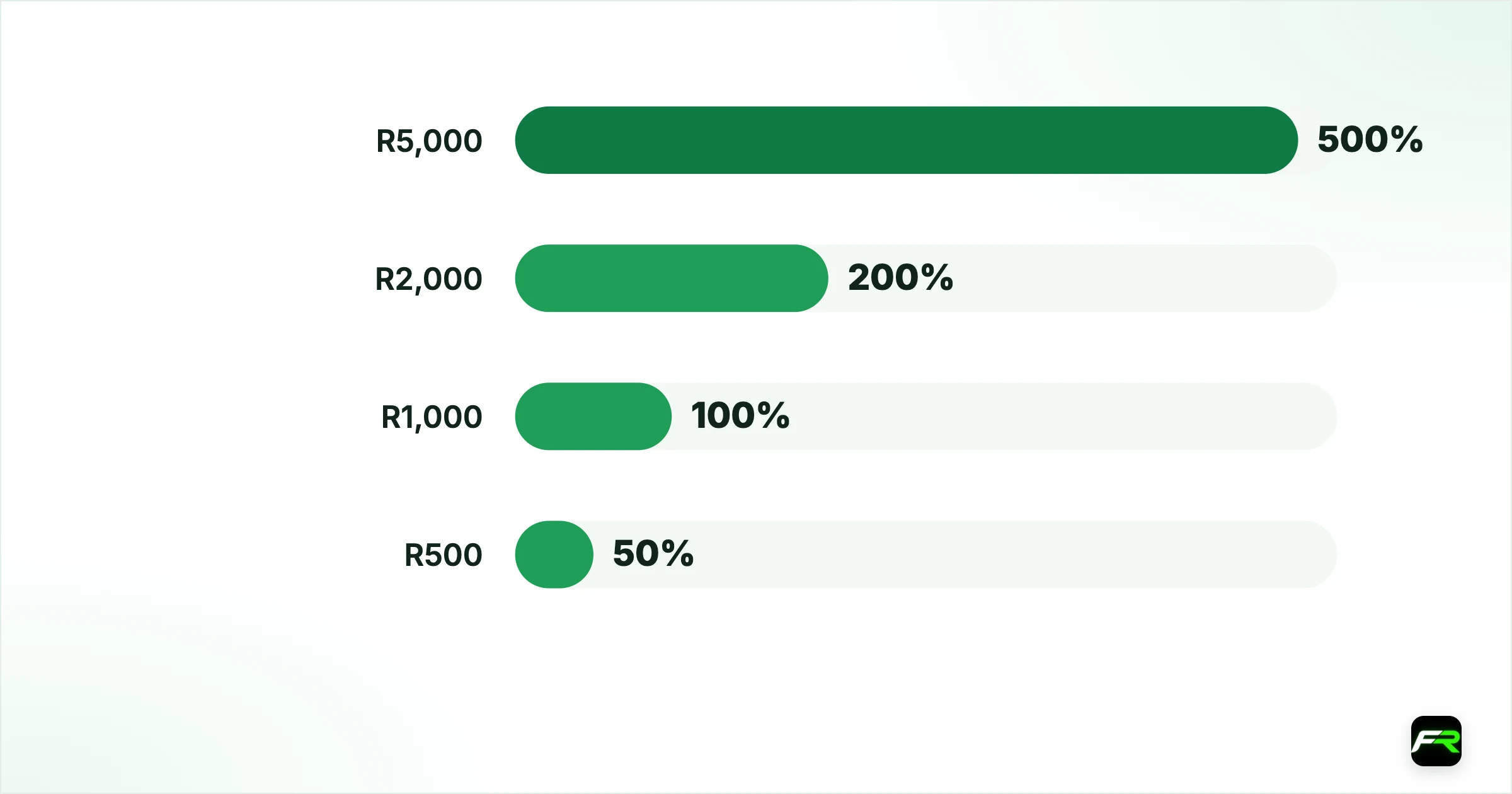
| Equity | Margin in use | Margin level | What happens |
|---|---|---|---|
| R5,000 | R1,000 | 500% | Nothing; plenty of room |
| R2,000 | R1,000 | 200% | Nothing yet, but losses are mounting |
| R1,000 | R1,000 | 100% | Margin call: no new trades; warning sent |
| R500 | R1,000 | 50% | Stop-out: the broker starts closing positions |
High leverage makes the margin in use small, so the margin level looks comfortable even on a dangerously large position. That is how traders reach the bottom row without noticing. A stop-loss sized at 1 per cent of the account should always close a trade long before margin becomes the issue.
Negative balance protection
In a violent gap, a position can lose more than the account holds, leaving a negative balance. Many brokers reset that to zero under a negative balance protection policy, and in the EU and UK retail clients are entitled to it. In South Africa it depends on the broker and the entity. Check the client agreement before you trade; it is one more reason to keep leverage moderate and size from your stop.
The level to use
For a beginner, 1:30 to 1:200 is plenty. It lets you take properly sized positions on any realistic account while making it difficult to build a position so large that one move wipes you out. You do not gain anything from 1:1000 that correct position sizing does not already give you, and a broker leading its marketing with very high leverage is usually a lightly regulated offshore entity. Set your account to a moderate level and forget about it.
High leverage as a broker signal
- Locally FSCA-licensed entities tend to offer more conservative leverage.
- Advertising "up to 1:2000" or "unlimited leverage" as a headline feature signals an offshore entity competing on the wrong thing.
- The traders that leverage attracts, and the losses it produces, tend to make those brokers' client outcomes worse.
- You can usually set your own account to a lower leverage than the maximum offered, and you should.
Sizwe opened a 1:1000 account because the marketing said it meant he needed less money. On a R2,000 account he opened a position that would have been sensible on R80,000, lost 1.4 per cent of the pair in an hour, and was down 56 per cent. He reopened with a locally licensed 1:100 account, sized every trade from a 1 per cent risk, and the high-leverage number turned out to be irrelevant to everything except how fast he could lose.
High leverage is marketed as a benefit and is closer to a hazard. It does not improve a well-sized trade, and it removes the natural limit on a badly-sized one. Use 1:30 to 1:200 and size positions from your stop and a 1 per cent risk.
Leverage is the most misunderstood number in retail forex. It is not free money and it is not your risk. Your risk is your position size and your stop. Pick a moderate leverage so you cannot fat-finger an account-ending trade, and put your attention on sizing instead. Any broker selling you on 1:2000 is telling you what kind of broker it is.
Frequently asked
What is the maximum forex leverage in South Africa?
There is no single retail leverage cap in South Africa the way there is in the EU or UK. Brokers set their own limits, from around 1:30 at conservative locally licensed entities to 1:2000 or more at some offshore firms.
Does higher leverage mean higher risk?
Not directly. Your risk is set by your position size and stop distance, not the leverage number. Higher leverage removes the margin limit that would otherwise stop you building a position far too large, so it enables higher risk rather than causing it.
What leverage should a beginner use?
1:30 to 1:200. That is enough to take properly sized positions on any realistic account while making it hard to build an account-ending position. You gain nothing from 1:1000 that correct position sizing does not already provide.
Is high leverage a warning sign?
When a broker leads its marketing with "up to 1:2000" or "unlimited leverage", it usually signals a lightly regulated offshore entity competing on the wrong feature. Locally FSCA-licensed brokers tend to be more conservative.
Can I lower the leverage on my account?
Usually yes. Most brokers let you set your account leverage below the maximum offered, either at sign-up or in the account settings. Setting it to a moderate level is sensible.
What is a stop-out level in forex?
The margin level at which the broker starts closing your positions automatically, often around 50 per cent of the margin in use, although each broker sets its own. Before that, a margin call, often at 100 per cent, stops you opening new trades.
How do I see my margin level in MT4 or MT5?
Open the Trade tab in the terminal window at the bottom of the platform. It shows your balance, equity, margin in use, free margin and margin level as a percentage. On the mobile app the same figures appear at the top of the Trade screen. Watch the margin level whenever positions are open.
Related reading
The team behind this guide
Researched, checked and approved by five forex specialists
Every guide is written, fact-checked and edited before it goes live, and updated when the facts change. Spotted an error? Tell us.