IC Markets































FSCA-Regulated vs Offshore Brokers: What South Africans Should Know
Both are legal to use. The difference is where your money sits, who you complain to, and what happens if the broker fails. A clear comparison for South African traders.
 WriterAbir KhanWriterWrites the guides · checks every figure against primary sources View profileAbout Abir →
 Market analysisTanbir Habib RiyadForex & Crypto AnalystForex and crypto analyst · technical and fundamental analysis View profileAbout Tanbir →
 Fact-checking & riskJannatul FerdaushFact-Checker & Risk AnalystFact-checks every figure · risk analysis · Applied Statistics, University of Dhaka View profileAbout Jannatul →
 Trading reviewJowel RanaCo-Founder & Forex TraderCo-founder · forex trader · reviews guides from a trader's view View profileAbout Jowel →
 Final approvalRanjan NiskrityFounder, Owner & Forex TraderFounder and owner · forex trader · signs off every guide View profileAbout Ranjan →
A South African trader can legally use a broker licensed locally by the FSCA or one licensed only offshore, in places like Seychelles, Mauritius, Belize or Saint Vincent and the Grenadines. Plenty of people use offshore brokers and never have a problem. The question is what you give up by doing so, and whether the things you gain are worth it to you. This is the honest comparison.
What a local FSCA licence gives you
- A South African regulator that supervises the entity holding your money.
- A local complaints route: the broker, then the FSCA, then the Ombud for eligible disputes, all in your time zone and language.
- Client-money segregation and capital rules enforced under South African law.
- Recourse against the firm's directors, who are vetted and can be fined personally.
- Usually a true ZAR account and local funding, which saves conversion costs.
What offshore brokers often offer instead
Offshore entities tend to advertise higher leverage (1:1000 or more), faster onboarding with lighter documentation, larger deposit bonuses, and sometimes tighter headline spreads. Some of this is genuinely useful to an experienced trader who understands the trade-off. Most of it, for a beginner, is a reason to be cautious rather than attracted. Very high leverage is a way to lose faster, not a feature, and big bonuses usually lock your withdrawals.
| Factor | Local FSCA broker | Offshore-only broker |
|---|---|---|
| Regulator you can complain to | FSCA, plus the Ombud | The offshore regulator only |
| If the broker fails | South African insolvency process, segregation rules | Foreign process, protection varies and is often thin |
| Leverage | Typically more conservative | Often 1:1000 or higher |
| ZAR account and local funding | Usually | Sometimes, often with conversion |
| Dispute practicality | Local, same time zone | Email, foreign hours, slow |
| Legal to use from South Africa | Yes | Yes |
The failure scenario is the real test
Ask what happens if the broker goes under or freezes withdrawals. With a locally licensed entity you have a regulator with jurisdiction, a defined complaints process, and enforced segregation. An offshore entity is a weaker position: your claim depends on the law and the client-money rules of a small jurisdiction, often with no practical enforcement and no scheme to draw on. Your money may be technically segregated and still take years to see, if ever.
Pieter used an offshore broker for three years because the leverage and spreads suited his strategy. The broker was fine until it abruptly restricted withdrawals during a dispute with a payment processor. His emails went to a support desk in another time zone, the local regulator there had no practical enforcement, and he eventually recovered about 60 per cent of his balance after a year. He still trades the same strategy, now with a locally licensed broker, and accepts slightly lower leverage as the price of having somewhere to go.
Five questions to put to any offshore broker
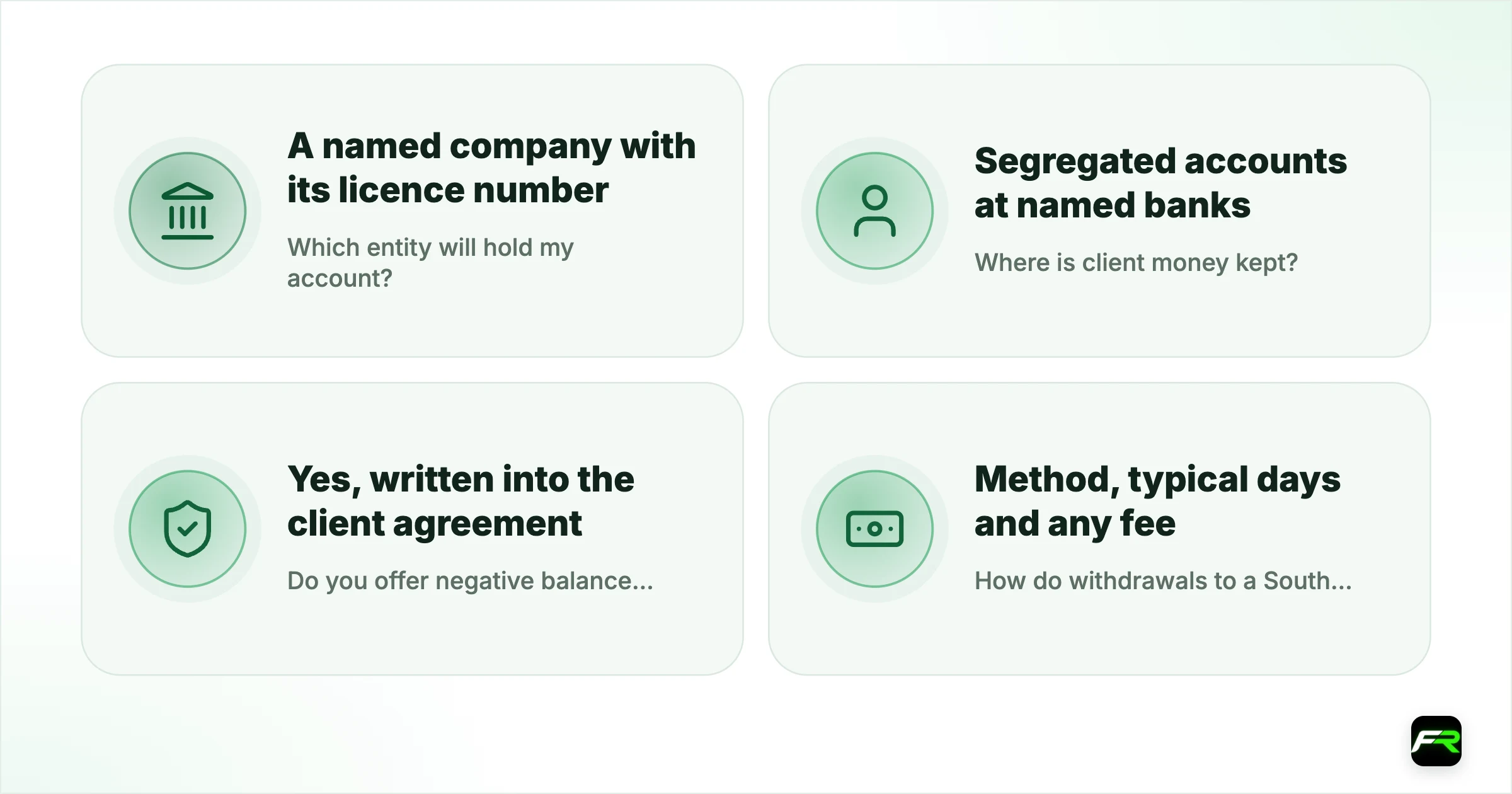
Offshore does not have to mean unknown. If you are weighing a broker licensed abroad, these questions turn a vague worry into specific answers you can compare. Send them by email so the replies are in writing.
| Question | A good answer | A worrying answer |
|---|---|---|
| Which entity will hold my account? | A named company with its licence number | "We are regulated" with no entity named |
| Where is client money kept? | Segregated accounts at named banks | No answer, or a payment processor's name |
| Do you offer negative balance protection? | Yes, written into the client agreement | "It rarely matters" |
| How do withdrawals to a South African bank work? | Method, typical days and any fee | Fees or conditions that appear only at withdrawal |
| Who handles complaints? | An internal process, then the regulator or ombudsman | Support chat only |
A broker that answers all five clearly is worth considering for the right trader. One that dodges two or more has told you what dealing with it will be like when something goes wrong.
Leverage is the reason most people go offshore
When traders explain why they moved to an offshore entity, the answer is nearly always leverage or a bonus. Both deserve a hard look. Leverage of 1:1000 lets a R5,000 balance control a position worth R5 million, which sounds powerful until you see that a move of a tenth of one per cent against that position wipes out the whole account. A bonus usually carries a trading-volume condition that ties up your own deposit until you meet it.
A trader who sizes positions properly, risking around 1 per cent of the account per trade, rarely needs more than modest leverage. If your plan only works with very high leverage, that says more about the plan than about the broker. Our leverage guide shows the margin maths in rand.
A reasonable way to decide
- If you are new, use a locally FSCA-licensed broker. The protection matters more than the leverage while you are learning.
- If you are experienced and an offshore broker genuinely fits your strategy, use one, but keep balances small and withdraw profits often.
- Never keep more with any broker, local or offshore, than you would be comfortable losing to a failure or a freeze.
- Whichever you choose, verify the licence on the actual regulator's site and match the entity to your agreement.
Offshore is not a dirty word. Some serious traders use offshore brokers with their eyes open. The mistake is choosing offshore for the leverage and the bonus without ever asking what your recourse is if the money does not come back. If you cannot answer that question, you are not ready to use that broker.
Both broker types are legal for South African residents to use, and both still carry the ordinary risk that most retail accounts lose money. The regulatory choice changes your protection, not your odds of trading profitably.
For the rules and brokers that apply where you live, see our guide to choosing a broker in South Africa.
Frequently asked
Is it illegal to use an offshore forex broker in South Africa?
No. A South African resident can legally trade with an offshore-licensed broker using their own money. The trade-off is that the FSCA does not supervise that account and a dispute has no local route.
Why do offshore brokers offer higher leverage?
Their regulators impose lighter limits, so they can offer 1:1000 or more. Higher leverage lets you take larger positions relative to your account, which increases both potential gain and the speed at which you can be wiped out. It is not free money.
What happens to my money if an offshore broker fails?
Your claim depends on the client-money rules and courts of a small offshore jurisdiction, often with no compensation scheme and limited enforcement. Recovery, if it happens, tends to be partial and slow.
Should a beginner use a local or offshore broker?
A local FSCA-licensed broker. The complaints route, segregation enforcement and local support matter more while you are learning than the extra leverage or bonus an offshore broker offers.
Can I use both?
Yes, some traders keep a locally licensed account as their main one and an offshore account for a specific strategy. If you do, keep the offshore balance small and withdraw profits frequently.
Does an offshore broker report my profits to SARS?
Do not assume it does or does not. South Africa exchanges financial account information with many countries, and SARS can request records. Either way, your trading profit is taxable in South Africa and you must declare it yourself, whichever broker you use.
Related reading
The team behind this guide
Researched, checked and approved by five forex specialists
Every guide is written, fact-checked and edited before it goes live, and updated when the facts change. Spotted an error? Tell us.