IC Markets





































How a USD/ZAR Trade Lost Half an Account in One SARB Meeting
A detailed breakdown of a single trade that went wrong: the setup, the position size, the SARB surprise, the stop that filled far from where it was placed, and what would have prevented it.
 WriterAbir KhanWriterWrites the guides · checks every figure against primary sources View profileAbout Abir →
 Market analysisTanbir Habib RiyadForex & Crypto AnalystForex and crypto analyst · technical and fundamental analysis View profileAbout Tanbir →
 Fact-checking & riskJannatul FerdaushFact-Checker & Risk AnalystFact-checks every figure · risk analysis · Applied Statistics, University of Dhaka View profileAbout Jannatul →
 Trading reviewJowel RanaCo-Founder & Forex TraderCo-founder · forex trader · reviews guides from a trader's view View profileAbout Jowel →
 Final approvalRanjan NiskrityFounder, Owner & Forex TraderFounder and owner · forex trader · signs off every guide View profileAbout Ranjan →
This is one trade, taken apart. It is the kind of trade that convinces people forex is rigged, when in fact every mistake in it was ordinary and avoidable. A composite built from a pattern the FX Recap desk sees around every SARB decision: a beginner holding a large USD/ZAR position through the announcement, stopped out far below the stop level on the spike.
Composite case based on a recurring pattern. Figures are illustrative of a typical over-sized SARB-day trade.
The trader and the account
| Account | R8,000 |
|---|---|
| Experience | About two months, mostly live, little demo |
| Leverage | 1:500 (offshore broker) |
| Usual risk per trade | Undefined; sized by 'what felt right' |
The setup
USD/ZAR had been grinding lower for a week and the trader expected the SARB to cut rates, which he believed would weaken the rand and push USD/ZAR up. The decision was due Thursday at 15:00. On Thursday morning he bought USD/ZAR with a position that used about R3,200 of margin, roughly 40 per cent of his account, at 1:500 leverage. He set a stop about 300 pips (3 cents) below entry, which he described as "giving it room", although at that size even a clean fill would have cost about a third of the account.
What happened
- At 15:00 the SARB held rates, against his expectation, and the Governor's statement was hawkish on inflation.
- USD/ZAR dropped about 1.5 per cent in roughly four minutes as the rand strengthened.
- The spread widened to several times its normal width in the first minute.
- His stop, sitting 300 pips below entry, was triggered, but because the market gapped and the spread was blown out, it filled about 500 pips (5 cents) below entry.
- The realised loss was roughly R4,300, about 54 per cent of the account.
| Factor | What he did | What it should have been |
|---|---|---|
| Position size | ~40% of account as margin | Sized so the stop = 1% (R80) loss |
| Timing | Held a large position into the SARB decision | Flat through the announcement |
| Stop type | Fixed stop in a gapping market | No position, so no stop needed; or tiny size |
| Leverage | 1:500, enabling the huge position | Lower leverage removes the temptation |
| View | Bet the whole thesis on one binary event | Trade the reaction after the event |
Why the stop did not save him
New traders assume a stop-loss guarantees the exit price. It does not. A stop becomes a market order when triggered, and in a fast, gapping market with a blown-out spread, it fills at the next available price, which can be far worse than the stop level. This is called slippage, and it is at its worst in exactly the first minutes after a high-impact announcement. The stop was not ignored; it was filled 500 pips from entry, 200 pips past the stop level, because that was the first price available.
The same view, traded within the rules
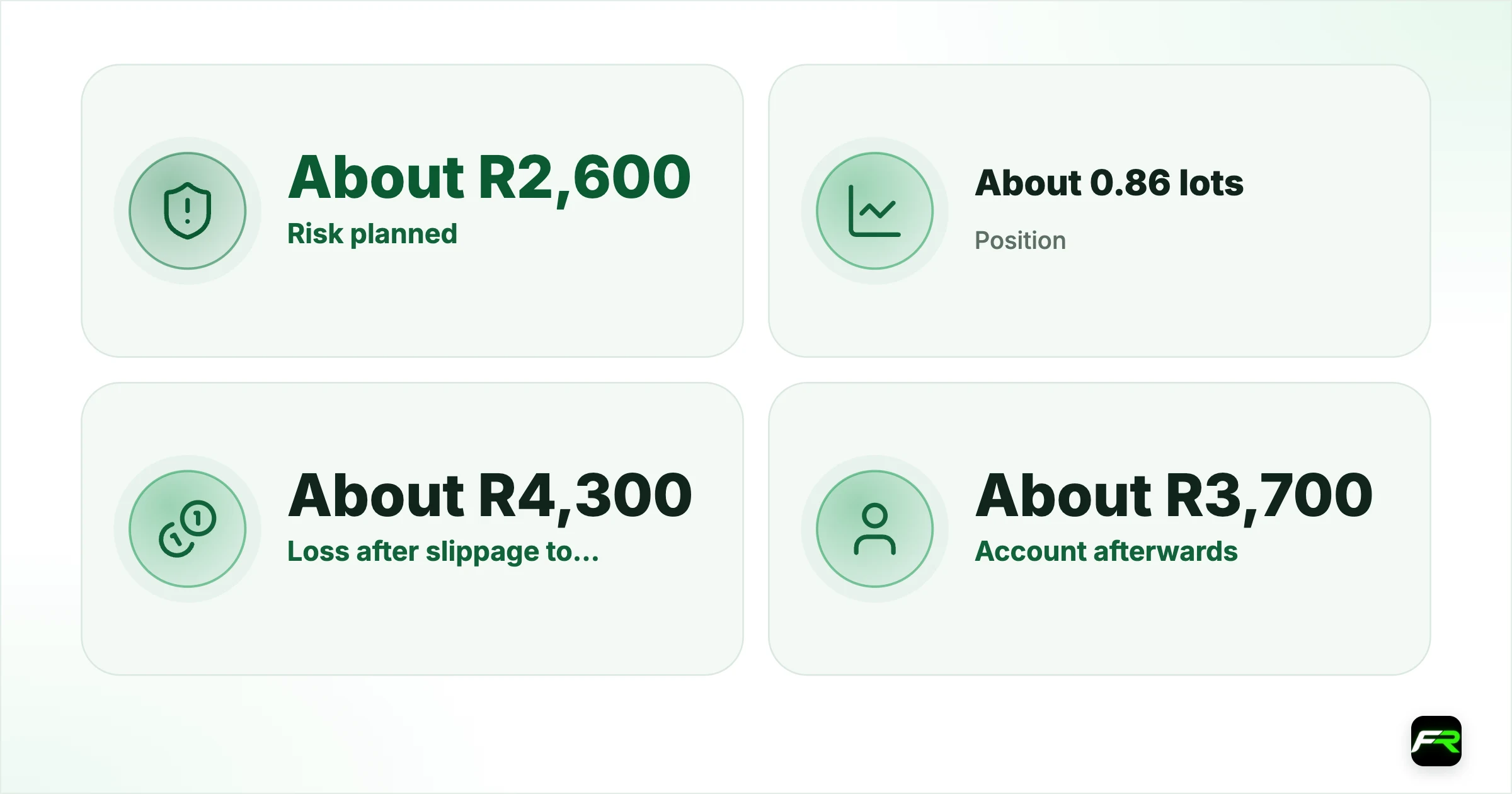
The trader's opinion was not unreasonable; his execution was. Replaying the same idea with ordinary risk rules shows how little it needed to change. Same R8,000 account, same 300-pip stop, same slippage to 500 pips:
| Element | What he did | Within the rules |
|---|---|---|
| Risk planned | About R2,600 (a third of the account) | R80 (1%) |
| Position | About 0.86 lots | 0.02 lots (rounded down) |
| Loss after slippage to 500 pips | About R4,300 (54%) | About R100 (1.25%) |
| Account afterwards | About R3,700 | About R7,900 |
Even the version that held through the announcement survives with a small loss, because size, not the stop, is what limits damage in a gap. Staying flat and trading the reaction would have been better still.
A SARB-day checklist
- Note the announcement date a week ahead from the SARB's calendar.
- By the morning of the decision, decide: flat, or a deliberately tiny position.
- Close or reduce any USD/ZAR position at least 15 minutes before the statement.
- Do not place new orders in the first 30 minutes; spreads are at their widest.
- After the dust settles, trade only the direction that has held, at normal size.
Our SARB decision guide lists the upcoming dates.
What would have prevented it
- Be flat through the SARB decision. The simplest fix. No position, no loss.
- Size from the stop and 1 per cent risk. An R80 risk on a 300-pip stop is a position of under 0.03 lots, so even 200 pips of slippage would have added only about R50 to the loss.
- Lower leverage. At 1:30 to 1:100 he could not have built a position 40 per cent of the account without noticing.
- Trade the reaction. Wait for the spike and first reversal, then trade the direction that holds after 30 to 60 minutes, with a normal stop and normal size.
He nearly quit, convinced the broker had hunted his stop. When we walked through it, the broker had done nothing unusual; the fill was consistent with the public price spike and the widened spread at that moment. What had actually happened was a 40-per-cent-of-account position held into a binary event. He now trades a locally licensed account at 1:100, sizes every trade from a 1 per cent risk, and is simply not in the market when the SARB speaks.
A stop-loss limits your risk in normal conditions. It does not guarantee your exit price in a fast market, and the SARB announcement produces exactly the fast market where slippage is worst. Position size and staying flat through the event are the real protections.
This trade is a stack of ordinary errors: too much leverage, no position-sizing rule, a full-thesis bet on a binary event, and a belief that a stop is a guarantee. Any one of them fixed and the account survives. The lesson is not that forex is rigged. It is that the SARB decision is not a trade for a two-month-old account.
Frequently asked
Can a stop-loss fail to protect me?
A stop-loss limits risk in normal conditions but does not guarantee your exit price. When triggered it becomes a market order, and in a fast, gapping market with a widened spread it fills at the next available price, which can be far worse. This slippage is worst right after high-impact news.
Why is holding USD/ZAR through the SARB decision dangerous?
The pair can move 1.5 per cent or more in minutes, the spread blows out, and stops fill far from where they were placed. A large position held into the announcement can take a loss many times the intended risk.
How big should a SARB-day position be?
For most traders, zero. Be flat through the announcement. If you do trade it, size so that even significant slippage past your stop is a small percentage of your account, which means a very small position.
Did the broker hunt the stop in this case?
No. The fill was consistent with the public price spike and the widened spread at that moment. The loss came from holding a position worth about 40 per cent of the account into a binary event, not from broker manipulation.
What is the safe way to trade a SARB decision?
Wait for the initial spike and the first reversal, then trade the direction that holds 30 to 60 minutes after the statement, with normal position size and a normal stop, once spreads have returned to normal.
How much would this trade have lost at 1 per cent risk?
With R80 at risk on a 300-pip stop, the position is about 0.02 lots after rounding down. The same slippage to 500 pips would have cost about R100, or 1.25 per cent of the R8,000 account, instead of R4,300.
Related reading
The team behind this guide
Researched, checked and approved by five forex specialists
Every guide is written, fact-checked and edited before it goes live, and updated when the facts change. Spotted an error? Tell us.