IC Markets





































SARB Rate Decisions and USD/ZAR: What to Watch
The Monetary Policy Committee decision is the domestic event that moves the rand most. Here is the schedule, what the market reacts to, and how to trade around it without being caught by the whipsaw.
 WriterAbir KhanWriterWrites the guides · checks every figure against primary sources View profileAbout Abir →
 Market analysisTanbir Habib RiyadForex & Crypto AnalystForex and crypto analyst · technical and fundamental analysis View profileAbout Tanbir →
 Fact-checking & riskJannatul FerdaushFact-Checker & Risk AnalystFact-checks every figure · risk analysis · Applied Statistics, University of Dhaka View profileAbout Jannatul →
 Trading reviewJowel RanaCo-Founder & Forex TraderCo-founder · forex trader · reviews guides from a trader's view View profileAbout Jowel →
 Final approvalRanjan NiskrityFounder, Owner & Forex TraderFounder and owner · forex trader · signs off every guide View profileAbout Ranjan →
The South African Reserve Bank's Monetary Policy Committee sets the repo rate, and its decisions are the single biggest scheduled driver of the rand. USD/ZAR can move 1.5 per cent or more in the minutes after the announcement, then reverse part of it. This guide covers when the decisions happen, what actually moves the price, and how to handle the event as a trader.
The schedule
The MPC meets several times a year, roughly every two months, with the decision announced by the Governor in a televised statement, usually on a Thursday afternoon South African time. Those dates are published a year ahead on the SARB website. The repo rate stands at 7.25 per cent after two 0.25 point increases in 2026, in May and again on 23 September, following a run of cuts in 2025, so the market is closely watching whether the next move is a hold, a cut or another hike.
What the market reacts to
- The decision versus expectations. A hold when a cut was expected strengthens the rand; a cut when a hold was expected weakens it. The surprise is what moves the price, not the level.
- The vote split. A unanimous decision carries more weight than a narrow one. A 3 to 2 vote signals the next move could go either way.
- The Governor's tone. Hawkish language on inflation risks supports the rand even alongside a hold. Dovish language softens it.
- The inflation forecast. The updated projections in the statement shape expectations for the next few meetings.
| Scenario | Typical rand reaction |
|---|---|
| Rate held, hawkish tone, unanimous | Rand strengthens (USD/ZAR down) |
| Rate cut as expected, neutral tone | Small move, often faded |
| Rate cut when a hold was expected | Rand weakens (USD/ZAR up) |
| Rate hike surprise | Rand strengthens sharply, then partial reversal |
| Split vote, uncertain guidance | Choppy, two-way volatility |
The next MPC dates
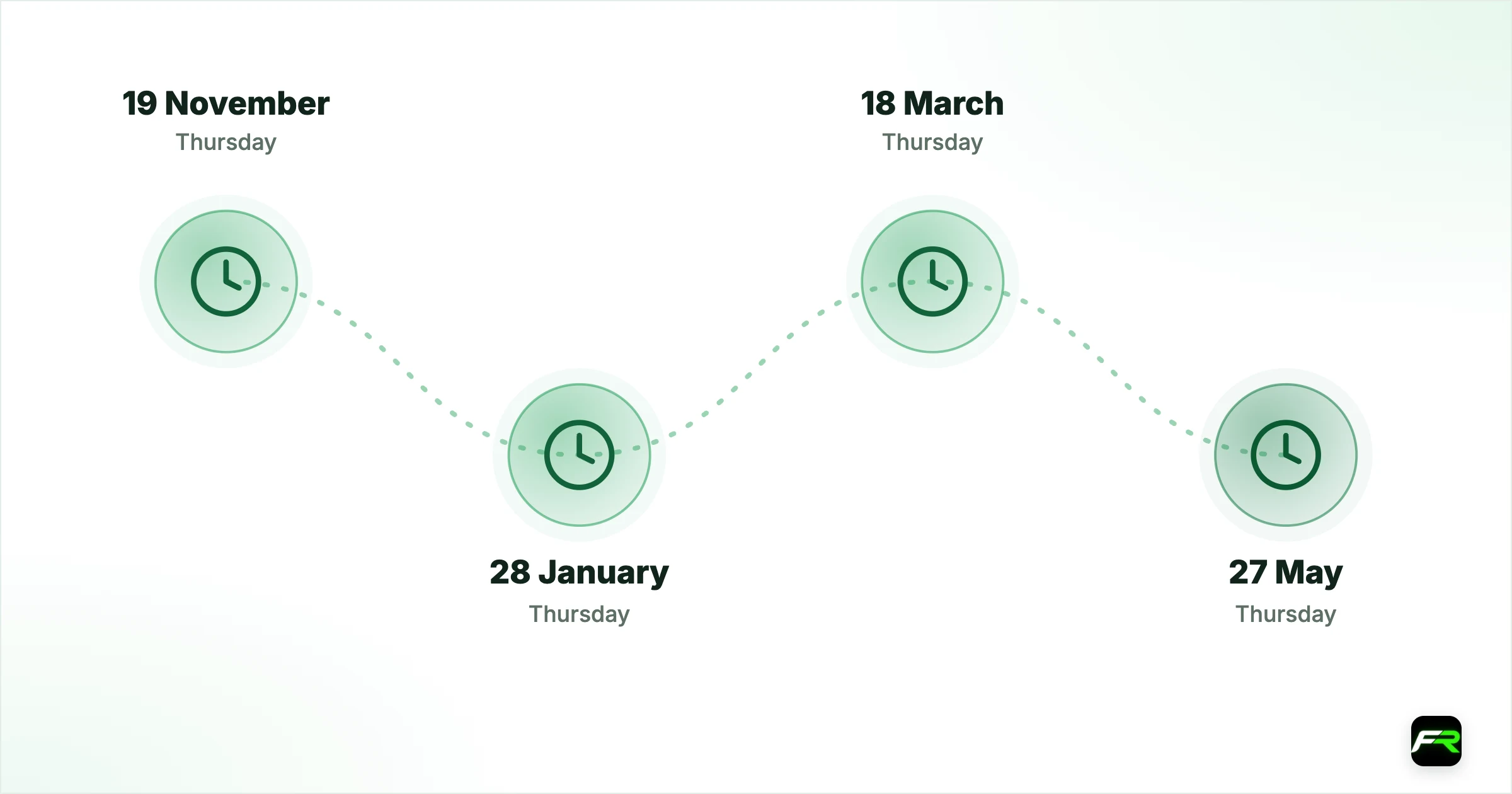
The SARB publishes its Monetary Policy Committee schedule well in advance. At its September 2026 meeting the committee raised the repo rate by 0.25 points to 7.25 per cent, effective 25 September, in a unanimous decision. These are the next announcement dates on the SARB's own calendar:
| Announcement | Day | Year |
|---|---|---|
| 19 November | Thursday | 2026 |
| 28 January | Thursday | 2027 |
| 18 March | Thursday | 2027 |
| 27 May | Thursday | 2027 |
| 22 July | Thursday | 2027 |
| 29 September | Wednesday | 2027 |
| 25 November | Thursday | 2027 |
SA CPI lands the day before the November 2026 decision, on 18 November, so that week carries two rand events back to back. Check the US calendar for the same weeks too, since a Fed decision or US CPI close to an MPC date doubles the risk on USD/ZAR.
Dates are from the SARB's MPC page at the time of writing. The SARB can change its calendar, so confirm on resbank.co.za before you plan around a date.
Reading the statement in five minutes
You do not need to read every page of the statement to understand the market's reaction. Look for four things in this order:
- The decision and the vote. A unanimous move signals conviction; a split vote signals the next meeting is open.
- The inflation forecast for the coming two years, set against the SARB's target.
- Whether the committee sees the risks to inflation as tilted up or down.
- Any comment on the rand itself or on global conditions, which often explains the Governor's tone.
Compare each with what economists expected beforehand, which the financial press reports in the days before the meeting. The rand moves on the gap between expectation and outcome, not on the decision alone.
How to trade around it
There are three honest approaches, and picking one in advance matters:
- Stay flat. Close USD/ZAR positions before the announcement and wait until the dust settles, often 30 to 60 minutes. This is the right choice for most beginners.
- Trade the reaction, not the number. Wait for the initial spike and the first reversal, then trade the direction that holds once the statement has been digested. Spreads are wide in the first minutes, so this is not a scalp.
- Position ahead with small size and a wide stop. Only if you have a genuine view and accept you may be stopped by the whipsaw. Size this at a fraction of a normal trade.
The first few minutes after the SARB statement have the widest spreads and the largest fake moves of any regular event in the rand. A normal-sized position with a normal stop placed just before the announcement is very likely to be stopped out on noise. If you are not deliberately trading the event, be flat.
Thabang held a normal USD/ZAR long into a SARB decision, expecting a dovish cut. The MPC held and sounded hawkish, USD/ZAR dropped 1.4 per cent in three minutes, his stop filled near the low, and the pair then retraced half the move within the hour. Had he been flat and traded the direction that held after the first 30 minutes, the same view would have been a loss avoided and possibly a trade in the better direction.
Put every MPC date in your calendar for the year from the SARB website. Also mark US CPI and FOMC dates, because a SARB decision landing in the same week as a big US event compounds the volatility.
The SARB decision is the one event where I tell newer South African traders to simply be flat. That move is real, but the first print is a trap, full of spread and reversal. Let the market decide what the statement meant over the first half hour, then trade the trend that survives. You give up the first candle and avoid the worst of the whipsaw.
Frequently asked
How often does the SARB decide on rates?
The Monetary Policy Committee meets roughly every two months, several times a year, with the decision announced by the Governor, usually on a Thursday afternoon South African time. The dates are published a year ahead on the SARB website.
How much does the rand move on a SARB decision?
USD/ZAR can move 1.5 per cent or more within minutes of the announcement, often followed by a partial reversal as the market digests the statement and the Governor's tone.
What moves the rand, the decision or the guidance?
The surprise relative to expectations, plus the vote split and the Governor's tone. A hold with hawkish language can strengthen the rand more than a cut that was fully expected.
Should I trade the SARB decision?
Most beginners should be flat through it. If you do trade it, wait for the initial spike and first reversal, then trade the direction that holds after 30 to 60 minutes, rather than positioning on the number itself.
What is the current repo rate?
7.25 per cent, set on 23 September 2026 after a unanimous 0.25 point increase, the second hike of 2026 following a series of cuts during 2025. Check the SARB website for the latest, as it changes at MPC meetings.
When is the next SARB rate decision?
The SARB's calendar lists 19 November 2026 as the next announcement, followed by 28 January, 18 March and 27 May 2027. In September 2026 the repo rate was raised to 7.25 per cent. Check resbank.co.za for any change to the dates.
Related reading
The team behind this guide
Researched, checked and approved by five forex specialists
Every guide is written, fact-checked and edited before it goes live, and updated when the facts change. Spotted an error? Tell us.