IC Markets





































Minimum Deposit Forex Brokers for South Africans Starting Small
You can open an account with the main FSCA brokers for R70 to R500. Whether you should start that small is a different question. Here is what a tiny account can and cannot do.
 WriterAbir KhanWriterWrites the guides · checks every figure against primary sources View profileAbout Abir →
 Market analysisTanbir Habib RiyadForex & Crypto AnalystForex and crypto analyst · technical and fundamental analysis View profileAbout Tanbir →
 Fact-checking & riskJannatul FerdaushFact-Checker & Risk AnalystFact-checks every figure · risk analysis · Applied Statistics, University of Dhaka View profileAbout Jannatul →
 Trading reviewJowel RanaCo-Founder & Forex TraderCo-founder · forex trader · reviews guides from a trader's view View profileAbout Jowel →
 Final approvalRanjan NiskrityFounder, Owner & Forex TraderFounder and owner · forex trader · signs off every guide View profileAbout Ranjan →
One of the genuine advantages of modern retail forex is that you can start with very little. The main FSCA-linked brokers open accounts from around R70 to R500, and cent accounts let you trade in tiny sizes. That removes the excuse that you need thousands to begin. It also creates a trap: a very small account can teach you the platform, but it cannot really teach you to trade, and it can push you into bad habits. This guide covers both sides.
What the minimums actually are
| Broker | Typical minimum deposit | Cent account? |
|---|---|---|
| HFM | About R70 (USD 5 equivalent) | Yes |
| Exness | About R70 (USD 10 equivalent) | Yes (Standard Cent) |
| XM | About R90 (USD 5 equivalent) | Yes (Micro) |
| Tickmill | About R1,800 (USD 100) | No |
| AvaTrade | About R1,800 (USD 100) | No |
Figures move with the exchange rate and broker changes, so confirm on the account-opening page. The point is that money is not the barrier to starting.
What a small account can do
- Teach you the platform: placing orders, setting stops, reading the account state, without the risk of a large balance.
- Let you feel the emotional difference between demo and real money, which is real even at R500.
- Prove out a simple process end to end, including funding and a test withdrawal.
- Keep your losses trivial while you make the beginner mistakes everyone makes.
What it cannot do
A R500 account cannot pay you a meaningful income, and trying to make it do so is where new traders go wrong. Three per cent a month on R500 is R15. To chase a number that feels worthwhile, you have to over-risk, which blows the account, which teaches you nothing except that trading "does not work". A small account is a classroom, not a business. Judge it on whether your process is improving, not on the rand figure.
The danger of a tiny account is psychological. Because the balance feels disposable, people take 20 per cent risk per trade "to make it interesting", learn nothing transferable, lose it, and conclude trading is a scam. Trade a small account with the same 1 per cent discipline you would use on a large one.
Cent accounts and how they help
A cent account denominates your balance and trades in cents rather than dollars, so a R900 deposit shows as, say, 5,000 cents and lets you trade in very small increments. The value is that you can practise real position sizing with real money at a scale where a mistake costs a few rand. It behaves like a live account, with real spreads and real emotions, but the stakes stay tiny while you build the habit of calculating a lot size from your stop and a 1 per cent risk. Once your process is consistent on a cent account, moving to a standard account with a larger balance is a change of scale, not a change of method.
The maths of a small account
| Account | 1% risk | A 2% winning month | A 5-trade losing streak at 1% |
|---|---|---|---|
| R500 | R5 | R10 | about R25 (5%) |
| R2,000 | R20 | R40 | about R100 (5%) |
| R10,000 | R100 | R200 | about R500 (5%) |
The percentages are identical at every size. Only the rand amounts change. This is the point: a small account teaches you the same discipline as a large one, it just does not pay you yet. Judge it on whether the percentages are holding, not on the rands.
Sizwe started with R400 and treated it as play money, risking a quarter of the account per trade. It was gone in a week and he decided forex was rigged. Six months later he tried again with R1,500, risked 1 per cent per trade, ran a demo alongside, and is still trading two years on. Same person, same market. The difference was treating the small account as a classroom with real rules rather than a lottery ticket.
Why very small accounts need a cent account
There is a hidden problem with tiny balances. On a standard account the smallest trade is 0.01 lots. For EUR/USD that is worth $0.10 a pip, about R1.75 at R17.50 to the dollar. With a sensible 20-pip stop, the smallest possible trade therefore risks around R35. Set that against 1 per cent of different balances:
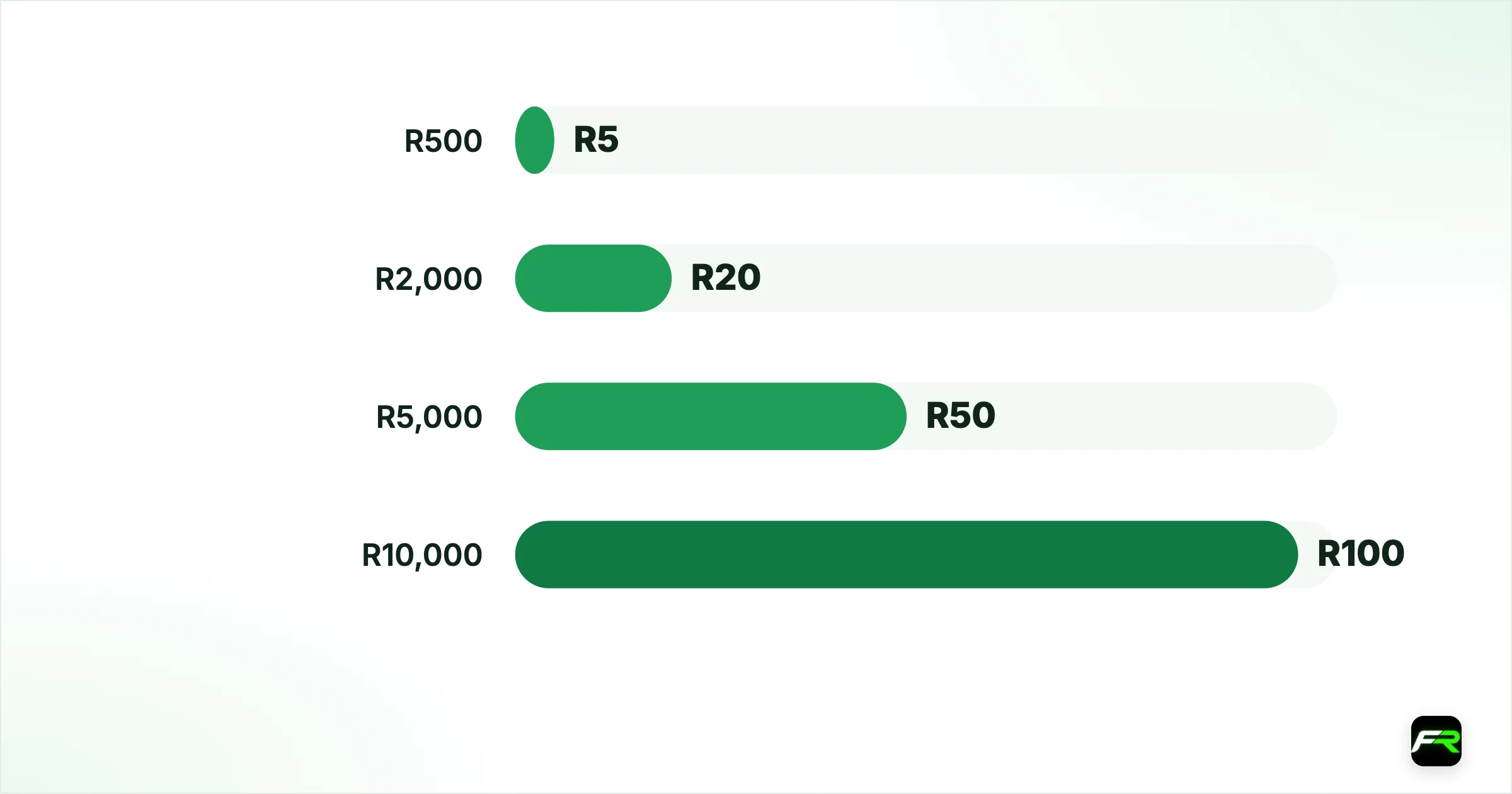
| Account | 1% risk | Smallest trade risks | As a share of the account |
|---|---|---|---|
| R500 | R5 | About R35 | 7%: too much |
| R2,000 | R20 | About R35 | 1.75%: borderline |
| R5,000 | R50 | About R35 | 0.7%: fine |
| R10,000 | R100 | About R35 | 0.35%: fine, room to size up |
A R500 account on a standard account cannot follow the 1 per cent rule at all; every trade is a 7 per cent bet. That is why a cent or micro account matters at that size. Trade sizes there are a hundred times smaller, so the same 20-pip stop risks about 35 cents, and you can size each position properly from the first trade.
Growing an account without forcing it
Adding money as your process proves itself is safer than trying to grow a small balance through returns. A simple rule many traders use is to add a set amount only after three consecutive months in which you followed your plan, whatever the result. That ties new money to discipline rather than to a lucky run, and it keeps you from topping up in frustration after a loss.
A sensible way to start small
- Deposit an amount that is real to you but that you can lose without stress, often R500 to R2,000.
- Run a demo in parallel and do most of your learning there.
- Risk 1 per cent per trade on the live account from the first trade.
- Do one small test withdrawal early to confirm the round trip works.
- Add to the account slowly as your process proves out, rather than starting large.
- Measure success by consistency and improvement, not by the balance.
Starting small is the right call, but only if you trade the small account by the same rules as a big one. The people who fail with a R500 account almost always failed because they treated R500 as nothing and gambled it. Treat it as a real account that happens to be small, and it does its job.
Frequently asked
What is the minimum to start forex trading in South Africa?
The main FSCA-linked brokers open accounts from around R70 to R500, and cent or micro accounts let you trade in very small sizes. Money is not the barrier to starting.
Is it worth starting with R500?
Yes, as a classroom. A R500 account can teach you the platform, the feel of real money, and a full funding-to-withdrawal cycle. It cannot pay you an income, and trying to make it do so leads to over-risking.
What is a cent account?
An account where balances and trade sizes are denominated in cents rather than dollars, so a small deposit gives you many units to trade with in tiny sizes. It is useful for learning position sizing with real but minimal money.
Why do people fail with small accounts?
Because the balance feels disposable, so they take very large risk per trade, blow the account quickly, and learn nothing transferable. A small account traded with 1 per cent risk discipline does its job.
How should I grow a small account?
Add to it gradually as your process proves out, rather than starting large. Measure progress by consistency and improvement in your trading, not by the rand balance.
Can I follow the 1 per cent rule with R500?
Not on a standard account. The smallest 0.01-lot trade on EUR/USD with a 20-pip stop risks about R35, which is 7 per cent of R500. A cent or micro account, where trade sizes are far smaller, lets a R500 account size positions at 1 per cent.
Related reading
The team behind this guide
Researched, checked and approved by five forex specialists
Every guide is written, fact-checked and edited before it goes live, and updated when the facts change. Spotted an error? Tell us.