IC Markets




































Forex Brokers With a True ZAR Base Account
A real ZAR account holds your balance in rand, saving a conversion spread on every transfer. How to tell it apart from rand deposits.
 WriterAbir KhanWriterWrites the guides · checks every figure against primary sources View profileAbout Abir →
 Market analysisTanbir Habib RiyadForex & Crypto AnalystForex and crypto analyst · technical and fundamental analysis View profileAbout Tanbir →
 Fact-checking & riskJannatul FerdaushFact-Checker & Risk AnalystFact-checks every figure · risk analysis · Applied Statistics, University of Dhaka View profileAbout Jannatul →
 Trading reviewJowel RanaCo-Founder & Forex TraderCo-founder · forex trader · reviews guides from a trader's view View profileAbout Jowel →
 Final approvalRanjan NiskrityFounder, Owner & Forex TraderFounder and owner · forex trader · signs off every guide View profileAbout Ranjan →
"Accepts ZAR" and "ZAR base account" are not the same thing, and the difference costs you money. A broker that accepts rand deposits but runs your account in US dollars converts your money twice, once in and once out, and you pay a spread each time. A broker with a true ZAR base account holds your balance in rand from deposit to withdrawal. This guide explains what to look for and which brokers offer it.
What a true ZAR account does
- No conversion at deposit or withdrawal. R10,000 in is R10,000 on the account; R10,000 out is R10,000 to your bank.
- Profit and loss in rand. Your equity, your risk per trade and your results are all in the currency you actually spend.
- No hidden currency exposure on your balance. With a dollar account, a rand move changes your balance in rand terms even if you never trade USD/ZAR.
- Simpler tax records. Your deposits, withdrawals and P&L are already in rand for SARS.
How to spot a fake ZAR account
Open the account-opening screen or the broker's account-types page. A true ZAR account lists ZAR as a base currency option alongside USD and EUR. A broker that only "accepts" rand will take your EFT but show your balance in dollars from the first login, having converted at its own rate. If the base currency choices are only USD, EUR and GBP, there is no real ZAR account, whatever the deposit page implies. Ask support directly: "Is the account balance held in rand, or converted to dollars on deposit?"
| Broker | ZAR base account | Local funding | Notes |
|---|---|---|---|
| Exness | Yes | EFT, Ozow, card | FSCA FSP 51024, Cape Town office |
| HFM | Yes | EFT, Ozow, card | FSCA FSP 46632 since 2016 |
| XM | Yes | EFT, card | FSCA authorised; ZAR account available |
| Tickmill | Limited | EFT, card | Check current base-currency options |
| AvaTrade | Limited | EFT, card | Often USD base for SA clients; confirm before funding |
Treat this table as a starting point for your own check. Base-currency options and licences change, so confirm on the broker's account-opening screen and the FSCA register before you deposit.
When a dollar account is fine anyway
If you specifically want to trade dollar-quoted instruments, understand the currency exposure, and withdraw regularly, a USD account is not a disaster. The conversion cost on a few transfers a year is small relative to a serious trader's activity. A ZAR account matters most for smaller accounts, frequent transfers, and anyone who wants their numbers to be clean and their tax simple. For a beginner, it removes one moving part.
Refilwe funded a broker that advertised rand deposits, then noticed her R5,000 showed as about USD 270 on login and her withdrawal came back as R4,850 after two conversions. Over a year of small top-ups and withdrawals the conversion spreads cost her a few hundred rand for nothing. She switched to a broker with a genuine ZAR base account, and now every deposit and withdrawal matches to the rand, which also made her first SARS return trivial to prepare.
Before funding, log in to the demo or the account-opening flow and check the base-currency options. If ZAR is not one of them, your money will be converted. Ask support to confirm in writing if the site is unclear.
The same R10,000 in two account currencies
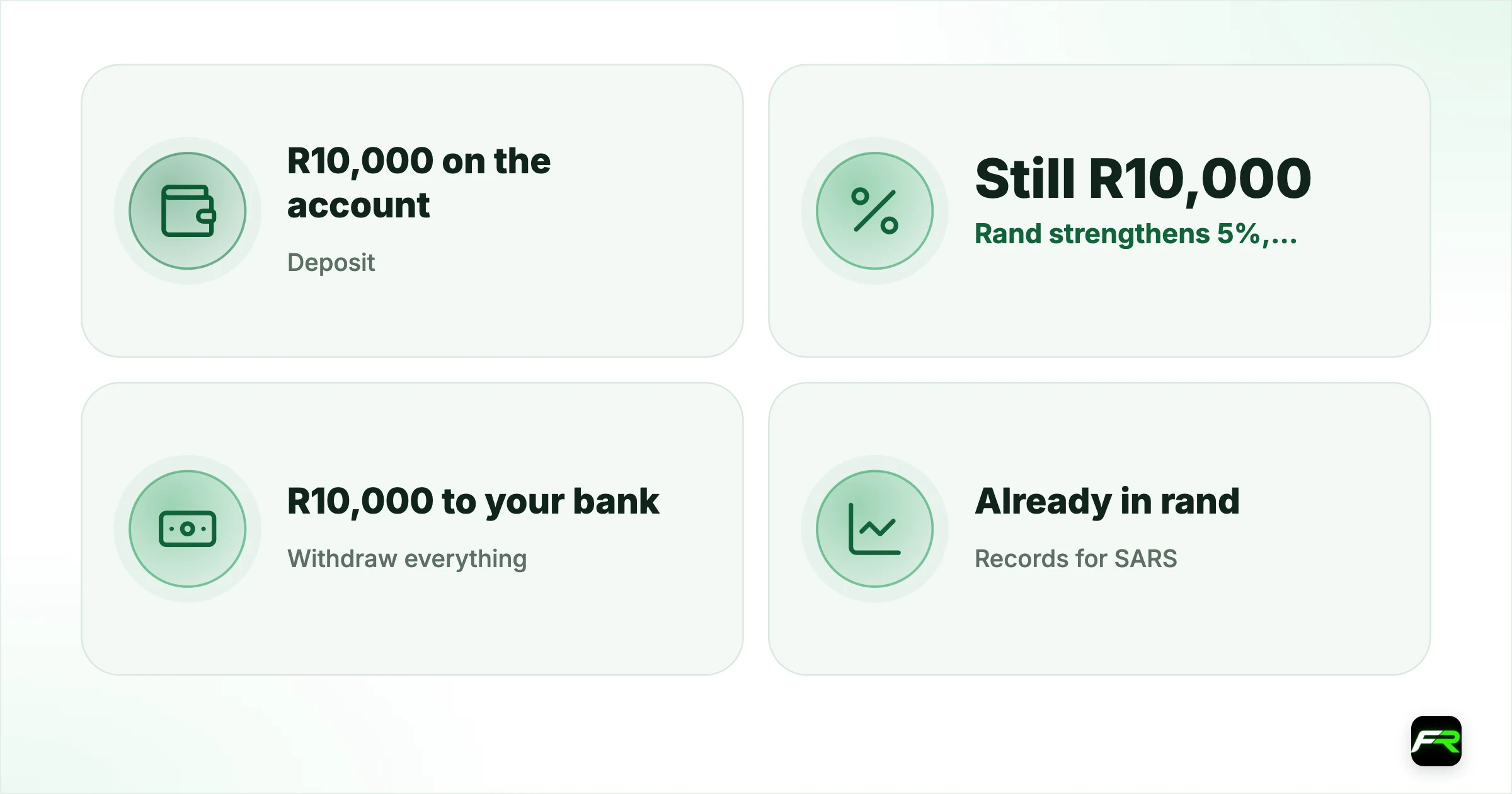
The difference between a rand account and a dollar account is easiest to see with one deposit followed through a quiet month in which you place no trades at all. Assume a deposit of R10,000 when USD/ZAR is 17.50, a broker conversion spread of 0.5 per cent each way, and a rand that strengthens 5 per cent during the month.
| Stage | ZAR base account | USD base account |
|---|---|---|
| Deposit | R10,000 on the account | About $568, after a R50 conversion cost |
| Rand strengthens 5%, no trades | Still R10,000 | Still $568, now worth about R9,450 |
| Withdraw everything | R10,000 to your bank | About R9,400 after the second conversion |
| Records for SARS | Already in rand | Every figure needs converting |
Without placing a trade, the dollar account has lost about R600, partly to conversion and mostly to a currency position you never chose. A weakening rand would have flattered it by a similar amount. That is the point: a dollar account adds a bet on USD/ZAR to everything you do, whereas a rand account keeps your balance in the money you spend.
Questions to settle in writing before you fund
- Is ZAR a base currency for the account type I want, or only a deposit currency?
- Will my deposits and withdrawals be converted at any point, including by your payment processor?
- Are spreads and commissions on the ZAR account the same as on the USD version?
- Can I switch an existing USD account to ZAR, or do I need to open a new one?
Ask by email or keep the chat transcript. If the answer to the first question is vague, assume the account is dollar-based. Our conversion cost guide shows how to measure what you pay if you already hold a dollar account.
The conversion cost, in numbers
A typical broker conversion spread is 0.3 to 0.8 per cent each way. On a R10,000 deposit and later a R12,000 withdrawal, at 0.5 per cent each way, that is roughly R110 in conversion cost you would not pay on a ZAR account. It is not huge on one cycle, but for a trader who tops up and withdraws several times a year on a small account, it adds up to real money for zero benefit. The conversion cost guide breaks this down further.
For a South African beginner I would put a true ZAR account near the top of the checklist, just under the FSCA licence and the withdrawal record. The point is not that the spread is large. It is that a ZAR account removes a layer of friction and a currency exposure you did not ask for, so your account shows you exactly what you have made or lost in the money you actually use.
Frequently asked
What is a ZAR base account?
A trading account whose balance is held in South African rand from deposit to withdrawal, rather than converted to US dollars. Your equity, risk and profit and loss are all in rand.
How do I know if a broker offers a real ZAR account?
Check the base-currency options on the account-opening screen. A true ZAR account lists ZAR alongside USD and EUR. If your balance shows in dollars from the first login, the broker only accepts rand deposits and converts them.
Which brokers have ZAR accounts?
Exness, HFM and XM offer ZAR base accounts and local funding, among others. Base-currency options change, so confirm on the broker's account-opening flow and verify the FSCA licence before depositing.
How much does currency conversion cost?
A broker conversion spread is typically 0.3 to 0.8 per cent each way. On a deposit and a later withdrawal that is often around 1 per cent of the amount, paid for no benefit if a ZAR account was available.
Is a USD account ever better?
For a serious trader who wants dollar-quoted instruments, understands the currency exposure and withdraws regularly, a USD account is fine. A ZAR account matters most for smaller accounts, frequent transfers and beginners who want clean numbers and simple tax records.
Can I change my broker account from USD to ZAR?
Usually not on the same account. The base currency is set when the account is opened, so most brokers ask you to open a new ZAR account and move your balance across. Check whether that transfer itself is converted, and close the old account once it is empty.
Related reading
The team behind this guide
Researched, checked and approved by five forex specialists
Every guide is written, fact-checked and edited before it goes live, and updated when the facts change. Spotted an error? Tell us.