IC Markets



































GBP/ZAR and EUR/ZAR: Trading the Rand Crosses
The pound and euro against the rand are wider, thinner and driven by two economies at once. When they are worth trading, how they behave, and why USD/ZAR is usually the better choice.
 WriterAbir KhanWriterWrites the guides · checks every figure against primary sources View profileAbout Abir →
 Market analysisTanbir Habib RiyadForex & Crypto AnalystForex and crypto analyst · technical and fundamental analysis View profileAbout Tanbir →
 Fact-checking & riskJannatul FerdaushFact-Checker & Risk AnalystFact-checks every figure · risk analysis · Applied Statistics, University of Dhaka View profileAbout Jannatul →
 Trading reviewJowel RanaCo-Founder & Forex TraderCo-founder · forex trader · reviews guides from a trader's view View profileAbout Jowel →
 Final approvalRanjan NiskrityFounder, Owner & Forex TraderFounder and owner · forex trader · signs off every guide View profileAbout Ranjan →
After USD/ZAR, the rand crosses South African traders look at most are GBP/ZAR and EUR/ZAR. They are tradeable, and some traders prefer them for specific reasons, but they come with costs and complications that USD/ZAR does not. This guide covers how they behave and when they make sense.
How the crosses are built
GBP/ZAR and EUR/ZAR are effectively combinations of two other rates. EUR/ZAR moves with both EUR/USD and USD/ZAR. So the pair reacts to euro-area news (ECB decisions, euro-zone inflation) and to everything that moves the rand, at the same time. That is more to watch, and it means the pair can move sharply on news from a region you were not following.
The costs are higher
| Pair | Typical spread | Overnight swap | Liquidity |
|---|---|---|---|
| USD/ZAR | Widest of the majors, but manageable | Meaningful | Good |
| GBP/ZAR | Wider than USD/ZAR | Larger | Thinner |
| EUR/ZAR | Wider than USD/ZAR | Larger | Thinner |
The wider spread is a cost on every trade, and the larger swap is a cost on every night held. For an active trader that adds up. The thinner liquidity also means more slippage around news and in the quiet hours.
When a cross makes sense
- You have a specific view on the pound or euro that you want to express with rand as the other leg, for example around a Bank of England or ECB decision.
- You are hedging a real exposure, such as GBP income or EUR expenses, rather than pure speculation.
- Your strategy has a genuine edge on GBP/ZAR or EUR/ZAR levels specifically, backed by testing, not just a preference for the pair.
Why USD/ZAR is usually better
For most South African retail traders, USD/ZAR is the better rand pair: tighter spread, smaller swap, deeper liquidity, and one dominant driver set to follow (the dollar and the rand) rather than two. If your interest is simply trading the rand, trade it against the dollar. The crosses are for when you specifically want the pound or euro leg. Our USD/ZAR guide covers the main pair.
Lerato traded EUR/ZAR because she found the levels 'cleaner' on the chart. Over two months she realised she was paying noticeably more in spread and swap than on USD/ZAR, and getting caught by euro-area news she did not track. She moved her rand trading to USD/ZAR and kept EUR/ZAR only for the occasional ECB-week trade where she had a euro view. Her costs dropped and her results improved with the same strategy.
The news you have to track doubles
On USD/ZAR, you follow the US calendar and the South African calendar. EUR/ZAR adds a third one: the ECB rate decision, euro-zone flash inflation, German data, and euro-group political news. GBP/ZAR instead adds the Bank of England, UK inflation and UK fiscal events. Either way it is a whole extra region of scheduled volatility landing on your position, often at hours you were not watching. A trader who only really follows the US and South Africa will be surprised by EUR/ZAR moves that had an obvious euro-area cause.
| Pair | Calendars to follow |
|---|---|
| USD/ZAR | US (Fed, CPI, jobs) and South Africa (SARB, CPI, Budget) |
| EUR/ZAR | US, South Africa, and the euro area (ECB, euro-zone CPI, German data) |
| GBP/ZAR | US, South Africa, and the UK (BoE, UK CPI, UK fiscal events) |
Pip value and position size on the crosses
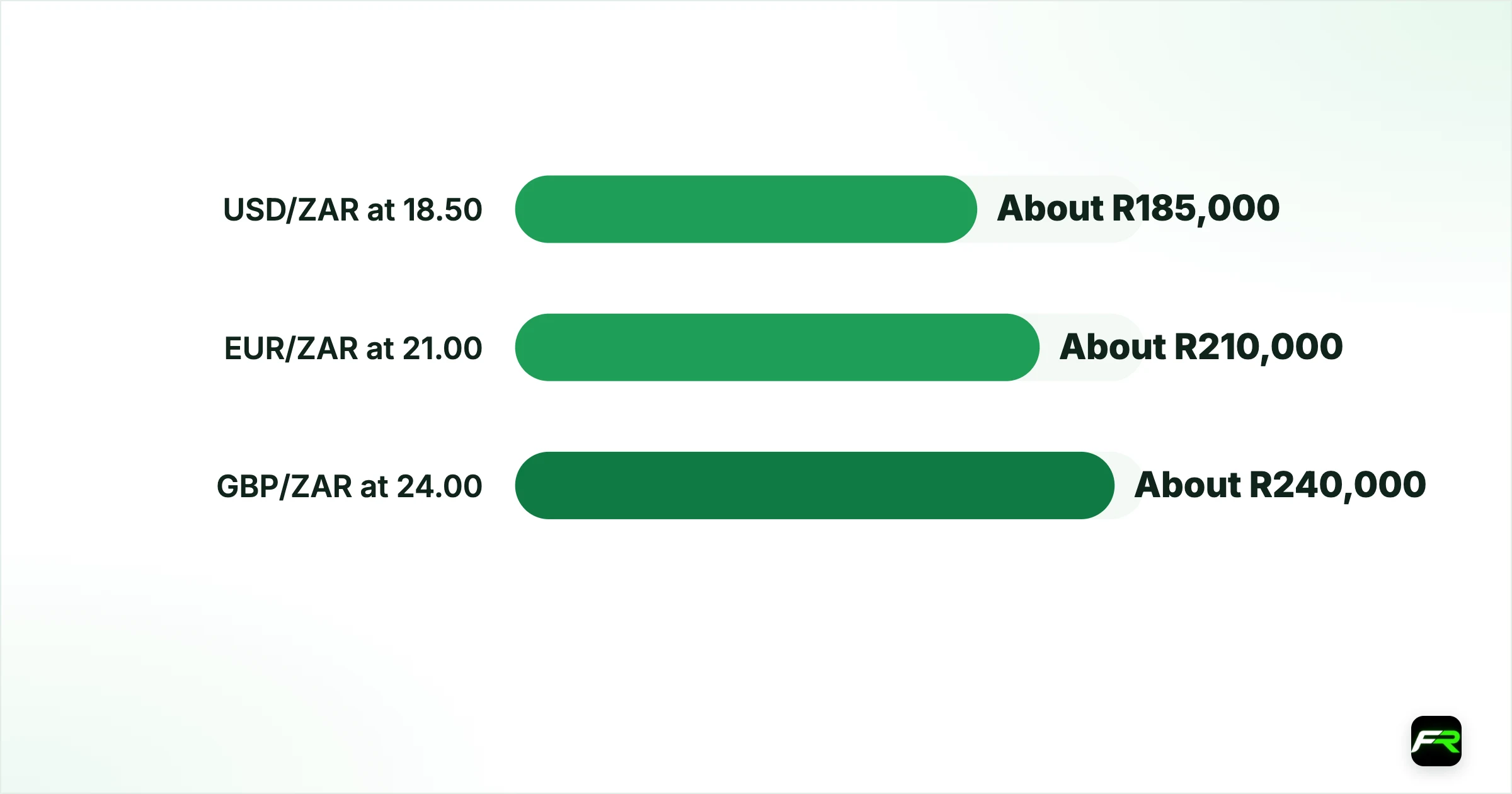
All three rand pairs are quoted in rand, so on a rand account a pip is worth the same on each: R10 per standard lot. What differs is the size of the position, because a lot of GBP/ZAR is £100,000, not $100,000. With illustrative rates of 18.50, 21.00 and 24.00:
| Pair | Notional of 0.10 lot | Pip value per 0.10 lot | Margin at 1:100 |
|---|---|---|---|
| USD/ZAR at 18.50 | About R185,000 | R1 | About R1,850 |
| EUR/ZAR at 21.00 | About R210,000 | R1 | About R2,100 |
| GBP/ZAR at 24.00 | About R240,000 | R1 | About R2,400 |
The crosses also tend to have a wider daily range in pips, since they carry the volatility of both legs. A stop that fits the day's range on GBP/ZAR will usually be wider than one on USD/ZAR, so for the same 1 per cent risk the position must be smaller again.
Hedging pound income: a worked example
Thandiwe is paid £2,000 a month for remote work and spends in rand. She worries a stronger rand will shrink her income. Ahead of a Bank of England meeting she shorts 0.02 lots of GBP/ZAR, about £2,000 of exposure, so that if the pound falls against the rand, the gain on the trade offsets most of the drop in her salary's rand value. She pays spread and nightly swap for the protection, which she treats as insurance, and closes the hedge once she has converted the month's pay.
A hedge reduces one risk by taking an offsetting position, and it costs money to hold. It is risk management, not a way to profit, and SARS treats any gain or loss on the trade like other trading income.
Swap costs on the crosses
Holding a rand cross overnight usually costs more in swap than holding USD/ZAR, because the interest-rate maths runs through a less liquid pair and brokers price the financing wider. A day trader who is flat by the evening rollover is unaffected. For a swing trader holding for days, the accumulated swap on GBP/ZAR or EUR/ZAR can quietly eat a meaningful share of the trade's profit. Check the swap rate for your pair and holding period before you assume the cross is equivalent to USD/ZAR.
GBP/ZAR and EUR/ZAR combine the rand's volatility with a second currency's news flow, at a wider spread and a larger swap. Trade them only when you specifically want that second leg, not as a default rand pair.
The rand crosses are a specialist tool. If a trader tells me they trade EUR/ZAR because they like the chart, I steer them to USD/ZAR, which is cheaper and simpler to follow. Save the crosses for the weeks when you have a real view on the pound or the euro.
Frequently asked
What drives GBP/ZAR and EUR/ZAR?
Both the rand's drivers and the second currency's. EUR/ZAR reacts to ECB decisions and euro-zone data as well as everything that moves the rand, so the pair can move sharply on news from either region.
Are the rand crosses more expensive to trade than USD/ZAR?
Yes. GBP/ZAR and EUR/ZAR have wider spreads, larger overnight swaps and thinner liquidity than USD/ZAR, which adds cost on every trade and every night held.
When should I trade GBP/ZAR or EUR/ZAR instead of USD/ZAR?
When you have a specific view on the pound or euro you want to express against the rand, when you are hedging a real GBP or EUR exposure, or when your tested strategy has an edge on those pairs specifically.
Which rand pair is best for beginners?
USD/ZAR. It has the tightest spread, smallest swap and deepest liquidity of the rand pairs, and one main driver set to follow rather than two.
Can I hedge pound income with GBP/ZAR?
You can use GBP/ZAR to hedge a real exposure such as GBP income against rand expenses, but understand the spread and swap costs and treat it as risk management rather than a profit trade.
Is a pip worth the same on GBP/ZAR as on USD/ZAR?
On a rand account, yes: R10 per standard lot on each, because all rand pairs are quoted in rand. The position behind each lot differs, though, since a GBP/ZAR lot is £100,000. That means more margin and, with the cross's wider range, usually a smaller position.
Related reading
The team behind this guide
Researched, checked and approved by five forex specialists
Every guide is written, fact-checked and edited before it goes live, and updated when the facts change. Spotted an error? Tell us.