IC Markets

































What an FSCA ODP Licence Actually Means for You
The ODP licence lets a forex and CFD broker act as counterparty to South African clients. What it covers, what it doesn't, and where your money sits.
 WriterAbir KhanWriterWrites the guides · checks every figure against primary sources View profileAbout Abir →
 Market analysisTanbir Habib RiyadForex & Crypto AnalystForex and crypto analyst · technical and fundamental analysis View profileAbout Tanbir →
 Fact-checking & riskJannatul FerdaushFact-Checker & Risk AnalystFact-checks every figure · risk analysis · Applied Statistics, University of Dhaka View profileAbout Jannatul →
 Trading reviewJowel RanaCo-Founder & Forex TraderCo-founder · forex trader · reviews guides from a trader's view View profileAbout Jowel →
 Final approvalRanjan NiskrityFounder, Owner & Forex TraderFounder and owner · forex trader · signs off every guide View profileAbout Ranjan →
When people say a broker is "FSCA regulated", the licence they usually mean is the Over-the-Counter Derivative Provider authorisation, the ODP licence. It came out of reforms that brought derivative dealers under the Financial Markets Act, and since 2022 a firm that wants to be the counterparty to South African clients' forex and CFD trades is expected to hold one, in its own name or through an authorised local entity. Knowing what that licence does, and what it leaves out, tells you how much protection you actually have.
What the ODP licence covers
An ODP is a firm that issues over-the-counter derivatives to clients. A retail forex or CFD trade is exactly that: a contract between you and the broker whose value tracks a currency pair. The authorisation makes that firm answerable to the FSCA for how it runs that business. In practice the licence brings requirements around capital held against client exposure, segregation of client money from the firm's own funds, fair treatment and disclosure rules, reporting of trades to a trade repository, and fit-and-proper checks on the people running the firm.
- Client money must be kept separate from the broker's operating funds.
- The firm must hold capital against the risk it runs, so it is not one bad week from insolvency.
- Marketing, onboarding and pricing come under FSCA conduct standards.
- The people in charge are vetted, and the FSCA can act against them personally, as the Banxso case showed.
- You have a local complaints route: the firm first, then the FSCA, and the Ombud for eligible disputes.
What it does not cover
The ODP licence is a conduct and prudential licence for the firm. It is not a guarantee fund. If a licensed broker fails, there is no South African scheme that automatically repays retail forex clients the way bank deposits are covered up to a limit. Segregation of client money helps, but recovering it still runs through an insolvency process. The licence also does nothing about your trading results. A fully licensed ODP will still show, in its own disclosures, that most of its retail clients lose money.
An ODP licence tells you the firm is supervised and your money should be segregated. It does not insure your balance and it does not make trading safe. Treat it as the minimum bar to clear, not a reason to relax about risk.
ODP versus a plain FSP number
Some brokers show an FSP (Financial Services Provider) number that authorises them to give advice or act as an intermediary, but not to be the derivative counterparty. That is a weaker position for a forex broker than a full ODP authorisation or a clear link to one. When you check the register, look at what the authorisation actually permits, not just that a number exists.
| Authorisation | What it lets the firm do | What to look for |
|---|---|---|
| ODP licence | Be the counterparty to your forex and CFD trades | Covers derivative instruments, current, in the entity you trade with |
| FSP (advice or intermediary) | Advise on or arrange products, not issue the derivative | May sit alongside an offshore entity that holds your account |
| No verifiable authorisation | Nothing lawful | Walk away |
How to use this when picking a broker
- Find the exact legal entity name and licence number in the broker's footer or legal pages.
- Search the FSCA register at fsca.co.za and open the record.
- Confirm the authorisation covers derivative instruments and is current, not lapsed or suspended.
- Confirm the entity on the licence is the same one your account agreement names. Many groups run a local licensed entity and an offshore one, and onboard South Africans to the offshore side.
- If the local entity only holds an advice FSP and the account sits offshore, treat it as an offshore broker for protection purposes.
Kagiso signed up through a broker's South African website, saw an FSP number, and assumed he was fully covered locally. When he read his client agreement closely, the counterparty was the group's entity in another country, and the local number only authorised advice. Nothing was hidden, he just had not checked which entity held his account. He moved to a broker whose ODP-licensed South African entity was the actual counterparty, so a dispute would stay with the FSCA.
The ODP licence is a real step forward for South African traders, but the trick brokers use is entity substitution. A glossy local site shows the local licence, and then the account you open is with an offshore company in the same group. Always match the entity name on your signed agreement to the entity name on the FSCA record. If they differ, you are an offshore client whatever the marketing says.
The licence-check guide walks through the register step by step, and the FSCA vs offshore guide covers the protection difference in full.
Reading the numbers on a broker's website
A broker's footer can carry three or four different reference numbers, and they do not all mean the same thing. Some belong to the South African entity, some to a sister company abroad, and one may be nothing more than a company registration with CIPC. Before you trust any of them, work out which body issued it and what it permits.
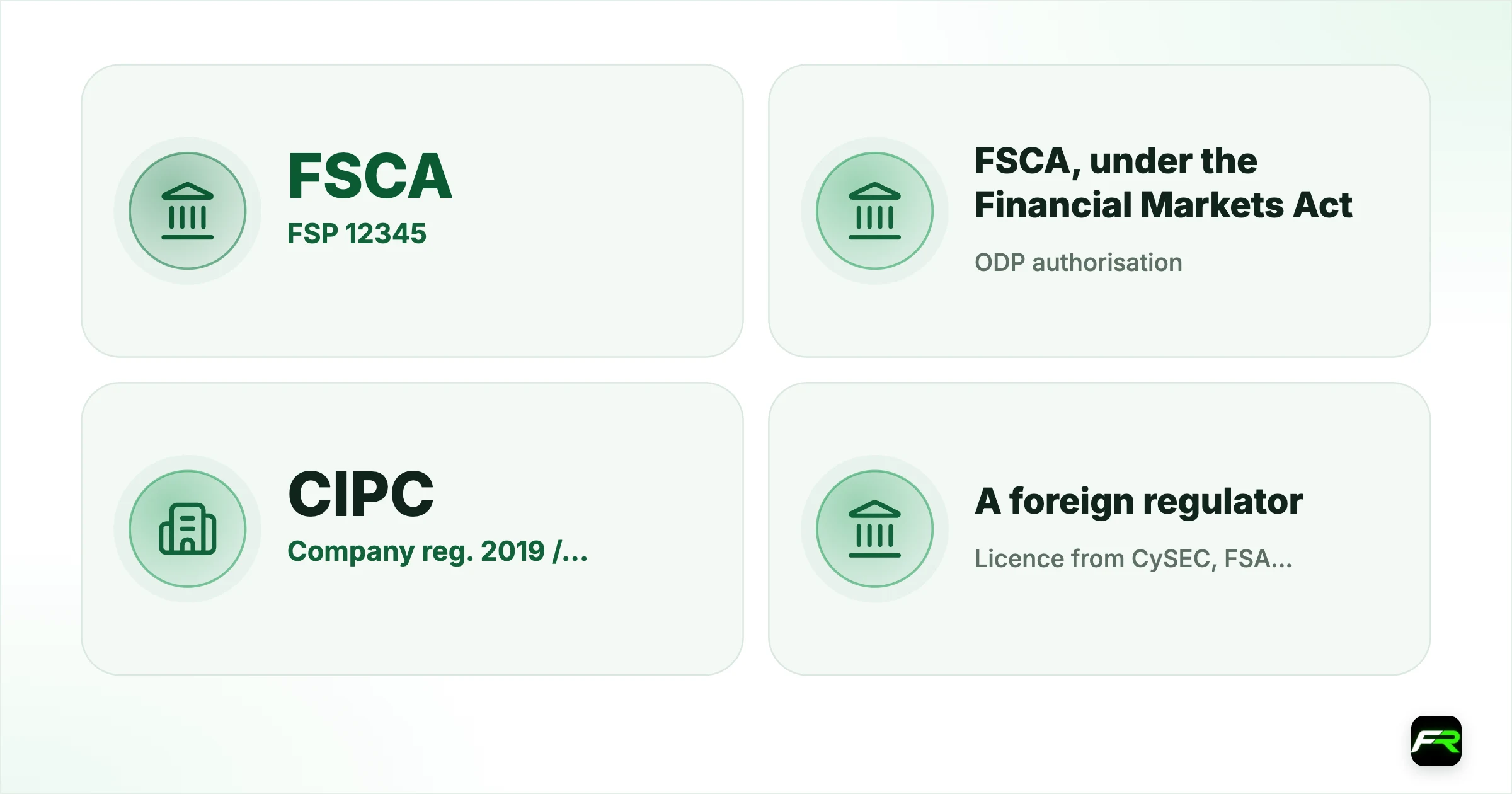
| What you see | Issued by | What it tells you |
|---|---|---|
| FSP 12345 | FSCA | The firm is an authorised financial services provider; check the categories it covers |
| ODP authorisation | FSCA, under the Financial Markets Act | The firm may be the counterparty to your OTC derivative trades |
| Company reg. 2019/123456/07 | CIPC | The company exists; it says nothing about a licence |
| Licence from CySEC, FSA Seychelles, FSC Mauritius | A foreign regulator | Covers the group's offshore entity, not South African protection |
The CIPC number is the one that misleads people most often. Every registered South African company has one, including the shells some scam operations trade through, so a registration number on its own proves only that someone filed paperwork. The FSCA record is what carries weight, and only when its entity name matches the company named in your client agreement.
What changes if the FSCA acts against a broker
A licence is not permanent. The FSCA can suspend an authorisation, provisionally withdraw it while it investigates, or withdraw it outright. During 2026 it used all three against CFD providers. For a client, the practical effect depends on the step: a suspended firm usually cannot take on new business but must still deal with existing clients, while a withdrawal normally comes with instructions on how open positions and balances will be handled.
- Read the FSCA's own notice on the firm, published on fsca.co.za, rather than relying on social media summaries.
- Do not deposit more while a firm is under suspension or provisional withdrawal.
- Request a withdrawal of any balance you do not need on the platform, and keep the confirmation.
- Save your statements and correspondence now, while you still have portal access.
If you need to report a firm or ask whether one is authorised, the FSCA's toll-free line is 0800 110 443, and complaints can be lodged through the enquiry form on fsca.co.za.
Frequently asked
What does ODP stand for?
Over-the-Counter Derivative Provider. It is the FSCA authorisation a firm needs to issue over-the-counter derivatives, which is what a retail forex or CFD trade is, to South African clients as the counterparty.
Is an ODP licence the same as being FSCA regulated?
It is the specific licence that matters for a forex broker. A firm can hold other FSCA authorisations, such as an advice FSP, without holding an ODP licence. For a broker that is your trade counterparty, the ODP authorisation is the one to confirm.
Does an ODP licence protect my deposit if the broker fails?
Not as a guarantee. It requires client money to be segregated and the firm to hold capital, which helps, but there is no South African scheme that automatically repays retail forex clients. Recovery still runs through insolvency.
How do I know if a broker holds an ODP licence?
Check the FSCA register at fsca.co.za using the broker's legal entity name or licence number. Confirm the authorisation covers derivative instruments and is current, and that the entity matches the one on your account agreement.
Why do some brokers show an FSP number but not an ODP licence?
An FSP number may authorise advice or intermediary services only. Some groups use a locally licensed entity for marketing and a separate offshore entity as the actual trade counterparty. Read your client agreement to see which entity holds your account.
Is a CIPC company number the same as an FSCA licence?
No. A CIPC number shows only that a company is registered in South Africa. It says nothing about whether the firm may offer forex or CFDs. For that you need an FSP number and, for a broker acting as your counterparty, an ODP authorisation on the FSCA register.
Related reading
The team behind this guide
Researched, checked and approved by five forex specialists
Every guide is written, fact-checked and edited before it goes live, and updated when the facts change. Spotted an error? Tell us.