IC Markets





































An R20,000 Forex Account: 6 Months of Real Trades
A month-by-month walk through a realistic R20,000 account: the drawdowns, the two losing months, the mistakes, and where it ended up. Not a success story, a normal one.
 WriterAbir KhanWriterWrites the guides · checks every figure against primary sources View profileAbout Abir →
 Market analysisTanbir Habib RiyadForex & Crypto AnalystForex and crypto analyst · technical and fundamental analysis View profileAbout Tanbir →
 Fact-checking & riskJannatul FerdaushFact-Checker & Risk AnalystFact-checks every figure · risk analysis · Applied Statistics, University of Dhaka View profileAbout Jannatul →
 Trading reviewJowel RanaCo-Founder & Forex TraderCo-founder · forex trader · reviews guides from a trader's view View profileAbout Jowel →
 Final approvalRanjan NiskrityFounder, Owner & Forex TraderFounder and owner · forex trader · signs off every guide View profileAbout Ranjan →
Most trading content shows you either a blown account or a Lamborghini. The normal outcome is in between: small progress, real drawdowns, some avoidable mistakes, and an ending that is neither disaster nor triumph. This is a month-by-month account of a realistic R20,000 South African account over six months, built from the patterns the FX Recap desk sees most often. The trader is a composite; the numbers are the point.
This is an illustrative composite based on common real patterns, not a single individual's statement. The figures are representative of a disciplined beginner's first six months.
The setup
| Starting capital | R20,000 |
|---|---|
| Broker | Locally FSCA-licensed, ZAR account |
| Risk per trade | 1% (R200), adjusted as the balance moved |
| Pairs | EUR/USD and USD/ZAR |
| Style | A few trades a week, held hours to two days |
| Prior experience | 4 months on demo |
Month 1: small loss, big lesson
Ended down about R900, roughly 4.5 per cent. Nine trades, five losers. The loss was not the problem; the problem was two trades where he moved his stop further away to avoid being stopped out, turning two planned R200 losses into a R450 and a R520 loss. He wrote a rule: the stop does not move against me, ever. That single rule changed the next five months.
Month 2: flat, and bored
Up about R150, and almost nothing happened, which was the danger. With little movement in his pairs during his trading hours, he started taking marginal setups out of boredom. Three of them lost. He caught it, cut back to only his A-grade setups, and accepted that some weeks he would place two trades. Boredom trades were his second-biggest leak after moving stops.
Month 3: the good month
The best stretch of the six: up about R1,700, roughly 8.5 per cent. A clean trending run on EUR/USD suited his strategy, and he followed the plan. The risk here was psychological: he finished the month tempted to double his risk per trade to 2 per cent because "it was working". He did not, which is why month 4 did not end him.
Month 4: the drawdown
Down about R1,600. A choppy, newsy month with two false breakouts and a SARB decision that whipsawed a USD/ZAR trade he should not have held into the announcement. Six losers in a row at one point. Because he was still risking 1 per cent, the streak was about a 6 per cent drawdown, uncomfortable but survivable. At 2 per cent it would have been 12 per cent and he admits he would have panicked.
| Month | Result | Running balance | Note |
|---|---|---|---|
| Start | R20,000 | ||
| 1 | -R900 | R19,100 | Moved stops; wrote the no-moving-stops rule |
| 2 | +R150 | R19,250 | Boredom trades; cut to A-setups only |
| 3 | +R1,700 | R20,950 | Clean trend; resisted raising risk |
| 4 | -R1,600 | R19,350 | Six-loss streak; held USD/ZAR into SARB |
| 5 | +R1,100 | R20,450 | Back to process; smaller USD/ZAR size |
| 6 | +R800 | R21,250 | Quiet, disciplined month |
Months 5 and 6: back to process
Month 5 ended up about R1,100 and month 6 up about R800. Nothing dramatic. He had stopped holding USD/ZAR through the SARB decision, cut his rand-pair position size after month 4 showed him the volatility, and was placing fewer trades. The account finished at about R21,250, up 6.25 per cent over six months, with a worst drawdown of around 8 per cent along the way.
The journal that made the review possible
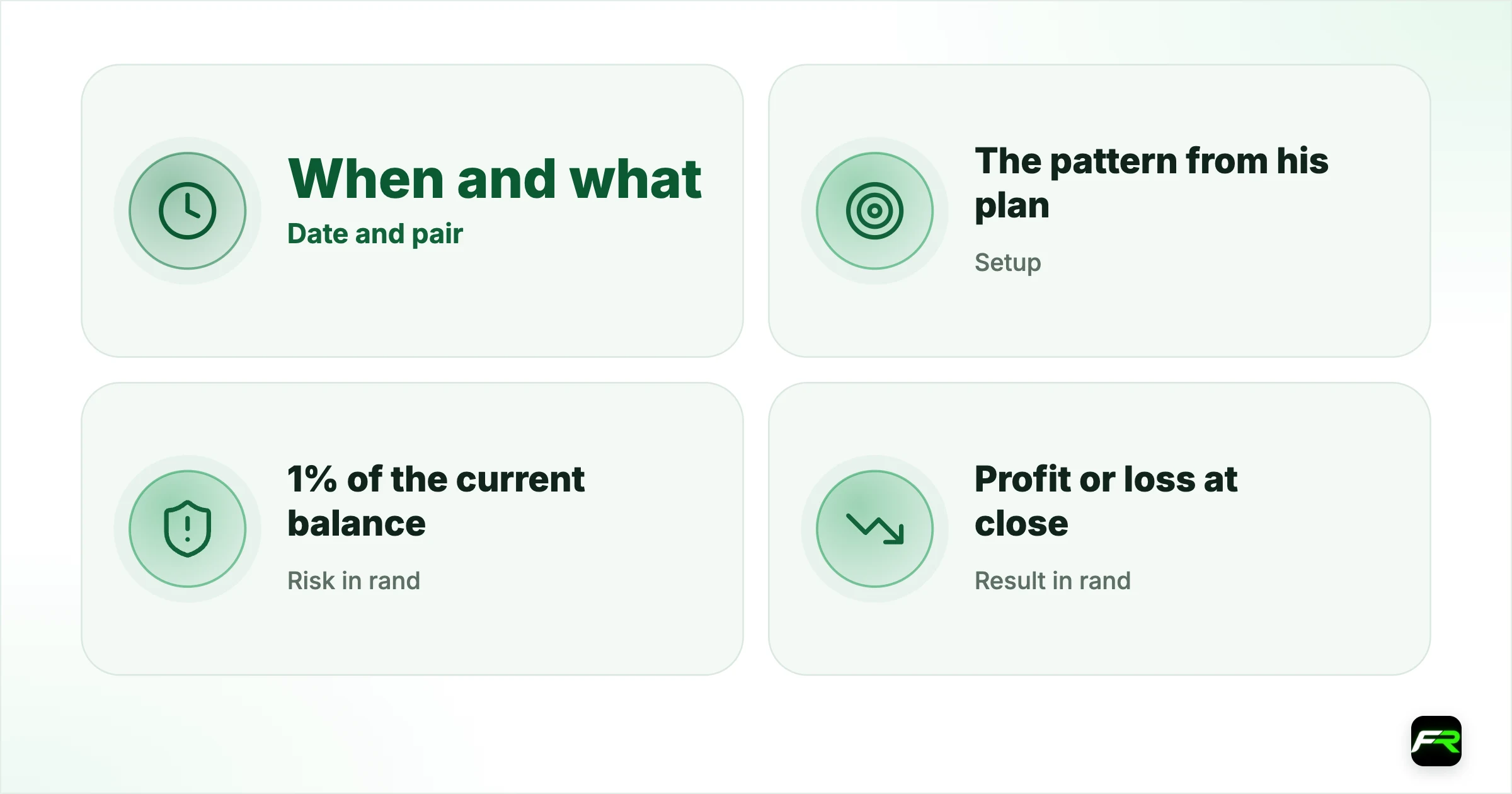
Each lesson above came from the trader's journal, not from memory. He logged every trade in a simple spreadsheet with the same columns, then reviewed it at the end of each month. A version of his layout, with one example row:
| Column | What goes in it | Example |
|---|---|---|
| Date and pair | When and what | 12 March, EUR/USD |
| Setup | The pattern from his plan | Pullback to 4-hour support |
| Risk in rand | 1% of the current balance | R205 |
| Result in rand | Profit or loss at close | +R390 |
| Followed the plan? | Yes or no, honestly | Yes |
| Note | One line on what he felt or saw | Wanted to close early; held to target |
The "followed the plan" column did the most work. When he filtered month four, three of the six losers were trades his plan did not allow. Without that column, the month would have looked like bad luck.
Five questions for a monthly review
- Which trades broke a rule, and what did they cost in total?
- What was the largest single loss as a percentage of the account, and why?
- Which setup made money and which lost it, over at least 20 trades?
- At what time of day did the losing trades cluster?
- What one change will I make next month, and how will I measure it?
What the six months actually taught
- The stop never moves against you. This one rule prevented the biggest losses.
- Boredom is a position-sizing risk. Marginal setups taken to fill time were a steady leak.
- Do not raise risk because you are winning. It is precisely before a drawdown that this feels safe.
- A 1 per cent risk makes a six-loss streak survivable. At 2 per cent the same streak causes panic decisions.
- USD/ZAR needs a smaller position and no open exposure through the SARB decision.
- Six per cent in six months is a fine, unremarkable result. It compounds to something real over years and it means you are still trading.
He told us the account felt like it was going nowhere for months, and then he looked at the curve and realised nowhere, for a beginner, is a win. What he had instead of a blown account was a rule set that survived a bad month and a clear picture of his own leaks. That, not the R1,250, was the return on the six months.
A 6 per cent six-month result is not a promise. Plenty of disciplined beginners are flat or down after six months. The point of this account is the process and the drawdown management, not the ending figure, which could easily have been negative with the same good habits and a worse market.
This is what a good first six months looks like: small net progress, one genuinely bad month that did not break the account, and a trader who can name their own mistakes. Anyone showing you a smooth curve and 20 per cent a month is showing you a demo or a lie.
Frequently asked
Is 6 per cent in six months a good result for a beginner?
It is a solid, unremarkable result. What matters more is that the account survived a losing month, the trader kept risk fixed at 1 per cent, and they can identify their own mistakes. Many disciplined beginners are flat or down after six months.
What was the biggest mistake in this account?
Moving stop-losses further away to avoid being stopped out, which turned two planned small losses into large ones in month one. A firm rule that the stop never moves against the position fixed it.
Why did the six-loss streak in month four not blow the account?
Because risk was fixed at 1 per cent per trade. Six losses in a row was about a 6 per cent drawdown. At 2 per cent risk it would have been 12 per cent, which the trader says would have triggered panic decisions.
Should I increase my risk when I am winning?
No. Raising risk after a good run feels safe precisely when a drawdown is most likely to follow. Keeping risk fixed is what makes the inevitable losing streak survivable.
How should I trade USD/ZAR around the SARB decision?
Most beginners should have no open USD/ZAR position through the announcement. It can move 1.5 per cent or more in minutes and whipsaw normal stops. Trade the direction that holds 30 to 60 minutes after the statement instead.
What should a forex trading journal include?
At minimum the date, pair, setup, risk in rand, result in rand and whether you followed your plan, plus a short note. The plan column matters most, because it separates bad trades from bad luck when you review the month.
Related reading
The team behind this guide
Researched, checked and approved by five forex specialists
Every guide is written, fact-checked and edited before it goes live, and updated when the facts change. Spotted an error? Tell us.