IC Markets



































The Real Cost of ZAR-to-USD Conversion on Your Broker
If your account is in dollars, every deposit and withdrawal is converted at the broker's rate, and the spread is a cost you pay for nothing. Here is how to measure it and how a ZAR account removes it.
 WriterAbir KhanWriterWrites the guides · checks every figure against primary sources View profileAbout Abir →
 Market analysisTanbir Habib RiyadForex & Crypto AnalystForex and crypto analyst · technical and fundamental analysis View profileAbout Tanbir →
 Fact-checking & riskJannatul FerdaushFact-Checker & Risk AnalystFact-checks every figure · risk analysis · Applied Statistics, University of Dhaka View profileAbout Jannatul →
 Trading reviewJowel RanaCo-Founder & Forex TraderCo-founder · forex trader · reviews guides from a trader's view View profileAbout Jowel →
 Final approvalRanjan NiskrityFounder, Owner & Forex TraderFounder and owner · forex trader · signs off every guide View profileAbout Ranjan →
A USD-denominated trading account looks normal because most of the forex world quotes in dollars. But if you are a South African funding in rand, that account converts your money to dollars on the way in and back to rand on the way out, and the broker applies a spread each time. Over a year of top-ups and withdrawals it adds up to real money for zero benefit. This guide shows how to measure the cost and avoid it.
Where the cost hides
The broker does not usually show a conversion fee as a line item. Instead it converts at a rate a little worse than the market mid-rate. If the market rate is 18.50 rand to the dollar, the broker might give you 18.60 when you deposit (you get fewer dollars) and 18.40 when you withdraw (you get fewer rand). That gap, typically 0.3 to 0.8 per cent each way, is the cost. It is invisible unless you compare the rate you got against the market rate on the day.
A worked example
| Step | Amount | Notes |
|---|---|---|
| Deposit | R10,000 | Market rate 18.50; broker converts at 18.60 |
| Dollars credited | ~USD 537.63 | vs USD 540.54 at mid-rate: about R54 lost |
| Later withdrawal | USD 600 | Market rate 18.50; broker converts at 18.40 |
| Rand received | R11,040 | vs R11,100 at mid-rate: about R60 lost |
| Total conversion cost | ~R114 | On one deposit and one withdrawal |
R114 on one cycle is not alarming. But a trader who tops up monthly and withdraws every few weeks might run 20 or more conversion events a year, and the cost scales with the amounts. On a small, active account it can quietly reach 2 to 4 per cent of turnover.
How a ZAR account removes it
A true ZAR base account holds your balance in rand from deposit to withdrawal. R10,000 in is R10,000 on the account. There is no conversion at the account boundary, so there is no spread to pay. You still trade dollar-quoted pairs; the platform handles the position currency internally. Currency conversion then matters only for the pip value on non-rand pairs, which is a normal part of trading, not a fee. Our ZAR account guide covers which brokers offer this.
Michelle traded a USD account for a year, funding it in small monthly amounts and withdrawing profits often. When she added up the difference between the broker's conversion rates and the market rates across all her transfers, it came to about R1,900 for the year, almost a full month's target profit lost to conversion spread. Moving to a ZAR account with the same broker took the cost to zero.
For one month, note the market USD/ZAR rate whenever you deposit or withdraw, and compare it to the rate the broker gave you. The gap, multiplied by your yearly transfer volume, is what a ZAR account would save you.
Conversion happens at the payment processor too
The broker is not the only place a conversion can be added. If you fund a USD account with a South African card, your bank may convert rand to dollars at its own rate and add an international transaction fee of around 2 to 3 per cent, before the money even reaches the broker. Then the broker may convert again if its processor works in a third currency. Stacked conversions are how a deposit can lose 4 to 5 per cent between your account and your trading balance. A local ZAR deposit to a local broker entity has none of these layers.
Measure your own conversion cost in four steps
The worked example above uses assumed rates. Your own broker's spread is easy to measure from figures you already have, and doing it once tells you whether switching to a rand account is worth the effort.
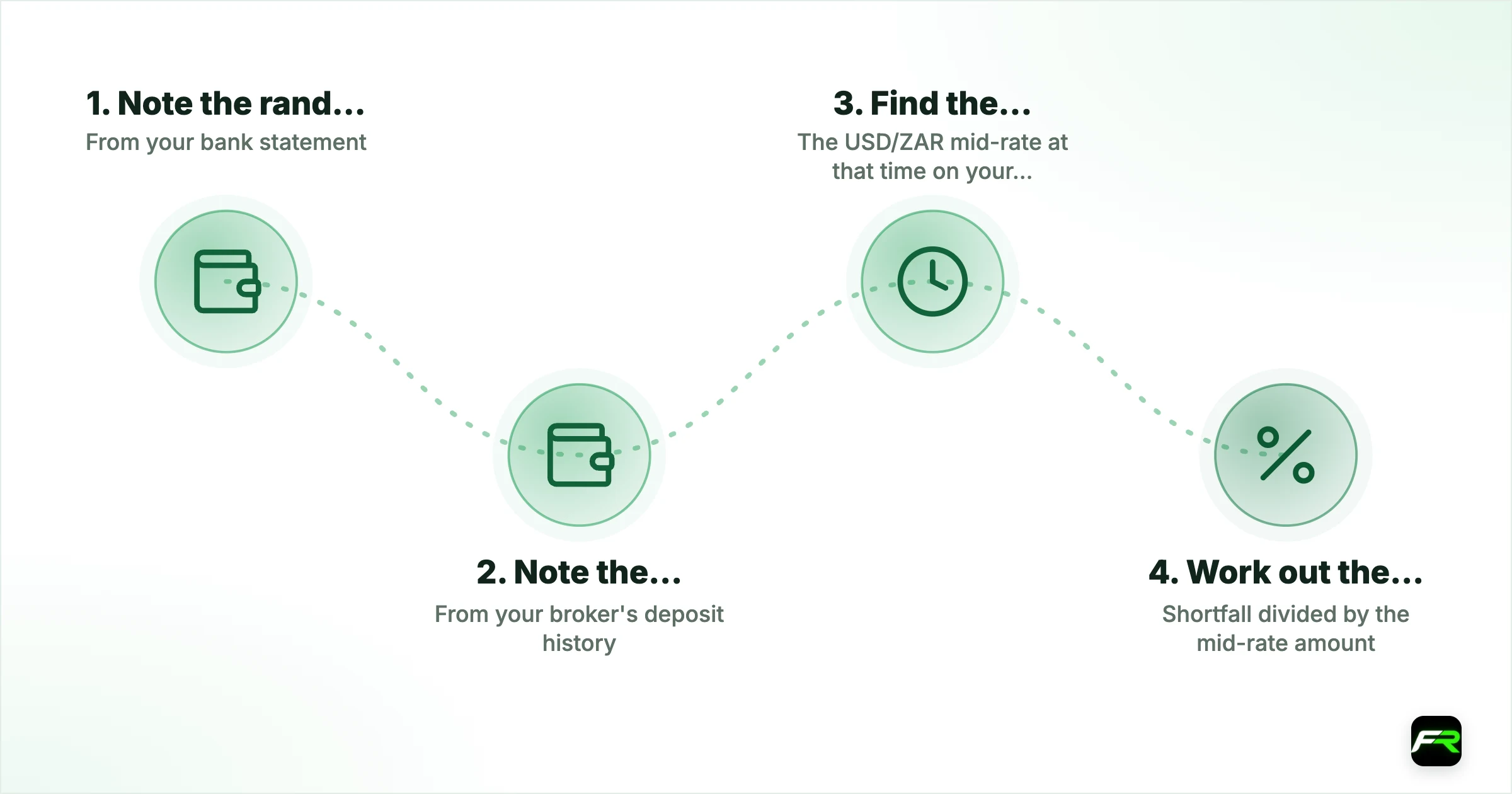
| Step | What you do | Example |
|---|---|---|
| 1. Note the rand amount | From your bank statement | R5,000 deposited |
| 2. Note the dollars credited | From your broker's deposit history | $283.29 credited |
| 3. Find the market rate | The USD/ZAR mid-rate at that time on your platform | 17.50, so $285.71 at mid |
| 4. Work out the gap | Shortfall divided by the mid-rate amount | $2.42 short, about 0.85% |
Repeat it for one withdrawal, add the two percentages, and you have your round-trip cost. Multiply by the rand you move in a year and compare the total with what you make in a typical month. For many small accounts that comparison ends the debate.
When paying the conversion is reasonable
There are cases where a dollar account is the sensible choice despite the cost. A trader who earns in dollars, for example a freelancer paid by foreign clients, would pay a conversion to move into rand and back. Someone who deliberately wants part of their savings in dollars may treat the balance's currency exposure as a feature. The cost only matters when it buys you nothing, which is the position of most South Africans who earn and spend in rand.
What about currency risk on the balance?
A subtler cost of a USD account for a rand earner is that your account balance itself carries an exchange-rate exposure. If you hold USD 500 and the rand strengthens 5 per cent, your balance is worth about R460 less in rand terms even if you never placed a trade. For a trader whose goals, rent and grocery bill are all in rand, that is an unwanted position layered on top of your actual trades. A ZAR account removes it: your balance is worth what it says in the currency you spend.
Some brokers offer a ZAR-labelled account that still converts internally. Confirm on the account-opening screen that ZAR is a genuine base-currency option and ask support whether the balance is held in rand or converted to dollars on deposit.
The conversion spread is the most overlooked cost in South African retail forex. It is small per transaction, which is exactly why people ignore it, and then it compounds across a year of top-ups and withdrawals into a number that would have been a good month. A real ZAR account makes it disappear.
Frequently asked
How much does ZAR to USD conversion cost on a broker?
Typically 0.3 to 0.8 per cent each way, applied as a worse-than-market exchange rate rather than a visible fee. On a deposit and later withdrawal that is often around 1 per cent of the amount.
How do I see the conversion cost?
Compare the exchange rate the broker used against the market mid-rate on the same day. The gap is the cost. It is not usually shown as a separate line item.
Does a ZAR account remove the conversion cost?
Yes. A true ZAR base account holds your balance in rand from deposit to withdrawal, so there is no conversion at the account boundary and no spread to pay. You can still trade dollar-quoted pairs.
Is the conversion cost a big deal?
On one transfer, no. For an active trader doing frequent small top-ups and withdrawals it can reach 2 to 4 per cent of turnover over a year, which is significant on a small account.
Can a ZAR-labelled account still convert my money?
Some do. Confirm on the account-opening screen that ZAR is a genuine base-currency option, and ask support whether the balance is held in rand or converted to dollars on deposit.
Is a dollar account better if I earn in US dollars?
It can be. If your income arrives in dollars, funding a dollar account avoids converting into rand and back, and your balance is already in the currency you hold. The conversion argument for a ZAR account applies to traders who earn and spend in rand.
Related reading
The team behind this guide
Researched, checked and approved by five forex specialists
Every guide is written, fact-checked and edited before it goes live, and updated when the facts change. Spotted an error? Tell us.