IC Markets

































The R10 Million Foreign Investment Allowance and Forex
The FIA allows up to R10 million a year offshore, on top of the R2 million discretionary allowance, with a SARS PIN. When it matters for traders.
 WriterAbir KhanWriterWrites the guides · checks every figure against primary sources View profileAbout Abir →

 Market analysisTanbir Habib RiyadForex & Crypto AnalystForex and crypto analyst · technical and fundamental analysis View profileAbout Tanbir →

 Fact-checking & riskJannatul FerdaushFact-Checker & Risk AnalystFact-checks every figure · risk analysis · Applied Statistics, University of Dhaka View profileAbout Jannatul →

 Trading reviewJowel RanaCo-Founder & Forex TraderCo-founder · forex trader · reviews guides from a trader's view View profileAbout Jowel →

 Final approvalRanjan NiskrityFounder, Owner & Forex TraderFounder and owner · forex trader · signs off every guide View profileAbout Ranjan →

The Foreign Investment Allowance is the larger of the two routes for moving money out of South Africa. It allows up to R10 million per person per calendar year for offshore investment, and it sits on top of the R2 million Single Discretionary Allowance. Unlike the SDA, it requires approval from SARS in the form of a Tax Compliance Status PIN. For most retail forex traders it never comes up. This guide explains it so you know where the line is.
How the FIA works
- You apply to SARS for a Tax Compliance Status PIN for foreign investment, sometimes still called a tax clearance. SARS checks your tax affairs are in order and that you can show the source of the funds.
- SARS issues a PIN, valid for a set period, that your bank can verify online.
- Your bank processes the transfer against the FIA, up to R10 million for the year, and reports it to the Reserve Bank.
- Larger amounts, above R10 million, need a separate approval process through the Reserve Bank's Financial Surveillance Department.
| Single Discretionary Allowance | Foreign Investment Allowance | |
|---|---|---|
| Annual limit | R2 million | R10 million |
| SARS approval | Not required | Tax Compliance Status PIN required |
| Source of funds | Not scrutinised for the SDA | Must be shown to SARS |
| Typical use | Trading account funding, travel, gifts | Larger offshore investment portfolios |
| Relevant to retail forex? | Yes, this is the normal route | Rarely |
When a trader would actually use it
You would only reach for the FIA if you wanted to move more than R2 million offshore in a single year, which for a forex trader would mean funding an account with serious capital, well beyond what a retail trader risks. Someone moving R3 million into a managed offshore account, or building a large offshore investment position alongside trading, would use it. A person funding a trading account with R50,000 will never touch it.
If you feel you need the R10 million allowance to fund a forex account, stop and think about position sizing. Risking sums that large on retail margin trading is how large amounts of money disappear quickly. The allowance existing does not mean using it for this is wise.
The source-of-funds requirement
The FIA process asks you to demonstrate where the money came from: salary, a property sale, an inheritance, business proceeds. This is an anti-money-laundering and tax check, not an obstacle for someone with ordinary, documented finances. It does mean the FIA is not a quick same-day facility the way an SDA transfer is; allow time for the SARS PIN.
Anele sold a rental property and wanted to move R4 million into a mix of offshore index funds and a small managed forex allocation. That is above the R2 million SDA, so she applied for a Tax Compliance Status PIN, showed the property sale as the source, and her bank processed the transfer against her FIA. Her financial adviser was clear that the forex allocation was the high-risk sliver of the plan, capped at an amount she could lose without it changing her retirement.
Applying for the AIT on eFiling, step by step
The process has a new name. SARS's eFiling now handles the foreign investment application through its Approval International Transfer option, usually shortened to AIT, which replaced the separate Foreign Investment Allowance and emigration applications. The result is still a Tax Compliance Status PIN that your bank verifies before it releases the transfer.
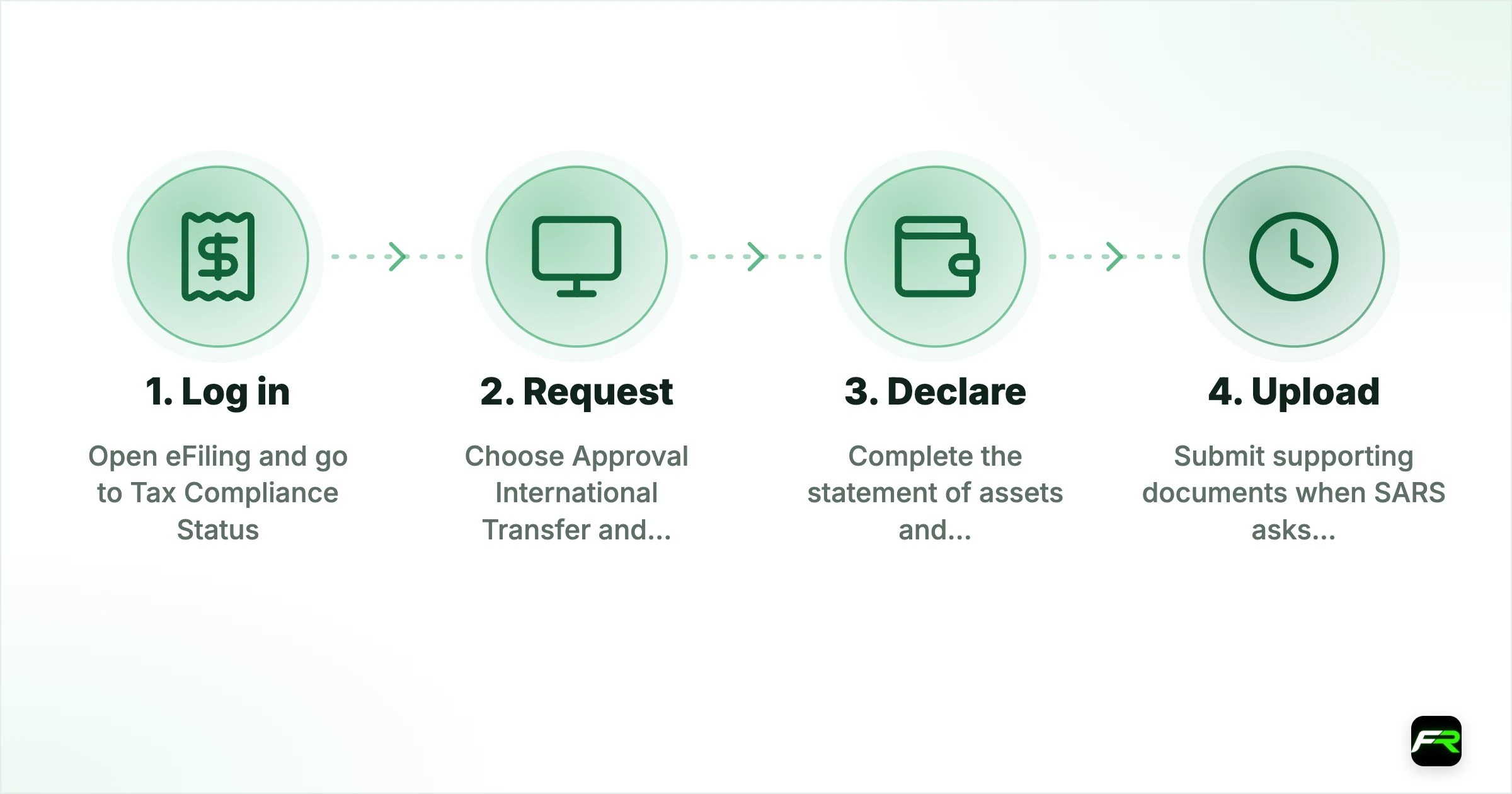
| Step | What happens | What to have ready |
|---|---|---|
| 1. Log in | Open eFiling and go to Tax Compliance Status | Your eFiling profile and tax number |
| 2. Request | Choose Approval International Transfer and enter the amount | The rand amount you plan to send |
| 3. Declare | Complete the statement of assets and liabilities and the source of funds | Recent figures for property, investments and debts |
| 4. Upload | Submit supporting documents when SARS asks for them | Sale agreements, bank statements, inheritance papers |
| 5. PIN | SARS sends a PIN by SMS once the request is approved | Give the PIN to your bank with the transfer instruction |
Outstanding returns or unpaid tax will hold the request up, so file anything late before you apply. Allow time: the request can be reviewed and documents queried before a PIN is issued, so this is not a same-day facility.
A sensible split for large sums
Someone with enough capital to need the FIA is in a different position from a beginner with R5,000. The temptation is to treat forex as a large slice of an offshore portfolio. Most planners would keep any leveraged trading allocation to a small fraction of investable wealth, sized so that losing all of it would not change your life, and hold the rest in plain, diversified investments.
Sizwe sold a business and planned to move R6 million offshore. He used his R2 million SDA first, then applied for an AIT for the remaining R4 million, uploading the sale agreement as the source of funds. The PIN arrived after SARS asked for one extra bank statement. Of the R6 million, R150,000 went into a trading account and the rest into global index funds, a split he chose so that a bad year of trading would be an annoyance, not a disaster.
Tax still applies
Using the FIA does not change anything about tax on your trading. SARS taxes active forex profit as income at your marginal rate whether the money went offshore under the SDA, the FIA, or into a local ZAR account. The FIA is an exchange-control approval, not a tax event in itself, though the profits it helps you earn are taxable as normal. Our SARS guide covers the tax side.
The Foreign Investment Allowance is a real tool for people moving substantial capital offshore, but it is the wrong frame for retail forex. If a trader is asking me about the R10 million allowance, my first question is how much of that they are planning to put at risk on margin, because the answer is usually far too much.
Frequently asked
What is the Foreign Investment Allowance?
An exchange-control facility allowing a South African resident to move up to R10 million per calendar year offshore for investment, on top of the R2 million Single Discretionary Allowance. It requires a SARS Tax Compliance Status PIN.
Do I need the FIA to trade forex?
Almost never. The R2 million discretionary allowance covers far more than a retail trader moves in a year. The FIA only matters if you are transferring more than R2 million offshore in a single year.
How do I get approval for the FIA?
Apply to SARS for a Tax Compliance Status PIN for foreign investment. SARS checks your tax affairs are in order and asks you to show the source of the funds. Your bank then processes the transfer against the allowance.
Can I move more than R10 million offshore?
Yes, but amounts above R10 million in a year require a separate approval from the Reserve Bank's Financial Surveillance Department, beyond the standard FIA process.
Does using the FIA affect my tax?
The transfer itself is an exchange-control approval, not a tax event. But any trading or investment profit you earn offshore is still taxable by SARS in the normal way.
What is an AIT from SARS?
AIT stands for Approval International Transfer, the eFiling option for requesting a Tax Compliance Status PIN to move money offshore above the R2 million discretionary allowance. It replaced the older Foreign Investment Allowance application. Your bank verifies the PIN before processing the transfer.
Related reading
The team behind this guide
Researched, checked and approved by five forex specialists
Every guide is written, fact-checked and edited before it goes live, and updated when the facts change. Spotted an error? Tell us.