 IC Markets





























What is Bid and Ask in Forex
Bid and ask prices are considered as the rates at which currencies are sold and bought in forex trading. This is the difference between both these prices and that is called the forex spread, which is one of the trading costs. Bid ask pricing makes traders estimate costs and enhance decision making. This article describes the formation of spreads, their fluctuation, and how the prices of bids and asks can affect the profitability of trade in general.
 WriterAbir KhanWriterWrites the guides · checks every figure against primary sources View profileAbout Abir →
 Market analysisTanbir Habib RiyadForex & Crypto AnalystForex and crypto analyst · technical and fundamental analysis View profileAbout Tanbir →
 Fact-checking & riskJannatul FerdaushFact-Checker & Risk AnalystFact-checks every figure · risk analysis · Applied Statistics, University of Dhaka View profileAbout Jannatul →
 Trading reviewJowel RanaCo-Founder & Forex TraderCo-founder · forex trader · reviews guides from a trader's view View profileAbout Jowel →
 Final approvalRanjan NiskrityFounder, Owner & Forex TraderFounder and owner · forex trader · signs off every guide View profileAbout Ranjan →
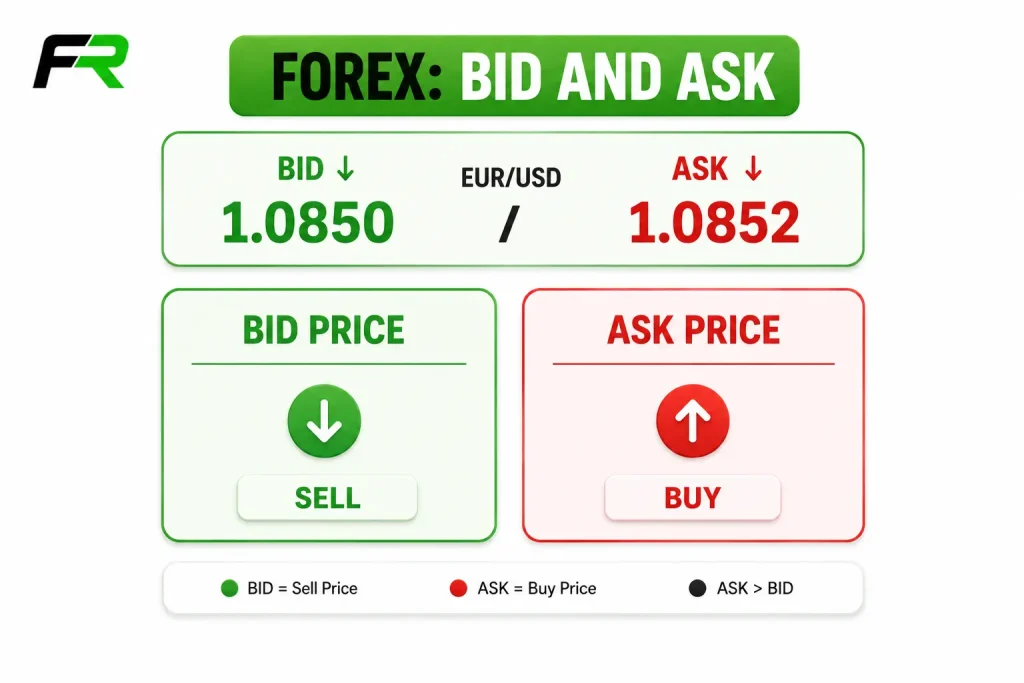
In any two-sided market, there are buyers and sellers. Buyers want to pay as little as possible. Sellers want to receive as much as possible. The bid price is the highest price a buyer is willing to pay for a currency pair right now. The ask price is the lowest price a seller is willing to accept.
When you trade forex, you are always on the other side of these prices from the market maker or liquidity provider. If you want to buy EUR/USD, you buy at the ask, the price sellers are asking. If you want to sell EUR/USD, you sell at the bid, the price buyers are bidding. This is not arbitrary. It is the fundamental structure of how any liquid market operates.
The bid is always lower than the ask. That gap between them is the spread. It represents the immediate cost of entering a trade and the immediate profit of the party taking the other side, which in retail forex is typically the broker or the liquidity provider behind them.
How a Forex Quote Works in Practice
Here is a concrete example. EUR/USD is quoted at 1.0850 / 1.0853.
- Bid = 1.0850. This is the price at which you can sell EUR/USD right now.
- Ask = 1.0853. This is the price at which you can buy EUR/USD right now.
- Spread = 3 pips. This is the cost of entering the trade.
If you click buy, your position opens at 1.0853. Your platform immediately shows the trade as 3 pips in the negative because the bid, which is what you would receive if you closed the trade right now, is 1.0850. The market needs to move 3 pips in your favor just to break even.
If you click sell instead, your position opens at 1.0850. To close that position, you would need to buy back at the ask, which is 1.0853. Again, the spread represents the starting cost.
This mechanism operates on every currency pair, every lot size, and every trade. The spread is not optional and it is not avoidable. It is built into the pricing structure of the market.
FXRecap’s guide on forex quotes covers how currency quotes are structured and how to read them accurately across different pairs and platforms.
The Bid-Ask Spread: What It Is and Why It Matters
The spread is the difference between the bid and ask prices, measured in pips. It is the most direct transaction cost in forex trading. Unlike brokerage commissions in stock trading, which are charged separately per transaction, forex spreads are embedded directly in the pricing. You pay the spread the moment you enter a trade.
For a trade to become profitable, price needs to move in your favor by more than the spread before you can claim any actual gain. On a 3-pip spread in EUR/USD, a 10-pip target means you need 13 pips of favorable price movement from your entry level before the spread cost is recovered.
The size of the spread matters more for some trading styles than others. A scalper who targets 5 to 10 pips per trade is paying a much higher proportion of the potential profit in spread costs than a swing trader who targets 100 pips. A 2-pip spread represents 20% to 40% of a scalper’s target but only 2% of a swing trader’s. This is one reason why scalping requires a broker with consistently tight spreads to be viable at all.
FXRecap’s guide on what is a forex spread covers spread types, how they compare across brokers, and how to factor them into your trade calculations.
Bid vs Ask: The Key Differences
The table below summarizes the practical distinction between the two prices:
| Bid Price | Ask Price | |
| What it represents | The price buyers are willing to pay | The price sellers are willing to accept |
| When you use it | When you sell a currency pair | When you buy a currency pair |
| Reflects | Demand in the market | Supply in the market |
| Always | Lower than the ask | Higher than the bid |
| EUR/USD example | 1.0850 | 1.0853 |
A common mistake among new traders is assuming they can enter or exit at the midpoint between the bid and ask. The midpoint, sometimes called the mid price, is a reference price used in charts and analysis, but actual trades execute at the bid or the ask depending on direction. You always pay slightly more to buy and receive slightly less to sell. The spread is the gap between those two realities.
How Platforms Display Bid and Ask Prices
On MetaTrader 4 and MetaTrader 5, the default chart typically displays the bid price as the main price line. The ask price is either shown as a separate line that can be enabled in chart settings or is visible in the quote panel and the trading terminal. When you open a buy trade, your entry is marked at the ask level. The ask line sits above the bid line by the current spread.
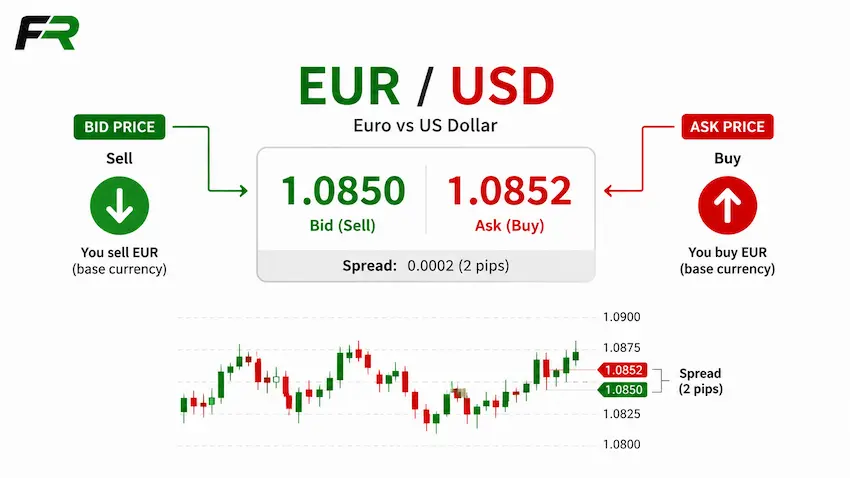
The trading panel or quote window shows the bid on the left and the ask on the right for each pair. The spread is sometimes displayed explicitly in pips beside the prices. On some platforms, the buy button shows the ask price and the sell button shows the bid price directly, making the distinction visible at the moment of execution.
One source of confusion for new traders is seeing their buy trade open with an immediate negative balance. This is not a platform error. The trade opened at the ask but closes at the bid. The spread is the distance between those two prices, and it shows up immediately as an unrealized loss until price moves to cover it.
On cTrader and some ECN platforms, the bid and ask are shown with additional precision, sometimes to five decimal places for most pairs and three decimal places for JPY pairs. The fifth decimal, called a pipette, represents a tenth of a pip and allows for more precise pricing in high-liquidity conditions.
Market Depth and Order Book Basics
Beyond the visible bid and ask, most platforms offer a view of market depth, also called Level II data or the order book. This shows multiple price levels on both sides, with the volume available at each level.
A simplified market depth view for EUR/USD might look like this:
- Ask side: 1.0853 at 5 million units, 1.0854 at 8 million units, 1.0855 at 12 million units
- Bid side: 1.0850 at 3 million units, 1.0849 at 6 million units, 1.0848 at 9 million units
The current bid and ask are the innermost prices on each side. The deeper levels show where additional supply and demand sits. When a large market order is placed that exceeds the available volume at the best price, it consumes that level and the next price tier becomes the new best bid or ask. This is called slippage and is why large orders in less liquid conditions can fill at a worse price than the displayed quote.
For retail traders, market depth data is most relevant in two situations: confirming that sufficient liquidity exists at the current price to execute a normal-sized order without slippage, and observing where large concentrations of orders are stacked, which can act as areas of support or resistance.
What Changes the Spread
Market Session and Liquidity
Spreads are tightest when trading volume is highest. For EUR/USD and GBP/USD, this is during the London session and the London-New York overlap, roughly 8am to 5pm London time, with peak liquidity between 1pm and 5pm. During these hours, major pairs can trade with spreads of 0.3 to 1 pip at competitive brokers.
During the Asian session, European and dollar pairs have lower participation. EUR/USD spreads that sat at 0.5 pips during London hours may widen to 1.5 or 2 pips during Asian session hours simply because there are fewer market makers actively quoting the pair. USD/JPY maintains better liquidity during Asian hours because of direct yen participation.
FXRecap’s guide on forex market hours explains how liquidity changes through the trading day and what that means for spread conditions in each session.
News Events and Economic Data
High-impact economic releases cause spreads to widen rapidly and briefly. In the seconds before and after a US non-farm payrolls release, ECB interest rate decision, or similar event, spreads on affected pairs can temporarily widen to 10 to 30 pips even for normally liquid major pairs. Liquidity providers widen their quotes to manage the risk of executing at outdated prices during the instant of maximum uncertainty.
Traders who hold positions through news events should account for this behavior. A stop-loss that is positioned 20 pips from entry may trigger at 35 pips from entry if the spread is 15 pips wider than normal at the moment of execution. This is not broker manipulation but a natural consequence of liquidity withdrawal during extreme uncertainty.
Instrument Type
Exotic currency pairs consistently have wider spreads than major pairs regardless of session timing. USD/TRY, USD/ZAR, and similar pairs may carry spreads of 30 to 100 pips under normal conditions because the underlying liquidity is thinner and the risk to market makers of holding positions in these currencies is higher.
Minor pairs sit between majors and exotics. EUR/GBP might carry a 1 to 2 pip spread during London hours. GBP/JPY might be 2 to 4 pips. The spread is directly related to the depth of the market for that specific pair at that specific time.
Broker Type
Brokers fall broadly into two categories based on how they handle spread pricing. Market maker brokers set their own spreads and take the other side of client trades directly. They have more control over pricing and may offer fixed spreads that do not widen during news events, though those fixed spreads are typically higher than variable spreads during normal conditions.
ECN or STP brokers pass orders directly to liquidity providers and charge a commission per trade instead of a markup on the spread. During liquid conditions, raw ECN spreads can be as low as 0.0 to 0.2 pips, but the commission must be added to calculate the true cost. Both models have merits depending on trading style. High-frequency scalpers often prefer raw ECN pricing. Traders who avoid news events may prefer the predictability of fixed spreads.
How Spread Costs Affect Real Trades
The practical impact of spread costs is most visible when examined across a series of trades rather than individually. Consider a trader who places 100 trades per month on EUR/USD with a 1.5-pip average spread and a 0.1 lot position size. Each pip on 0.1 lot EUR/USD is worth $1. Each trade costs 1.5 pips, or $1.50, before any price movement.
Over 100 trades, the spread cost alone is $150. If the average profit target is 20 pips and the average stop-loss is 15 pips, the spread represents 7.5% of the target and 10% of the stop. Those percentages grow rapidly for traders targeting smaller moves or using larger position sizes.
This is why spread comparison between brokers matters practically. A trader making 100 trades per month on EUR/USD with a 0.5-pip spread rather than 1.5 pips saves $100 per month in transaction costs. Over a year, that difference is $1,200 on a single pair with moderate trading frequency. For high-volume traders, the difference compounds significantly.
Calculating the spread as a percentage of the target before entering a trade is a practical discipline. If the spread is more than 20% of the potential reward, the trade’s mathematical edge is materially reduced before a single pip moves.
Using Bid and Ask Information Strategically
Timing Entry Around Liquidity
The most practical use of bid-ask awareness is timing trades to avoid high-spread periods. Entering a position during the London-New York overlap on a major pair gives the tightest available spread and the best execution conditions. Entering the same setup during Asian session hours or immediately before a major news release adds unnecessary cost and execution risk to an otherwise valid trade.
Limit Orders vs Market Orders
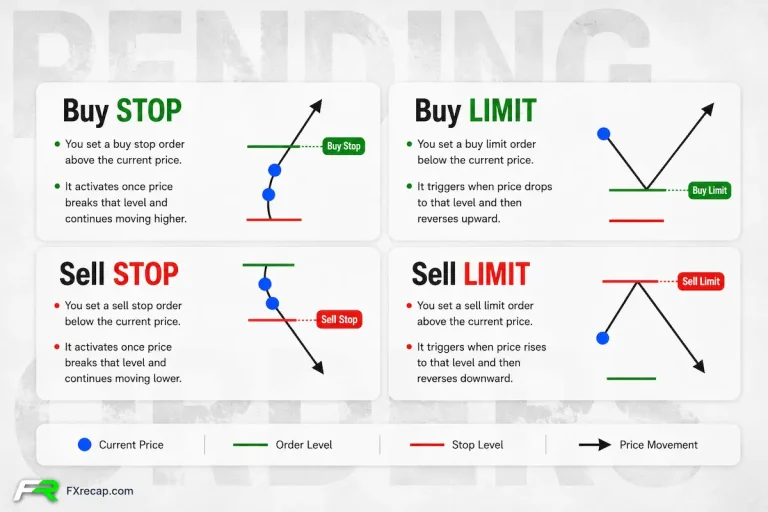
A market order executes immediately at the current ask (for buys) or bid (for sells). The trader has no control over the exact fill price. In fast-moving conditions, the executed price may be several pips from the displayed price at the moment the button was clicked, a phenomenon called slippage.
A limit order specifies the exact price at which the trader is willing to buy or sell. A buy limit order will only execute at the specified price or better, meaning at the ask price the trader set or lower. A sell limit order executes at the specified bid price or higher. Limit orders eliminate slippage in the direction of price improvement but may not fill if the market does not reach the specified level.
For entries at key support or resistance levels, limit orders often provide better average entry prices than market orders because the trader can wait for the market to come to a pre-planned level rather than chasing current price.
Monitoring Spread as a Market Condition Signal
Watching the spread in real time can provide context about current market conditions. When the spread on EUR/USD suddenly widens from 0.5 pips to 3 pips without an obvious news catalyst, it often signals that liquidity providers are temporarily stepping back from the market. This can precede sharp directional moves or indicate that institutional participants are repositioning. A sudden spread widening during an apparently quiet period is a signal to exercise caution rather than an invitation to trade.
A Case Study: The Cost of Ignoring the Spread
A trader new to exotic pairs noticed a strong setup in USD/TRY. The chart showed a clean breakout above a resistance level on the 4-hour timeframe, and the setup looked similar to patterns that had worked reliably on EUR/USD. He entered with a market order.
What he had not checked before entering was the spread. USD/TRY was carrying a 40-pip spread at the time of entry due to moderate liquidity conditions. His entry at market was 40 pips above where the breakout level actually sat. By the time price moved 30 pips in his direction, he was still 10 pips in the negative on the trade. The setup that looked profitable on the chart was already partially consumed by transaction costs before any price movement was captured.
The trade eventually moved enough to produce a modest profit, but the effective risk-to-reward ratio was significantly worse than what the chart had suggested because the spread had not been factored into the calculation. The same setup on EUR/USD with a 0.8-pip spread would have provided entry within a fraction of a pip of the breakout level.
After this experience, the trader added a spread check to his pre-trade routine: look up the current spread before entering, calculate what percentage of the target it represents, and avoid entries where the spread makes the trade mathematically marginal. He now applies this check regardless of the pair or the setup quality.
Summary
The bid and ask are the two prices present in every forex quote. The bid is what buyers are offering; the ask is what sellers are accepting. You buy at the ask and sell at the bid. The difference between them is the spread, which is your immediate transaction cost on every trade.
The spread changes based on the currency pair, the trading session, whether news events are approaching, and the type of broker account you use. Major pairs during peak session hours carry the tightest spreads. Exotic pairs, off-session trading, and news event windows carry significantly wider spreads.
For practical trading, the spread matters most when the target is small relative to the spread size, when comparing brokers on overall cost, and when timing entries around high-liquidity periods. Checking the spread before entry and incorporating it into the risk-to-reward calculation is a simple discipline that prevents a category of avoidable losses that have nothing to do with market direction.
The team behind this guide
Researched, checked and approved by five forex specialists
Every guide is written, fact-checked and edited before it goes live, and updated when the facts change. Spotted an error? Tell us.
Related Articles
 Education
17 min read
Education
17 min read

 Education
8 min read
Education
8 min read
 Education
9 min read
Education
9 min read
 Education
6 min read
Education
6 min read
 Education
9 min read
Education
9 min read
 Education
7 min read
Education
7 min read