 IC Markets





































Change of Character (CHoCH)
A change of character is the first sign a trend may flip, when price breaks a level against the trend. How to read it and wait for confirmation.
 WriterAbir KhanWriterWrites the guides · checks every figure against primary sources View profileAbout Abir →
 Market analysisTanbir Habib RiyadForex & Crypto AnalystForex and crypto analyst · technical and fundamental analysis View profileAbout Tanbir →
 Fact-checking & riskJannatul FerdaushFact-Checker & Risk AnalystFact-checks every figure · risk analysis · Applied Statistics, University of Dhaka View profileAbout Jannatul →
 Trading reviewJowel RanaCo-Founder & Forex TraderCo-founder · forex trader · reviews guides from a trader's view View profileAbout Jowel →
 Final approvalRanjan NiskrityFounder, Owner & Forex TraderFounder and owner · forex trader · signs off every guide View profileAbout Ranjan →
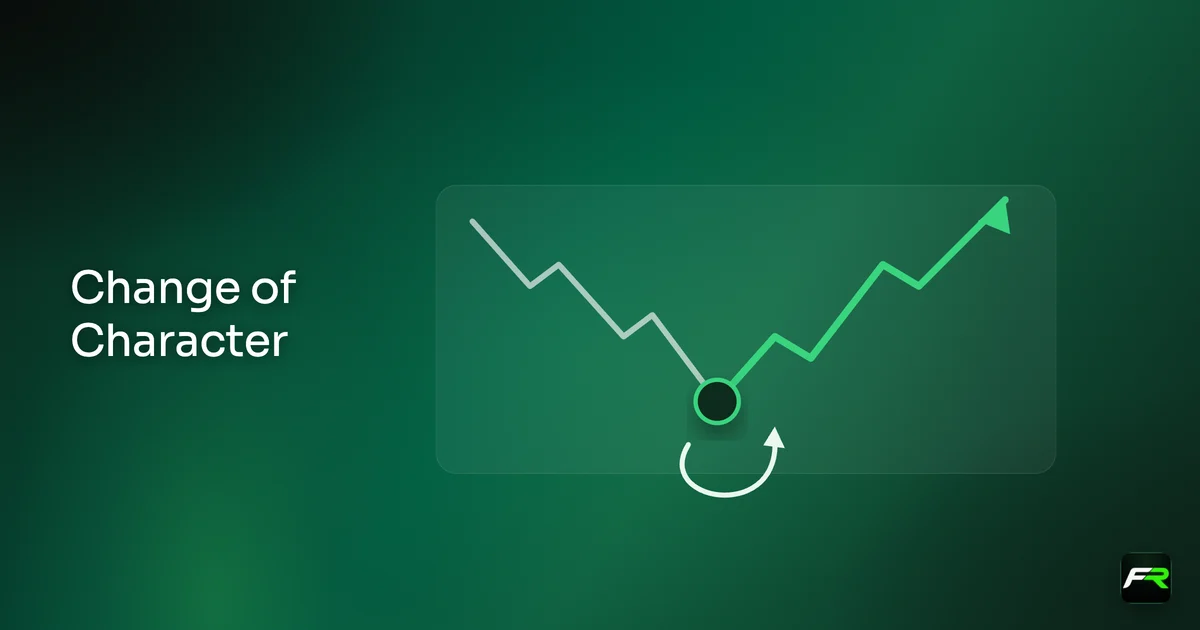
Change of character, shortened to CHoCH, is the first structural signal that a trend may be reversing. It happens when price breaks the swing point that was protecting the trend, a break below the last higher low in an uptrend, or above the last lower high in a downtrend, rather than the swing point in the trend’s own direction. A bullish CHoCH marks the possible start of a shift from a downtrend to an uptrend. A bearish CHoCH marks the possible start of a shift from an uptrend to a downtrend.
It’s an early warning, not a confirmed reversal. Reading a CHoCH the moment it happens and treating it as proof the trend has flipped is one of the more common ways traders get caught on the wrong side of a fakeout, since price often needs a follow-through move, a retest, or a second structural break before the reversal actually holds.

What Makes a CHoCH Different From a Reversal Pattern
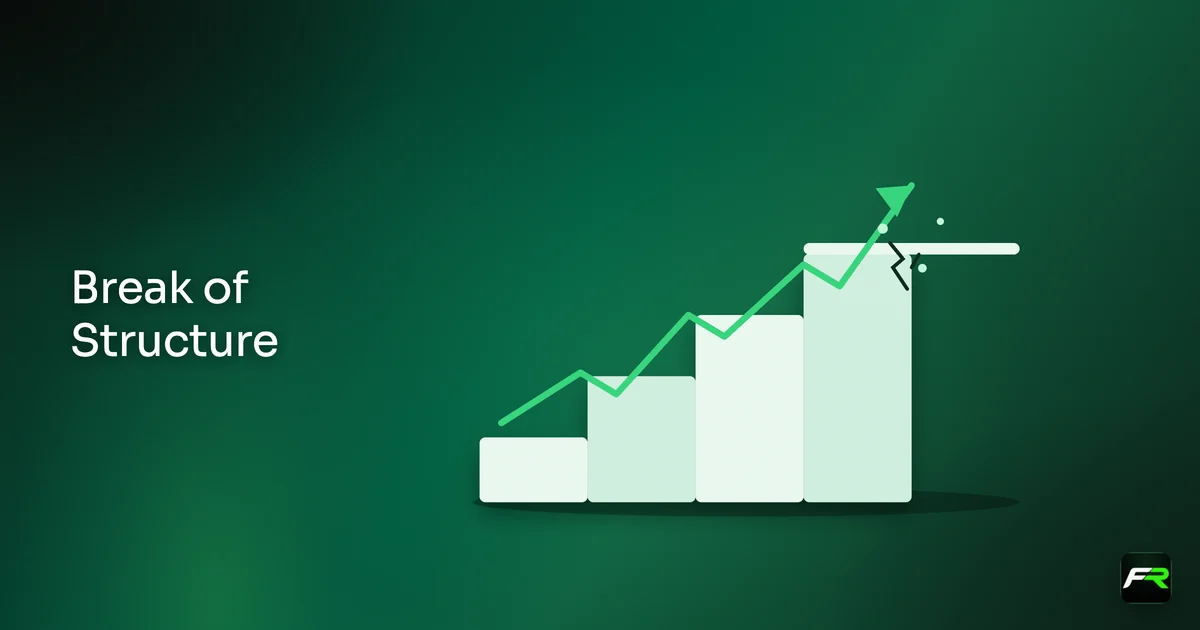
CHoCH isn’t the same thing as classic reversal patterns like a head and shoulders or a double top, even though it’s describing a similar idea from a different angle. Those patterns are defined by their shape. CHoCH is defined purely by which specific swing point gets broken and in which direction, with no requirement for a particular visual pattern to form first. That makes it a faster, more mechanical read: there’s no need to wait for a full pattern to complete, just a structural break of the correct level.
Bullish vs Bearish CHoCH
A bullish CHoCH happens during a downtrend. A downtrend is built from lower highs and lower lows. If price rallies and closes above the most recent lower high, rather than making a new lower low, that’s a bullish CHoCH: the first sign that sellers may be losing control.
A bearish CHoCH happens during an uptrend. An uptrend is built from higher highs and higher lows. If price drops and closes below the most recent higher low, rather than making a new higher high, that’s a bearish CHoCH: the first sign that buyers may be losing control.

A Worked Example
Picture USD/CAD in a clear downtrend: a lower high at 1.3720, a lower low at 1.3650, another lower high at 1.3690, another lower low at 1.3600. That’s the sequence defining the downtrend.
Now say price rallies from 1.3600 and, instead of stalling below 1.3690 (the last lower high) and rolling over into a new lower low, it closes above 1.3690 at 1.3705. That close above the protected lower high is a bullish CHoCH. It doesn’t confirm a new uptrend by itself, but it’s the signal that tells a trader to stop looking for short continuation setups and start watching for confirmation of a shift.
Filtering Fake CHoCH Signals
• The break needs a clean candle close beyond the correct swing point, not a wick.
• The swing point broken should be a genuine, recent structural point, not a random minor fluctuation mistaken for one.
• Ideally, the break follows a liquidity sweep of the level it’s breaking, rather than happening as the very first test of that level.
• A CHoCH on a lower timeframe that isn’t supported by anything unusual on the higher timeframe is more likely to be internal noise inside an ongoing pullback than a genuine reversal signal.
• Waiting for a retest of the broken level, now acting as support or resistance from the new side, adds confirmation before committing size to the new direction.
CHoCH vs BOS
| Signal | What Breaks | What Usually Happens Next |
| BOS | Swing point in the trend’s own direction | Trend continues; traders look for pullback entries in that direction |
| CHoCH | Swing point protecting the trend | Traders stop trend-following entries and watch for a new structure to confirm |
Internal vs External CHoCH
The same internal versus external distinction that applies to BOS applies to CHoCH. An internal CHoCH breaks a minor swing point, often visible only on a lower timeframe inside a single leg of the larger trend, and usually reflects a short pause or pullback rather than a genuine reversal. An external CHoCH breaks a major swing point visible on the higher timeframe used for bias, and carries far more weight as an actual signal that the dominant trend may be turning.
Some traders use the term market structure shift (MSS) specifically for this external case, treating it as a distinct, higher-conviction event compared to a routine internal CHoCH.
Confirming a CHoCH With Confluence
A CHoCH on its own is a warning, not a trade signal. Traders typically wait for one or more additional confirmations before acting on it: a fair value gap forming during the reversal move that price can pull back into, an order block sitting at the point of the break, or a liquidity sweep of the level just before the CHoCH occurred. A CHoCH that lines up with several of these at once is generally treated as more reliable than one appearing in isolation with nothing else supporting it.
People’s Most Asked
What does CHoCH mean in trading?
Change of character. It’s the break of the swing point protecting the current trend, the first structural sign the trend may be reversing.
Is CHoCH the same as a trend reversal?
Not automatically. A CHoCH is an early warning that the trend may be turning, but it needs follow-through, often a retest of the broken level or a subsequent BOS in the new direction, before the reversal is considered confirmed.
What is the difference between CHoCH and BOS?
BOS breaks a swing point in the direction the trend is already moving, confirming continuation. CHoCH breaks the swing point protecting the trend, in the opposite direction, and signals a possible reversal.
Can CHoCH happen on any timeframe?
Yes, though CHoCH on higher timeframes generally carries more weight than on lower ones. A CHoCH on a fifteen-minute chart can simply be noise inside a larger pullback on the daily chart.
What confirms a CHoCH is genuine rather than a fakeout?
A clean candle close beyond the correct swing point, ideally following a liquidity sweep of that level, plus confluence from an order block or fair value gap and a retest of the broken level before the new direction is trusted.

Is the Quasimodo pattern the same as CHoCH?
They describe closely related ideas from different trading traditions. The Quasimodo pattern is an older price action pattern built around a similar structural failure, and much of what CHoCH describes overlaps with it, though CHoCH comes from SMC and ICT terminology specifically.
Final Word
CHoCH gives you a precise, structural way to catch the earliest sign that a trend might be turning, before the reversal is obvious to everyone watching a moving average cross. Treat it as the start of a question rather than the answer. Wait for the confirmation, the retest, the confluence, the follow-through, and CHoCH becomes a genuinely useful early warning system instead of another signal that gets traded a step too early.
The team behind this guide
Researched, checked and approved by five forex specialists
Every guide is written, fact-checked and edited before it goes live, and updated when the facts change. Spotted an error? Tell us.
Related Articles
 Education
12 min read
Education
12 min read

 Education
7 min read
Education
7 min read
 Education
13 min read
Education
13 min read
 Education
3 min read
Education
3 min read
 Education
9 min read
Education
9 min read
 Education
7 min read
Education
7 min read