 IC Markets
































Forex Trading for Beginners: The Core Concepts
How the forex market works: currency pairs, leverage, market hours, free resources, and a step-by-step path to your first trade.
 WriterAbir KhanWriterWrites the guides · checks every figure against primary sources View profileAbout Abir →
 Market analysisTanbir Habib RiyadForex & Crypto AnalystForex and crypto analyst · technical and fundamental analysis View profileAbout Tanbir →
 Fact-checking & riskJannatul FerdaushFact-Checker & Risk AnalystFact-checks every figure · risk analysis · Applied Statistics, University of Dhaka View profileAbout Jannatul →
 Trading reviewJowel RanaCo-Founder & Forex TraderCo-founder · forex trader · reviews guides from a trader's view View profileAbout Jowel →
 Final approvalRanjan NiskrityFounder, Owner & Forex TraderFounder and owner · forex trader · signs off every guide View profileAbout Ranjan →
The Forex market isn’t a physical building or a central stock exchange. Instead, it’s a massive global network where banks, governments, and everyday people buy and sell currencies directly with each other. It’s where the world’s money flows, silently, every single second. Think of it as the ultimate engine of global business and the quiet force that determines how much your next holiday abroad will actually cost.
Governments, banks, businesses, and travelers are always somewhere buying and selling currencies, shifting their relative values by tiny fractions with every transaction.
Even small everyday price movements, just a few pennies here and there, can shift billions of dollars across the global system. In this beginner’s guide, we’ll break down what Forex actually is and how it works. You’ll also discover the best places to learn, the tools and apps you actually need, and how to practice safely without risking a single penny of your real money.
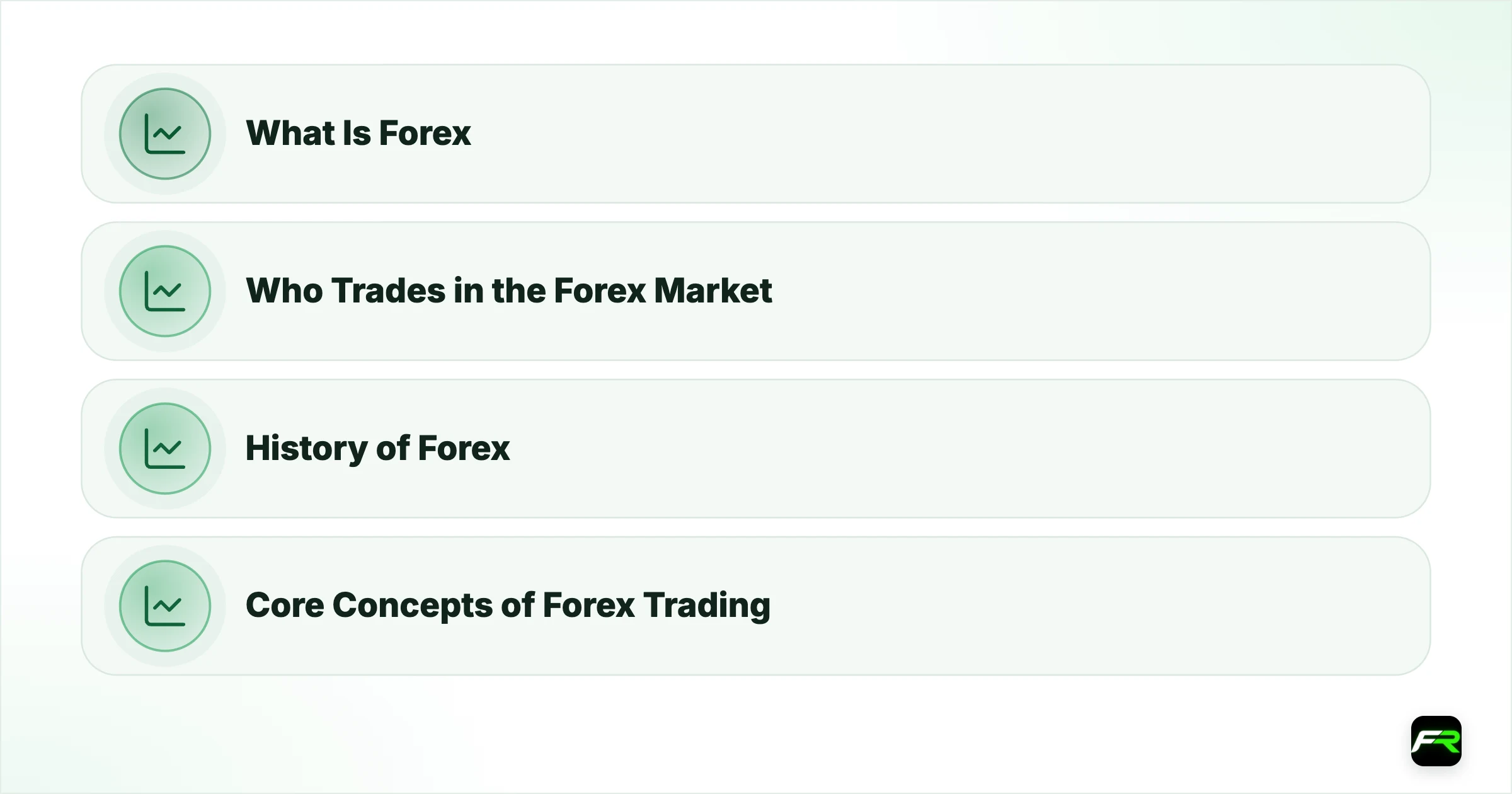
What Is Forex?
The foreign exchange market or Forex is the biggest financial market on the planet. It runs non-stop, five days a week, with no official opening bell, no central headquarters, and no single boss running the show. Instead, the whole thing happens entirely online through a massive global network of banks, brokers, and everyday traders.
When you travel or shop online from another country, you exchange money.
Across the globe, these trades add up to over $9.6 trillion a day. To put that in perspective, the Forex market is vastly bigger than all the world’s stock markets combined.
How Forex Trading Works: A Simple EUR/USD Example
Let’s say a company in the US wants to buy parts from a supplier in Germany. There’s one problem. The German supplier wants to be paid in Euros, but the US company only has Dollars.
So what happens? The US company goes to the Forex market and trades its Dollars for Euros. That’s it. That’s a real Forex trade happening right there.
Now here’s where it gets interesting.
If the Euro becomes stronger, those same German parts get more expensive. The US company now needs more Dollars to pay for the exact same order. But if the Euro gets weaker? The order becomes cheaper.
This is exactly how Forex traders make money. They try to predict these price moves. Buy a currency when it’s cheap, sell it when it’s worth more, and keep the difference as profit.
Who Trades in the Forex Market?
First, there are central banks. Every country has one. In the US it’s the Federal Reserve. These banks decide interest rates, and their decisions can make a country’s currency stronger or weaker.
Next are the big commercial banks. Think of names like JPMorgan or HSBC. They move money between countries for their customers, and they also trade huge amounts to make profit for themselves.
Then you have regular businesses. Imagine a US company buying phones from Japan. It has to pay in Japanese Yen, so it swaps Dollars for Yen. That’s a currency trade, even if the company doesn’t think of it that way.
Then there’s people like you and me. We’re called retail traders. That just means individuals trading from home with a phone or laptop, trying to make money when currency prices move.
And here’s a fun one. Even a tourist changing Dollars into Euros at the airport is doing a tiny currency exchange. So in a way, almost everyone has touched this market at some point.
Now the best part. When you start trading Forex, you’re trading in the exact same market as the big banks and governments. Your trades will be much smaller, of course. But the market itself is the same one they use.
History of Forex
People have been trading currencies for hundreds of years. Before the internet, traders exchanged gold and goods between countries.
Since then, money has gone through three big stages:
- The gold standard. Every country tied its money to gold. Paper money was basically a receipt for real gold.
- The Bretton Woods system (1944). After World War II, most currencies were tied to the US Dollar, and the Dollar was backed by gold. The Dollar became the center of the money world.
- Free floating (1971). The old system collapsed. From then on, no gold and no fixed rates. Currency prices moved based on supply and demand alone. More buyers means the price goes up. More sellers means it goes down.
That last change created the Forex market we have today.
Then the internet made it huge. Now anyone with a phone or laptop can trade currencies from home. And since the market reacts to news, one economic report or one surprise political event can move prices in seconds.
Core Concepts of Forex Trading
Before you place your first trade, there are a few key terms and concepts you need to understand. Don’t worry, none of them are hard. But if you skip them now, they’ll cost you real money later.
Currency Pairs
In Forex, you never trade just one currency. You always trade two at the same time. These are called currency pairs.
Take EUR/USD, the most popular pair in the world. It has two parts:
- The base currency is the first one (EUR). This is the currency you’re actually buying or selling.
- The quote currency is the second one (USD). This is what you pay with.
The exchange rate simply tells you how much of the quote currency you need to buy one unit of the base currency.
So if EUR/USD is 1.10, it means 1 Euro costs 1.10 Dollars. That’s it.
Now that you know EUR/USD at 1.10 means one Euro costs 1.10 Dollars, here’s the next step. What does it mean to buy or sell a pair?
- Buying EUR/USD means you’re buying Euros and selling Dollars at the same time. You do this when you think the Euro will get stronger.
- Selling EUR/USD means the opposite. You’re selling Euros and buying Dollars, because you think the Euro will get weaker.
Every trade works this way. You’re always betting one currency will do better than the other. Learning how to read forex quotes is one of the first skills worth building.
Now, not all currency pairs are the same. They come in three types:
- Major pairs. The most traded pairs in the world, and they all include the US Dollar. Examples: EUR/USD, GBP/USD, USD/JPY.
- Minor pairs. Pairs that don’t include the US Dollar. Example: EUR/GBP.
- Exotic pairs. A major currency paired with one from a smaller economy. Examples: USD/TRY (Turkish Lira) or USD/ZAR (South African Rand).
If you’re just starting out, stick to major pairs. They have tons of buyers and sellers, so trading costs are lower and it’s easy to find news and analysis about them. Exotic pairs might look exciting, but they’re more expensive to trade and can move wildly.
Pips
A pip is the smallest standard move a currency pair can make. Think of it as the “unit” traders use to count price changes.
For most pairs, a pip is the fourth number after the decimal point.
So if EUR/USD moves from 1.1050 to 1.1051, that’s one pip. If it moves from 1.1050 to 1.1060, that’s ten pips.
There’s one exception worth knowing. In pairs with the Japanese Yen, like USD/JPY, a pip is the second decimal place instead. So a move from 150.20 to 150.21 is one pip.
Why do pips matter so much? Two reasons:
- They measure your profit and loss. Traders don’t say “I made 50 dollars.” They say “I made 50 pips,” because the dollar value depends on your trade size.
- They help you control risk. Once you know what one pip is worth for your trade size, you can calculate exactly how much you could lose before you ever click the buy button.
Bid Price, Ask Price, and the Spread
Every currency pair always has two prices at the same time. These are called the bid and the ask.
- The bid is the price you can sell at.
- The ask is the price you can buy at.
The ask is always slightly higher than the bid. That small gap between the two is called the spread.
Here’s a simple way to think about it. It works just like a money exchange shop at the airport. They buy your Dollars at one price and sell Dollars at a slightly higher price. The difference is how they make money.
Forex brokers do the same thing. The spread is how most brokers get paid. You don’t see a separate fee, but every time you open a trade, you start slightly in the negative because of the spread.
For example, if EUR/USD shows a bid of 1.1050 and an ask of 1.1052, the spread is 2 pips. That’s your cost for the trade.
Why should you care? The smaller the spread, the less each trade costs you. This matters a lot if you plan to trade often, because those small costs add up fast.
Borrowing Capital to Trade: How Leverage and Margin Work
Leverage is like borrowing power from your broker. It lets you control a trade much bigger than the money in your account.
With 100:1 leverage, every $1 of yours controls $100 in the market. So a $100 deposit lets you open a $10,000 trade.
Sounds amazing, right? Here’s the catch.
Leverage multiplies everything. Your profits, but also your losses. If that $10,000 trade moves just 1% in your favor, you make $100 and double your money. But if it moves 1% against you, you lose $100. Your entire account. Gone from a 1% move.
This is why leverage is the number one reason new traders blow their accounts. It’s a powerful tool, but you need to respect it before touching a live account.
Now, leverage and margin go hand in hand.
Margin is the money your broker locks up as a security deposit while your leveraged trade is open. In the example above, that $100 is your margin. It’s still your money, you just can’t use it for anything else while the trade is running.
Here’s the part every beginner needs to know. If your trade goes against you badly enough, your broker won’t wait for your permission. It closes your trade automatically to make sure you don’t lose more than what’s in your account. This is called a margin call, and it’s one of the most painful surprises in trading.
Understand these two things properly, and you’ve already avoided the mistake that wipes out most beginners.
Lot Sizes
In Forex, you can’t just buy “some” Euros. Trades come in fixed sizes called lots.
There are three main sizes:
- Standard lot = 100,000 units of the base currency
- Mini lot = 10,000 units
- Micro lot = 1,000 units
Remember how we said pip value depends on your trade size? This is where it comes together. On EUR/USD, one pip is worth about $10 on a standard lot, $1 on a mini lot, and just 10 cents on a micro lot.
That’s why micro lots are the perfect starting point for new traders. If the market moves 50 pips against you, that’s a $5 loss on a micro lot. Painful? A little. But on a standard lot, that same move costs you $500.
Start small. Learn with micro lots while your mistakes are still cheap. You can always trade bigger later, once you actually know what you’re doing.
How the Forex Market Runs 24 Hours a Day
Ever wonder why the Forex market never closes during the week? It’s because when banks in one part of the world go home, banks in another part are just waking up.
The market runs through three main trading sessions that follow the sun around the globe:
- The Asian session (Tokyo) starts first, around midnight GMT.
- The London session opens a few hours later, while Asia is still finishing up.
- The New York session opens while London is still active.
Because the sessions overlap, the market never stops from Monday to Friday. Someone, somewhere, is always trading.
Now here’s the part that actually matters for you. Not all hours are equal.
The busiest time of day is when London and New York are open at the same time. That’s roughly 1 PM to 5 PM GMT. During this window, the most money is flowing, prices move the most, and trading costs drop because spreads get smaller.
That’s exactly why day traders love this window. More movement means more opportunity.
The quiet hours have their place too. When the market is slow, it’s a calmer environment to practice in. But if you’re looking for action, the London and New York overlap is where it happens.
How to Learn Forex Trading for Free
One of the first questions every new trader asks is: “Do I need to pay for a course to learn Forex?”
Short answer: no.
There’s a huge amount of free material out there, and it covers everything you need. The basics, chart reading, risk management, even trading psychology. And here’s the surprising part. Some of the free stuff is actually better than the paid courses people charge hundreds of dollars for.
BabyPips School of Pipsology
If you only bookmark one free resource, make it BabyPips’ School of Pipsology. Ask any experienced trader where to start, and this is the answer you’ll hear most often.
Think of it as a full school, but for Forex. The course is split into levels, just like grades in school, starting from “what is a pip?” all the way up to chart analysis and trading psychology.
The best part is that it assumes you know absolutely nothing. Every lesson is written in plain, simple English, with jokes and cartoons that keep even the dry topics fun. After each section there’s a short quiz, so you can check that things actually stuck before you move on.
And it’s completely free and self-paced. No deadlines, no pressure. Ten minutes a day is enough.
Honestly, this course alone covers more than most paid ones. Work through it slowly and you’ll be ahead of the average beginner.
FX Academy
Not everyone loves reading long lessons. If you’d rather watch and learn, FX Academy is made for you.
It’s a full video-based course built by real, experienced traders. The lessons are interactive, and each one ends with a short quiz to make sure the ideas actually stuck before you move to the next one.
And just like BabyPips, it costs nothing. No trial, no locked lessons, the whole thing is free.
One more thing worth knowing. The course gets updated regularly, so you’re not learning from dusty videos recorded ten years ago. That matters in a market that changes as fast as Forex.
Broker Education Centres
Here’s something many beginners don’t realize. Some of the best free education comes from the brokers themselves. Most regulated brokers will give you full access to their learning platforms just for opening an account, even a free demo account.
IG Academy offers structured courses sorted by experience level, so you always know what to learn next instead of jumping around randomly.
FOREX.com has a learning centre packed with recorded webinars. It also tracks your progress and includes quizzes, so it feels more like an actual course than a pile of articles.
AvaTrade’s AvaAcademy has over 100 lessons, and you can choose how you learn them. Watch the videos, read the written versions, or go through the interactive exercises. Whatever suits you.
The real magic here is the combination. Learn a concept in a lesson, then immediately try it on your demo account with fake money. Reading about a stop loss is one thing. Placing one yourself, even a practice one, is when it actually sticks.
YouTube and Udemy
YouTube is a goldmine for free Forex content. You’ll find everything from complete beginner courses to breakdowns of specific strategies, all without paying a cent.
But there’s a catch, and it’s a big one. Quality is all over the place.
For every genuine teacher, there are ten “gurus” posting videos from rented Lamborghinis, selling a dream instead of teaching a skill. Here’s a simple rule to filter them out. Look for traders who show their real, documented results, and skip anyone whose channel is more about their lifestyle than their charts. If the thumbnail screams money, the video probably won’t teach you how to make it.
Udemy is worth a look too. Forex courses there go on deep discount all the time, and some are completely free. A good beginner course on Udemy usually includes recorded live trading sessions, which are gold for a new trader. Watching someone place real trades in real market conditions connects the theory to reality in a way no article can.
Forex Trading Books for Beginners
Don’t sleep on books. They might feel old school next to videos, but they have one big advantage. You move at your own pace, and when something doesn’t click, you just read it again. No rewinding, no scrubbing through a video to find that one part.
Two books come up again and again when traders talk about where to start:
‘Currency Trading for Dummies’ by Brian Dolan. Ignore the title, there’s no shame in it. This book explains the practical basics in plain English and is probably the fastest way to build a solid foundation.
‘Trading in the Zone’ by Mark Douglas. This one is about the side of trading nobody warns you about: your own mind. Fear, greed, revenge trading after a loss. Most courses skip psychology completely, but ask any experienced trader and they’ll tell you the mental game is what separates winners from losers.
Forex Trading Apps Worth Using as a Beginner
Type “forex app” into any app store and you’ll get flooded with hundreds of options. It’s overwhelming. But here’s the secret. Almost every app falls into one of just three groups:
- Broker apps, where you actually place trades with real money
- Charting apps, where you study price movements and plan your trades
- Practice apps, where you trade with fake money and zero risk
Here’s the mistake most beginners make. They look for one perfect app that does everything. That app doesn’t exist. Even professional traders use a combination.
The smarter move is to pick one app from each group. Chart on one, practice on another, and eventually trade on the third. Think of it like a toolbox. You don’t need one magic tool, you need the right three.
MetaTrader 4 and MetaTrader 5
Ask any Forex trader which platform they use, and you’ll almost always hear one of two names: MT4 or MT5. Short for MetaTrader 4 and MetaTrader 5, these are the most popular trading platforms in the world, and both have free mobile apps for Android and iOS.
So which one should you pick? Comparing MT4 and MT5 in detail helps, but here’s the short version.
MT4 is the older, simpler one. Fewer buttons, cleaner layout, easier to find your way around. That simplicity is exactly why many beginners start here.
MT5 is the newer, more powerful one. It gives you more timeframes to view charts, lets you trade more than just currencies, and comes with a better tool for testing strategies. The trade-off is that it can feel a bit crowded when you’re brand new.
A quick note: despite the names, MT5 isn’t an upgrade that replaced MT4. They’re two different platforms that both remain hugely popular. You can’t go wrong with either.
And here’s the best part for a beginner. Both apps let you open a demo account in minutes, straight from your phone. You get live, real-time market prices, but you trade with fake money. It’s the safest way to get a feel for real trading without risking a single dollar.
eToro
If MT4 feels a bit like a cockpit full of switches, eToro is the opposite. It’s one of the most beginner-friendly broker apps out there, with a clean, modern layout that feels more like a social media app than a trading terminal.
A few things make it easy to start with. You can open a live account with as little as $10, though the minimum deposit varies depending on your country. And before you risk anything at all, you get a demo account loaded with $100,000 in virtual money to practice with.
But eToro’s most famous feature is copy trading. It does exactly what it sounds like. You pick an experienced trader, and the app automatically copies their trades in your account.
For a beginner, the real value here isn’t the profits. It’s the learning. You get to watch, in real time, how experienced traders enter positions, how big their trades are, and when they take profits or cut losses. It’s like looking over the shoulder of someone who’s been doing this for years.
One honest warning though. Copy trading is not a shortcut to easy money. Even experienced traders lose, and a trader who did great last year can have a terrible run this year. Use it as a classroom, not a money machine.
TradingView
If eToro is where beginners trade, TradingView is where traders of every level stare at charts. It started as a simple charting website and has grown into one of the best analysis tools you can carry in your pocket.
The app lets you pull up live Forex charts for any currency pair and apply technical indicators to them. Indicators are basically visual tools that help you spot patterns and trends in price movements. We won’t go deep on them here, just know this is the app where you’ll use them.
It also has a feature called paper trading. Fancy name, simple idea. You place pretend trades on real, live prices, and the app tracks how you would have done. No account needed with any broker, no money at risk. Just you testing your ideas against the actual market.
But my favorite part for beginners is the community section. Traders from all over the world post their chart analysis publicly, marked up with their predictions and reasoning. You can literally see how someone with ten years of experience reads the exact same chart you’re looking at. You won’t agree with all of it, and not everyone posting is good, but as a free education in how traders think, it’s hard to beat.
How to Learn Forex Step by Step
How long does it take to go from complete beginner to placing your first real trade? For most people, somewhere between one and three months of consistent learning. Not one weekend, like some YouTube gurus promise. But not years either.
Here’s the exact path, stage by stage. It skips the shortcuts that feel faster now but cost real money later. And if you want more detail on the very first steps, there’s a full guide on starting out in Forex as a beginner.
Stage 1: Build the Foundation (Weeks 1 to 2)
For the first two weeks, your only job is to learn. No trading. Not even demo trading.
Get comfortable with the basics: what currency pairs are, what pips measure, how the spread works, and what leverage really does to a trade. BabyPips or FX Academy will cover all of this.
Think of it like learning the rules before playing the game. You wouldn’t sit at a poker table without knowing what beats what. Same idea here. Learn the language of Forex first, and the charts will make far more sense when you get to them.
Stage 2: Learn to Read Charts (Weeks 2 to 4)
Once the basics feel comfortable, it’s time to learn how to read charts.
Start with candlestick charts. They look intimidating at first, but they pack more information into one glance than any other chart type, which is why professional traders use them as the standard.
Focus on three skills. Spotting support and resistance, which are the price levels where the market tends to bounce or stall. Reading trend direction, meaning whether the price is generally climbing or falling. And recognizing a few basic candlestick patterns.
After that, add just one or two indicators, like a moving average and the RSI. And here’s the important part. Understand what each one actually measures before you trust it. An indicator you don’t understand is just a pretty line on your screen.
Stage 3: Open a Free Demo Account (Weeks 3 to 6)
Now the fun begins. A free demo account lets you place real trades on live market prices, but with virtual money. The experience is identical to real trading. The only difference is that your mistakes cost nothing. And trust me, you will make mistakes. That’s the point.
Three tips to get the most out of your demo:
- Use the same platform you plan to trade live on, so you’re building muscle memory that transfers.
- Trade the same pairs you plan to trade with real money.
- Set your demo balance to match your real planned deposit. Practicing with a fake $100,000 teaches you nothing about trading a real $500 account.
And give it time. At least four to six weeks of consistent demo trading before you even think about going live. That’s not being overly careful. Bad habits formed on demo become expensive habits on a live account.
Stage 4: Build a Strategy and Test It
While you’re on demo, start building your own trading strategy.
A strategy is just a set of rules you write down and follow. When exactly do you enter a trade? Where does your stop-loss go? Where do you take profit? How much of your account do you risk on one trade? If you can’t answer these before clicking buy, you’re not trading. You’re guessing.
This is also where risk management starts, from your very first demo trade. The golden rule is simple. Never risk more than 1 to 2 percent of your account on a single trade. And always, always use stop-loss and take-profit orders so one bad trade can’t wreck your account.
You can also use forex signals during this stage. Not to blindly copy, but to compare. Seeing how experienced traders read the same market you’re watching is a great way to check your own thinking.
Stage 5: Pick a Broker and Account Type
Before any real money moves, do your homework on brokers. Find a well-regulated broker that offers the platform you’ve been practicing on, low trading costs, and a minimum deposit that fits your budget. Regulation is the non-negotiable part. It’s what protects your money.
Then look at the different account types. Standard, ECN, micro. They differ in costs and minimum trade sizes, but here’s the simple version for now. Start with a micro or mini account. It keeps your trades small while you get used to the strange new feeling of real money moving on your screen.
Stage 6: Go Live with a Small Deposit
Here’s the rule for your first deposit. Only put in an amount you could lose completely without it hurting your life.
That’s not because you’re expected to lose it. It’s about your head. If you deposit rent money, fear will control every decision you make, and scared traders make terrible traders. When the money genuinely doesn’t scare you, you can actually follow your plan.
Start with micro lots. Stick to the strategy you tested on demo. And treat your entire first month of live trading as the last stage of school, not a money-making operation. The profits can come later. Right now, your only job is to trade real money without abandoning everything you learned.
Mistakes That Cost New Traders the Most
Here’s some good news hidden in bad news. Most beginners lose money on the same handful of mistakes. Which means if you know them in advance, you can simply avoid them.
Mistake 1: Trading without a plan. This is the big one. Every trade needs a reason to enter, a stop-loss, and a profit target, all decided before you click buy. “It feels like it’s going up” is not a plan. “Some guy on a forum said so” is definitely not a plan. If you can’t explain why you’re entering a trade, don’t enter it.
Mistake 2: Skipping the stop-loss. A stop-loss is not optional. It’s your seatbelt. Its whole job is to make sure one bad trade can’t destroy your account. The classic beginner story goes like this. A trade goes into loss, the trader removes the stop because “it will come back,” and the small loss quietly grows into the account-killing loss the stop was there to prevent. Don’t be that story.
Mistake 3: Letting emotions take the wheel. Fear and greed are the two thieves of trading. Fear makes you close winning trades too early. Greed, or the hope of a comeback, makes you hold losing trades way too long. Notice something? That’s the exact opposite of what good trading requires. Emotions also lead to overtrading, taking trade after trade with no real reason, which just multiplies the damage.
Mistake 4: Rushing to real money. This one quietly costs more than all the others. Skipping education and demo practice because you’re excited to make “real profits” is like skipping driving lessons because you’re excited to drive. In the end, the traders who improve aren’t the smartest ones. They’re the disciplined, patient ones who kept learning.
The team behind this guide
Researched, checked and approved by five forex specialists
Every guide is written, fact-checked and edited before it goes live, and updated when the facts change. Spotted an error? Tell us.
Related Articles
 Education
8 min read
Education
8 min read

 Education
7 min read
Education
7 min read
 Education
23 min read
Education
23 min read
 Education
7 min read
Education
7 min read
 Education
9 min read
Education
9 min read
 Education
7 min read
Education
7 min read