 IC Markets





































Break of Structure (BOS) for Forex Traders
A break of structure is price pushing past a recent high or low, signalling the trend may continue. How to spot it and avoid false breaks.
 WriterAbir KhanWriterWrites the guides · checks every figure against primary sources View profileAbout Abir →
 Market analysisTanbir Habib RiyadForex & Crypto AnalystForex and crypto analyst · technical and fundamental analysis View profileAbout Tanbir →
 Fact-checking & riskJannatul FerdaushFact-Checker & Risk AnalystFact-checks every figure · risk analysis · Applied Statistics, University of Dhaka View profileAbout Jannatul →
 Trading reviewJowel RanaCo-Founder & Forex TraderCo-founder · forex trader · reviews guides from a trader's view View profileAbout Jowel →
 Final approvalRanjan NiskrityFounder, Owner & Forex TraderFounder and owner · forex trader · signs off every guide View profileAbout Ranjan →

A break of structure (BOS) happens when price closes beyond the most recent swing high, in an uptrend, or swing low, in a downtrend, confirming that the existing trend is still in control. It’s a continuation signal, not a reversal one: a bullish BOS tells you buyers are still driving the move, and a bearish BOS tells you sellers are.
The rule that actually matters when reading one is the close, not the wick. A candle that spikes through a swing high on a long wick and closes back below it hasn’t produced a BOS. It’s produced a stop hunt.
What Counts as a Valid BOS
Three conditions separate a real break of structure from a candle that merely touched a level. First, price needs to close beyond the swing point, not just wick through it. Second, the close should hold, meaning the next candle or two doesn’t immediately reverse back through the level as if nothing happened. Third, the move should happen in the direction of the existing trend; a break against the trend is a change of character (CHoCH), a different signal entirely.
BOS vs CHoCH
These two get confused constantly, so it’s worth being precise. A BOS breaks the swing point in the direction the trend is already moving, confirming continuation. A CHoCH breaks the swing point that was protecting the trend, the opposite direction, and signals a possible reversal. In an uptrend built from higher highs and higher lows, a break above the last higher high is a BOS. A break below the last higher low is a CHoCH.
Internal vs External BOS
Not every BOS carries the same weight, and the internal versus external distinction is where a lot of the confusion around this concept comes from.
External BOS breaks a major swing point, the kind visible on the timeframe used for directional bias, typically the four-hour or daily chart. It confirms the dominant trend and carries the most weight.
Internal BOS breaks a smaller swing point, usually visible only once you drop to a lower timeframe inside a single leg of the larger trend. It’s useful for fine-tuning entries and reading momentum inside a pullback, but on its own it says far less about the broader trend than an external BOS does.
BOS vs Market Structure Shift (MSS)
A related term worth separating out is a market structure shift, sometimes called MSB (market structure break). Where a BOS confirms the existing trend by breaking a swing point in that trend’s direction, an MSS breaks a major swing point against the trend, which functionally makes it an external CHoCH: a break of a higher-timeframe, higher-importance level rather than a small internal swing. The distinction matters because an MSS carries far more weight as a reversal signal than a minor internal CHoCH does, even though both technically fall under the same change of character umbrella.
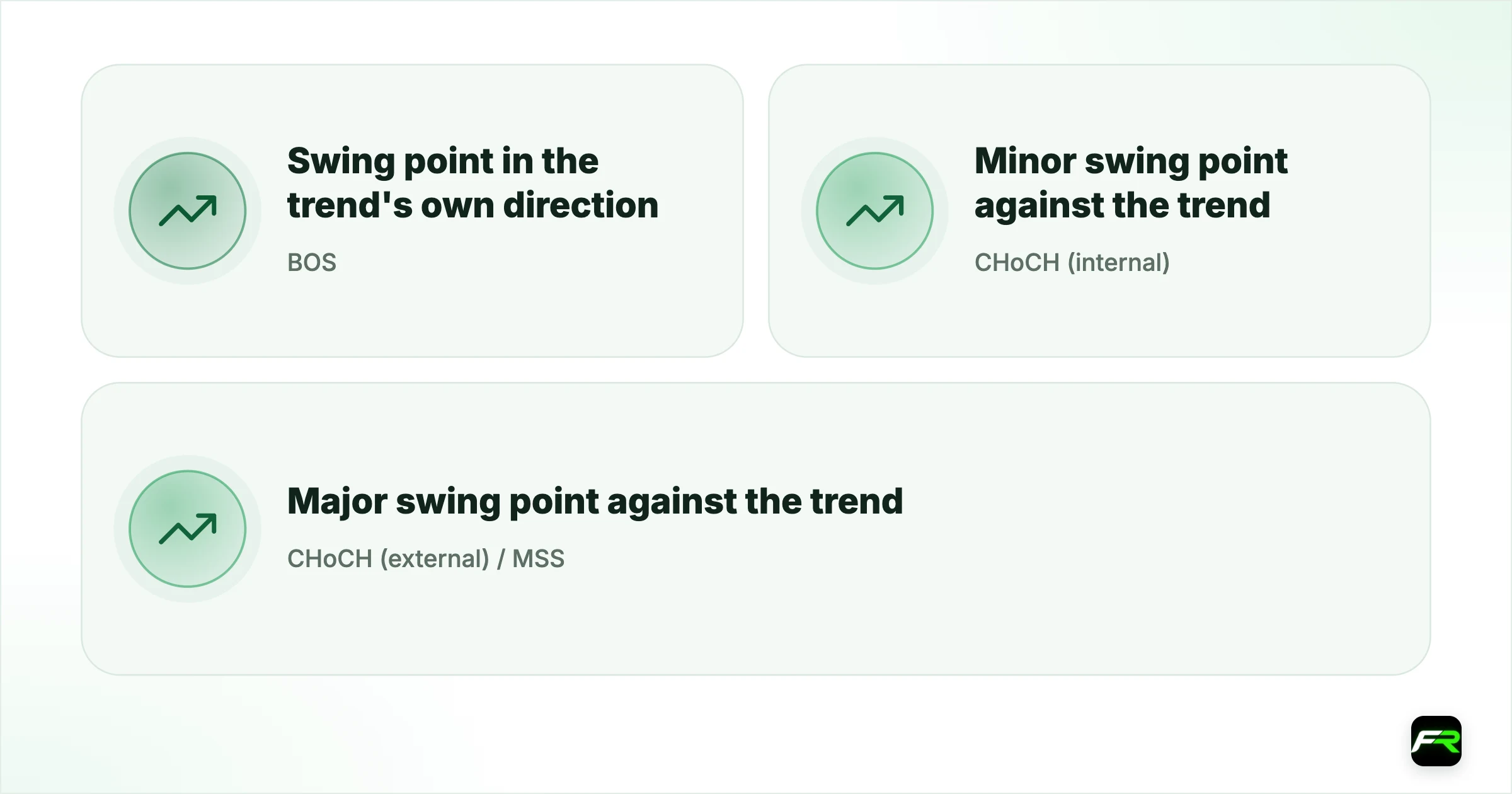
| Term | Breaks | Signals |
| BOS | Swing point in the trend’s own direction | Trend continuation |
| CHoCH (internal) | Minor swing point against the trend | Early warning, not full confirmation |
| CHoCH (external) / MSS | Major swing point against the trend | Higher-weight reversal signal |
Inducement: Why Some BOS Signals Fail
A common reason a BOS turns out weak or reverses quickly is missing inducement, the liquidity grab that typically precedes a genuine structural break. Before price commits to breaking a major swing point, it often first sweeps a smaller, more obvious level nearby, triggering the stops or pending orders clustered there, before making the real move.
A BOS that happens without that inducement sweep first is generally treated as a lower-quality signal, sometimes called a minor BOS, compared to one where the inducement got taken first. This is one of the more debated refinements in SMC-adjacent BOS trading, and not every trader applies it, but it’s common enough to be worth recognizing when it comes up.
A Worked Example
Picture AUD/USD trending up from 0.6520. Price rallies to a swing high at 0.6580, pulls back to 0.6545, then pushes higher again. If the next rally closes above 0.6580, say at 0.6595, and holds there for the next couple of candles, that’s a valid bullish BOS: a clean close beyond the prior swing high, in the direction of the existing uptrend.
Compare that to a candle that spikes to 0.6588 on a long upper wick, then closes back down at 0.6560. That’s not a BOS. It’s a failure to close beyond the level, the kind of wick that often signals a liquidity sweep rather than genuine continuation.
Multi-Timeframe BOS Reading
Reading structure on a single timeframe in isolation is one of the more common ways traders get whipsawed. A common approach: mark structure and BOS on the daily chart for overall bias, drop to the four-hour chart to confirm that bias is playing out there too, then use the one-hour or fifteen-minute chart to time the actual entry once a lower timeframe BOS or CHoCH lines up with the higher timeframe direction.
A BOS on a fifteen-minute chart that runs directly against the daily trend is usually treated as noise inside a pullback rather than a signal to trade against the larger structure.
Stop-Loss Placement Around a BOS
The structural level that produced the BOS gives a natural place for a stop. On a bullish BOS, that’s typically below the swing low the impulsive move started from, or below the swing high that just got broken, since that same level often flips into support on a retest. Placing a stop inside that range, rather than beyond it, risks getting stopped out on a normal retest that hasn’t actually invalidated the setup.
| Method | How It Works | Best For |
| Structure-based | Stop placed beyond the swing point that invalidates the setup | Most setups; ties risk directly to the trade idea |
| ATR-based | Stop set at 1.5 to 2x the Average True Range beyond entry | Adjusting for a pair’s normal volatility |
| Fixed pip | A set number of pips regardless of structure | Least preferred; only when sizing constraints require it |
People’s Most Asked
What is a break of structure in simple terms?
It’s a close beyond the most recent swing high (in an uptrend) or swing low (in a downtrend), confirming the current trend is continuing rather than reversing.
What is the difference between BOS and CHoCH?
BOS confirms trend continuation by breaking a swing point in the trend’s direction. CHoCH signals a possible reversal by breaking the swing point that was protecting the trend.
What is the difference between internal and external BOS?
External BOS breaks a major swing point visible on the higher timeframe used for bias, and confirms the broader trend. Internal BOS breaks a smaller swing point inside that trend, useful for entries but less significant on its own.
Does a wick count as a break of structure?
No. A valid BOS requires a candle close beyond the swing point. A wick that pokes through the level without a close beyond it is generally read as a liquidity sweep or stop hunt rather than a genuine break.
What is a market structure shift (MSS)?
It’s a break of a major swing point against the current trend, functionally an external CHoCH. It carries more weight as a reversal signal than a minor internal CHoCH.
Can BOS be used without Smart Money Concepts?
Yes. Reading swing highs and lows for trend continuation predates SMC and ICT terminology by decades, tracing back to Dow Theory and classical price action. SMC popularized the specific term and added concepts like inducement around it, but the core idea works as a standalone price action tool.
Final Word
A break of structure is one of the simpler concepts in price action trading to define and one of the easier ones to misuse. The signal only holds up when the close is clean, the direction matches the higher timeframe trend, and the level broken actually carries structural weight. Get those three things right and BOS becomes a reliable filter for staying on the right side of a trend instead of another line drawn on a chart after the fact.
The team behind this guide
Researched, checked and approved by five forex specialists
Every guide is written, fact-checked and edited before it goes live, and updated when the facts change. Spotted an error? Tell us.
Related Articles
 Education
9 min read
Education
9 min read

 Education
6 min read
Education
6 min read
 Education
7 min read
Education
7 min read
 Education
20 min read
Education
20 min read
 Education
9 min read
Education
9 min read
 Education
7 min read
Education
7 min read