 IC Markets























XM Spreads 2026
XM offers different spread structures across its account types, and your overall trading cost depends on the account you choose, the instrument, and current market conditions. The Ultra Low account combines relatively low spreads with no separate commission, making it a practical option for many traders who prefer simple pricing. We compared spread structures across popular instruments, reviewed major competitors, and explained how different account types may affect trading costs.




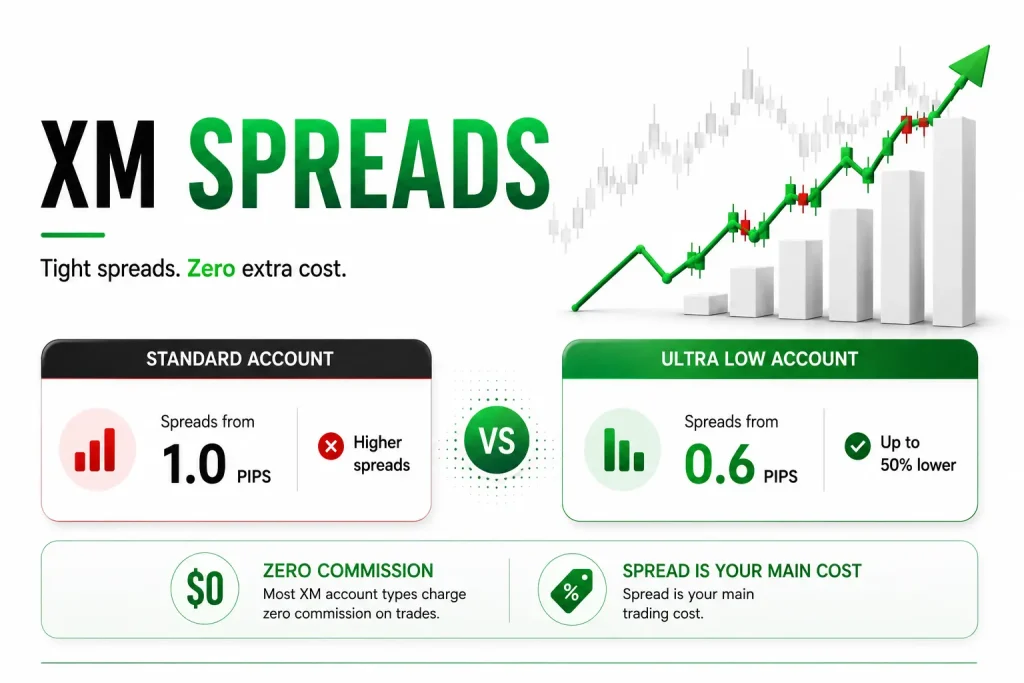
XM uses a floating spread model across all its account types. On the Standard and Micro accounts, EUR/USD spreads on Standard and Micro accounts are typically wider than XM’s lower-cost account options and do not include a separate trading commission. The Ultra Low account generally offers tighter spreads than the Standard account while remaining commission-free. The Zero account offers spreads from 0 pips together with commission-based pricing that can start from 0 pips on selected major pairs, with a separate commission charged per trade.. For a full breakdown of account differences beyond spreads, see our XM account types guide.
On a Standard account, the spread makes up a large part of the total trading cost for EUR/USD. On the Zero account, the total trading cost depends on the live spread plus the applicable commission. It combined spread and commission may result in a similar overall trading cost while offering a lower spread structure. For a broader look at the broker, our XM safety and legitimacy review covers regulation, trust, and the broader overview.
What Is a Spread and Why Does It Matter?
A spread is the gap between the price you can buy at (ask) and the price you can sell at (bid). Every time you open a trade, you start slightly in the red by the size of that spread. Your trade needs to move in your favour by at least the spread amount before you break even.
For most traders, spreads are one of the most common trading costs and have a direct impact on overall profitability. CCommissions appear as separate charges, while spreads are built into the price whenever you enter or exit a trade. If you place five trades a day on EUR/USD with a 1.6-pip spread, you are paying roughly $80 per day in spread costs on a standard lot. Over time, frequent trading with wider spreads can noticeably increase overall trading costs. Choosing the right account type can have a noticeable impact on your trading costs.
How XM Structures Its Spreads
XM uses floating spreads, meaning the gap between bid and ask moves with market conditions. Spreads are often at their narrowest during periods of higher market liquidity, such as the London-New York trading session overlap. During the Asian session or around major news releases, spreads widen.
XM offers different pricing structures across its account types, with spreads varying depending on the account selected, The Zero account uses a low-spread pricing model with a separate trading commission. The main difference is that Standard and Ultra Low accounts include trading costs within the spread, while the Zero Account combines spreads from 0 pips with a separate commission charge.
Spreads by Account Type
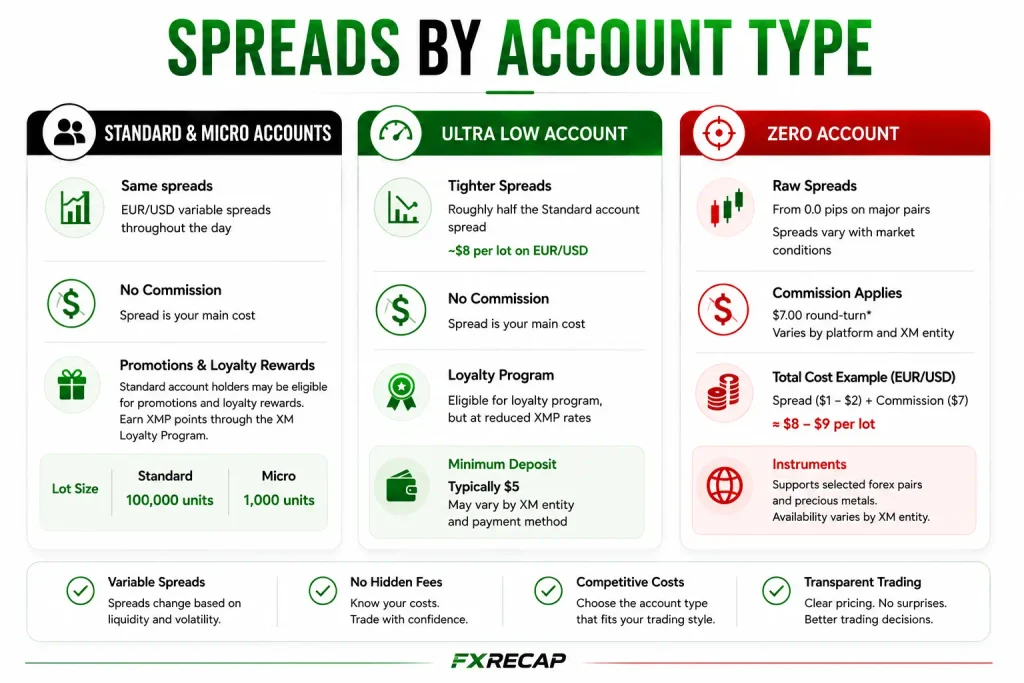
Standard and Micro Accounts
These two accounts share identical spreads. The only difference is lot sizing: Standard uses 100,000-unit lots, Micro uses 1,000-unit lots. EUR/USD spreads are variable and may change throughout the trading day depending on market liquidity and volatility. There is no commission on either account.
Depending on the country and XM entity serving the client, Standard account holders may be eligible for selected promotions and loyalty rewards. Loyalty rewards may help offset part of your overall trading costs, depending on how they are used. Eligible traders can earn XMP points through the XM Loyalty Program, with rewards varying according to their loyalty status and the programme’s current terms.. Some traders may view loyalty rewards as partially offsetting their overall trading expenses. Whether you consider that a genuine reduction depends on how you value bonus credit versus cash.
Ultra Low Account
The Ultra Low account provides tighter spreads than the Standard account while keeping trading costs commission-free. That is roughly half the Standard account spread, which translates to about $8 per lot on EUR/USD versus $16. For active traders, lower spreads may help reduce overall trading costs over time. One thing to consider is: Ultra Low accounts are not eligible for the deposit bonus. They do qualify for the loyalty programme, but at reduced XMP rates. The minimum deposit is typically $5, although it may vary depending on the XM entity and payment method. For details on how to fund it, see our XM minimum deposit breakdown.
Zero Account
The Zero account offers raw spreads from 0.0 pips on major forex pairs. Spread levels fluctuate throughout the trading day based on market liquidity and trading activity. However XM charges a commission on Zero accounts. The commission structure depends on the trading platform and the XM entity serving your account, so $7.00 for a complete round-trip trade.
In practice, the combined spread and commission determine the total trading cost for one standard lot of EUR/USD on the Zero account is roughly $8 to $9: the $1 to $2 in spread cost plus $7 in commission. While overall costs may be similar in some situations, the tighter spread structure may appeal to short-term traders. If you are running an EA (Expert Advisor) or scalping, Some traders prefer tighter spreads for greater pricing precision. Instrument availability differs between XM entities, so traders should check the product list available under their account. The Zero account supports selected forex pairs and precious metals. The available instruments depend on the XM entity and account offering.
Real Cost Per Trade: EUR/USD on 1 Standard Lot
| Standard | Ultra Low | Zero | |
| Average Spread (pips) | Wider spreads than its Ultra Low and Zero accounts. | 0.8 | 0.1 – 0.2 |
| Spread Cost ($) | $16 – $20 | $8 | $1 – $2 |
| Commission (per lot, round-trip) | $0 | $0 | $7.00 |
| Total Cost per Lot | $16 – $20 | $8 | $8 – $9 |
| Bonus Eligibility | Yes (deposit + XMP) | XMP only | No bonuses |
The figures above are descriptive estimates and should not be treated as fixed trading costs, as spreads and trading conditions change continuously. Actual spreads fluctuate with market conditions.
Spreads Across Popular Instruments
Forex is just one piece. Here is how XM spreads look across the instruments traders ask about most. The figures shown are illustrative estimates and should not be interpreted as official average spreads.
| Instrument | Standard (pips) | Ultra Low (pips) | Zero (pips) |
| EUR/USD | 1.6 | 0.8 | 0.1 |
| GBP/USD | 2.1 | 1.1 | 0.3 |
| USD/JPY | 1.5 | 0.8 | 0.1 |
| AUD/USD | 1.8 | 1.0 | 0.4 |
| EUR/GBP | 2.0 | 1.0 | 0.3 |
| USD/CAD | 2.2 | 1.2 | 0.5 |
| Gold (XAUUSD) | 3.5 | 2.5 | 1.5* |
| US30 (Dow Jones) | 3.6 | 3.6 | N/A |
| NAS100 (Nasdaq) | 2.0 | 2.0 | N/A |
| Brent Crude Oil | 0.05 | 0.05 | N/A |
*Trading costs for gold depend on the account type and current contract specifications published by XM.Trading costs for gold depend on the applicable account type, spread, and contract specifications published by XM, so the 1.5 pip figure is your total cost for gold on Zero.
How XM Spreads Compare to the Industry
XM offers floating spreads across its account types. Minimum spreads start from 0.0 pips on the Zero account, while Standard account spreads vary depending on the instrument and market conditions. The Ultra Low Account is designed to offer lower spreads than the Standard Account while remaining commission-free. The Zero account at 0.1 to 0.2 pips is competitive with the ECN average.
The table below compares XM’s pricing with several well-known forex brokers using EUR/USD as an example:
| Broker | Standard/Commission-Free | Raw/ECN | Commission (round-trip) |
| XM (Ultra Low) | 0.8 pips | N/A | $0 |
| XM (Zero) | N/A | 0.1 pips | $7.00 |
| Exness (Standard) | 1.0 pips | N/A | $0 |
| Exness (Raw Spread) | N/A | 0.0 pips | $7.00 |
| IC Markets (Standard) | 0.8 pips | N/A | $0 |
| IC Markets (Raw) | N/A | 0.1 pips | $7.00 |
| Pepperstone (Standard) | 1.0 pips | N/A | $0 |
| Pepperstone (Razor) | N/A | 0.1 pips | $7.00 |
Based on the comparison above, XM’s pricing appears competitive in several account categories, although trading costs vary between brokers and market conditions. The Standard account may be less competitive on spread costs than some lower-spread alternatives., and that is worth considering before choosing an account.
When Do XM Spreads Widen?
XM uses floating spreads, so widening is normal and expected. Spreads are more likely to widen in the following situations.
High-impact news releases. During major economic events, spreads may widen significantly because of increased volatility and reduced liquidity. Spread levels can vary significantly during periods of heightened market volatility. During major economic announcements, spreads can widen significantly as market volatility increases and liquidity decreases
Low-liquidity sessions. Spreads may widen during lower-liquidity trading sessions, particularly outside peak market hours wider than the London-New York overlap. EUR/USD on the Zero account moves from 0.1 pips during London to about 0.5 pips during Tokyo.
Market open gaps. Sunday evening (or Monday morning depending on your time zone) sees wider spreads for the first 15 to 30 minutes as liquidity providers reconnect. This applies to every broker, not just XM.
Exotic and cross pairs. Pairs like USD/TRY, EUR/ZAR, and USD/HUF carry spreads 5 to 20 times wider than majors. EUR/TRY on the Standard account can sit above 40 pips. These are normal for exotics across the industry.
How to Check XM Spreads Before You Trade
Traders can monitor current spreads using several tools provided by XM. XM provides several tools to monitor live and historical spread data.
MT4 and MT5 Market Watch. Right-click the instrument name, select ‘Spread’, and the current spread appears as a column in pips. On MT5, you can also overlay the spread as a histogram on your chart.
XM App. The XM Trading app shows live bid/ask prices for every instrument. The spread is visible directly from the order ticket before you confirm a trade.
XM Pip Value Calculator. Available on XM’s website. Enter your currency pair, lot size, and account currency, and it calculates the dollar value of each pip. Multiply that by the current spread, and you have your cost per trade.
If you want to test spread behaviour without risking money, XM’s demo account is designed to reflect live market conditions. Virtual balance and account terms may vary depending on the platform and region. Our XM demo account guide walks through the setup.
Which Spread Model Fits Your Trading Style?
The most suitable account depends on your trading style, preferred instruments, and trading frequency. Here is a practical breakdown.
Beginners with small capital ($5 to $100): Traders considering the Standard Micro Account should review the promotions available in their region, as bonus eligibility may vary by country and regulatory entity. At micro lot sizes (1,000 units), the spread cost on EUR/USD is about $0.16 per trade. The bonus eligibility outweighs the spread difference at this scale.
Day traders placing 3 to 10 trades per day: The Ultra Low account may be a suitable option. At 5 trades per day on EUR/USD (1 lot each), you could reduce trading costs compared with the Standard account, depending on your trading volume. compared to the Standard account. That is $200 per week and $800 per month in reduced spread costs.
Scalpers and EA traders: The Zero account may appeal to traders who prefer raw-spread pricing, lower slippage, and more accurate backtesting. The $7 commission per lot is fixed and predictable, which is easier to model in automated strategies than a variable spread.
Gold and index traders: Ultra Low. The Zero account does not carry commission on gold (the spread covers the cost), but indices and most non-forex instruments are not available on Zero at all. Available instruments depend on your XM entity and account type. with competitive spreads.
Some traders choose to use more than one account type to suit different trading needs: Ultra Low for stocks, indices, and general trading, and Zero for forex and gold. Clients may open multiple trading accounts, subject to the rules and limits of the applicable XM entity., and you can transfer funds between them instantly from the Members Area. Our how to open an XM account guide covers the setup.
Costs Beyond the Spread
Spreads are one of the most common ongoing trading costs, but they are not the only cost. Three other fees affect your bottom line at XM.
Swap fees (overnight interest). If you hold a position past the daily rollover time (around 10:00 PM GMT), XM charges or credits swap interest based on the interest rate differential between the two currencies. Swap costs on EUR/USD are relatively small, but on exotic pairs and gold, they add up fast. Swap-free availability depends on your account type, trading instrument, and the XM entity serving your account.
Inactivity fee. Inactivity charges may apply to dormant accounts in accordance with the terms and conditions of the relevant XM entity. The fee is deducted from your account balance, not your bonus credit.
Currency conversion. If your account base currency is different from the instrument’s denomination, XM applies a conversion at market rate. XM applies currency conversion where applicable. The applicable exchange rate and any associated costs are governed by its trading terms, which is worth noting. To avoid this cost, open your account in USD if you mostly trade USD-denominated instruments.
XM does not charge fees on deposits or withdrawals for most payment methods. XM aims to process withdrawal requests promptly, although final processing times depend on the payment provider used. Bank wires take 1 to 5 business days. We cover the full withdrawal process in our XM withdrawal guide.
Does Leverage Affect Your Spread Cost?
No. This is a common misconception. Leverage determines how much margin you need to open a position, but the spread cost is calculated on the full notional value of the trade. Whether you use 1:50 or 1:1000 leverage, 1 lot of EUR/USD still carries the same pip-value spread cost. Leverage can amplify your profit or loss on the trade itself, but it does not change the entry cost. For a deeper look at how leverage works across different XM entities and instruments, see our XM leverage guide.
Frequently Asked Questions
What is the lowest spread at XM?
The Zero Account offers spreads from 0 pips, although actual spreads vary according to market conditions, liquidity, and trading activity. A $3.50 per lot per side commission applies on this account.
Is the Ultra Low or Zero account cheaper?
They are roughly equal in total cost for EUR/USD. Ultra Low charges 0.8 pips with no commission (about $8 per lot). Zero charges 0.1 pips plus $7 commission (about $8 per lot). Zero gives you tighter entries, which some scalpers and automated traders may prefer. Ultra Low gives you access to more instruments.
Why are Standard account spreads higher than the industry average?
XM’s Standard account averages 1.6 to 2.0 pips on EUR/USD. The Ultra Low account offers lower spreads than the Standard account, with spreads starting from 0.8 pips on selected instruments.. Standard accounts generally have wider spreads than XM’s lower-cost account options, while promotional eligibility depends on the applicable account type and region.. If you do not care about bonuses, switch to Ultra Low for half the spread cost at no extra charge.
Do XM spreads widen during news events?
Yes. All brokers widen spreads during high-impact news. During major economic announcements, spreads may widen significantly due to increased market volatility and reduced liquidity. On Standard accounts, spikes above 5.0 pips are common during major releases.
Does XM charge commission on gold?
Trading costs for gold depend on the account type and the applicable contract specifications published by XM.Gold spreads on the Ultra Low account average about 2.5 pips, while the Standard account averages 3.5 pips.
Can I check spreads before opening a live account?
Yes. XM’s demo account shows live market spreads in real time. You can monitor spread behaviour across different sessions and instruments before committing any money. See our XM demo account guide for setup instructions.
Are XM spreads fixed or floating?
Floating. XM does not offer fixed spreads on any account type. The figures you see quoted (0.6 pips on Ultra Low, 0.0 on Zero) are minimums, not fixed rates. Actual spreads depend on market liquidity, session time, and volatility.
What spreads should I expect on exotic currency pairs?
Exotic pairs carry significantly wider spreads than majors. EUR/TRY on the Standard account can sit above 40 pips. USD/ZAR averages around 15 pips. These wide spreads are standard across the industry for low-liquidity pairs, not specific to XM.
Is XM a good choice for scalping based on spreads?
The Zero Account combines low spreads with commission-based pricing, which may appeal to traders who prefer tighter pricing and a separate commission structure.. XM supports Expert Advisors, hedging, and a variety of trading strategies in accordance with its trading policies and platform rules. On the Standard account, the 1.6-pip spread makes scalping targets of 10 to 20 pips difficult because the spread eats 8% to 16% of your target before you start.
Final Thoughts on XM Spreads
XM gives you three distinct cost structures. The Standard account generally carries wider spreads than XM’s lower-cost account options, but it comes with bonus eligibility that can offset part of the gap.The Ultra Low Account is designed to provide lower spreads without a separate commission, making it a commonly considered option for traders seeking lower transaction costs.. The Zero account offers a low-spread, commission-based pricing structure at 0.1 pips plus $7 commission, and may appeal to forex traders who use scalping or automated trading strategies.The account you start with is not permanent. You can open multiple accounts and test each type on demo before going live. Trading costs, including spreads and commissions, can have a meaningful impact on long-term performance, so choosing an account that fits your trading style is worth careful consideration. Understanding spreads, commissions, and other trading costs can help traders choose the account that best matches their trading style and long-term goals.


Ranjan Niskrity is a seasoned Crypto and Forex expert at FX Recap with over a decade of market experience. He specialises in verifying broker data, regulatory frameworks, and cryptocurrency trading insights. His rigorous fact-checking ensures every article meets the highest standards of accuracy.
Related Articles
 Brokers
12 min read
Brokers
12 min read

 Brokers
10 min read
Brokers
10 min read
 Brokers
12 min read
Brokers
12 min read
 Brokers
11 min read
Brokers
11 min read