

 EUR/USD
  GBP/USD
  USD/ZAR
  EUR/INR
  EUR/GBP
  XAU/USD (Gold)
  XAG/USD (Silver)
  XM Global
  AvaTrade
  RoboForex
  IC Markets
  LiteFinance
  IUX Markets
  FP Markets
  South Africa
  Thailand
  Singapore
  Japan
Japan  Pakistan
  Malaysia
  Philippines
  Brazil
  Bangladesh
  Vietnam
  India
India 
Is XM Broker Safe and Legit
Yes. Based on its regulatory licenses, operating history, and publicly available records, XM is considered a legitimate forex and CFD broker that has operated since 2009. XM operates through several regulated entities licensed by CySEC (Cyprus), ASIC (Australia), DFSA (Dubai), FSC (Belize), FSCA (South Africa), CMA (Kenya), and the FSC (Mauritius). XM operates through the Trading Point group of companies, serves over 15 million registered clients across 190+ countries, and offers access to more than 1,400 trading instruments. Client funds are held in segregated accounts at tier-1 banks including Barclays. Negative balance protection is standard for EU and Australian clients. One important point to understand is that most international traders end up under the Belize IFSC entity, which is a Tier-4 regulator with significantly less investor protection than CySEC or ASIC.




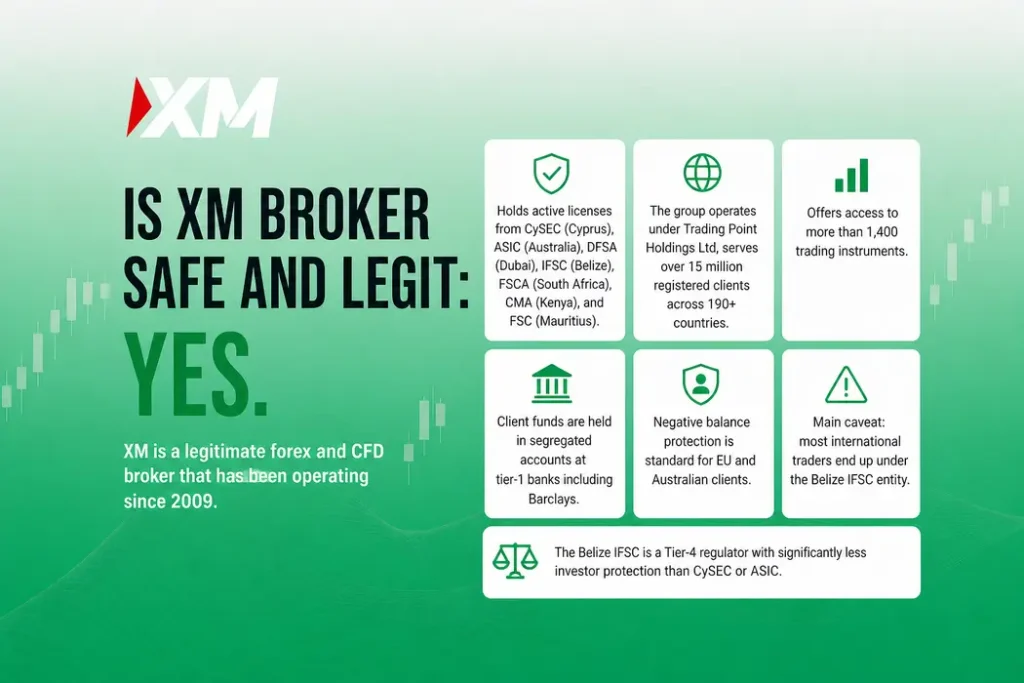
XM is one of the longest-established retail forex and CFD brokers serving global traders. Founded in Cyprus in 2009 by Trading Point of Financial Instruments Ltd, it has grown from a small regional broker into a global operation executing over 2.4 billion orders annually. Features such as a low minimum deposit, educational webinars, and its execution policy have helped XM attract traders worldwide among new traders in Asia, Africa, and the Middle East. However, popularity alone is not enough to judge a broker’s reliability. The following sections examine of who regulates XM, how your money is protected, where the broker falls short, and whether it is a broker you can consider in 2026.
How Is XM Regulated?
XM operates through multiple legal entities, each licensed in a different jurisdiction. The legal entity that opens your account depends on your country of residence, and this determines the level of protection your account receives.
| Entity | Regulator | Key Details |
| Trading Point of Financial Instruments Ltd | CySEC (Cyprus) | License 120/10. EU entity under MiFID II. ICF coverage up to €20,000. |
| Trading Point of Financial Instruments Pty Ltd | ASIC (Australia) | License 443670. Strict capital reserves and 1:30 retail leverage cap. |
| Trading Point MENA Ltd | DFSA (Dubai) | License F003484. DIFC-regulated entity for Middle East clients. |
| XM Global Limited | FSC (Belize) | Update exactly as listed on XM’s regulation page. Primary entity for most international retail traders. |
| XM ZA (Pty) Ltd | FSCA (South Africa) | FSP 49976. Serves South African market. |
| XM KE Ltd | CMA (Kenya) | Serves East African market. |
| XM (Mauritius) Ltd | FSC (Mauritius) | Offshore entity for selected regions. |
Our assessment: CySEC, ASIC and DFSA provide the strongest regulatory oversight within the XM group. All three are Tier-1 or Tier-1 equivalent regulators with strict capital requirements, mandatory fund segregation, and investor compensation mechanisms. However, neither the CySEC nor ASIC entity is available to most international retail traders. If you sign up from South Asia, Southeast Asia, Africa, or Latin America, most international clients are generally onboarded under the IFSC Belize entity. Many independent broker research firms classify the Belize regulator as a lower-trust offshore regulator compared with CySEC or ASIC. It has recognised financial regulator, but it does not provide segregated fund mandates, investor compensation coverage, or negative balance protection guarantees at the same level as CySEC or ASIC.
How Does XM Protect Your Money?
Segregated accounts. XM stores client funds in separate bank accounts at tier-1 institutions. Your money is kept distinct from the company’s company funds. If the company were ever to become insolvent, Separate client account help keep client money separate from company operating funds, creditors would not be able to access client funds.
Negative balance protection. Under CySEC and ASIC regulation, retail clients cannot lose more than their deposited balance. This is a regulatory requirement, not just a company policy. For clients under the IFSC entity, XM states that negative balance protection applies, but it is not mandated by the regulator with the same legal force.
Investor Compensation Fund (ICF). EU clients registered under CySEC are covered by the ICF for up to €20,000 per person in case of broker insolvency. This protection is established under the applicable European investor compensation framework. Clients under the Belize IFSC entity do not have access to any equivalent compensation scheme.
SSL encryption and 2FA. XM uses industry-standard SSL encryption for all data transfers and supports two-factor authentication (2FA) for eligible accounts for account access. Payment processing partners include Skrill and Neteller (regulated by the Central Bank of Ireland), Przelewy24 (regulated by Poland’s Financial Supervision Authority), and Nuvei, Sepaga, EcommBX, and Unlimint (regulated by the Central Bank of Cyprus).
What Is XM’s Track Record?
XM was founded in 2009, giving it over 16 years of continuous operation. The broker has never had a license revoked, and there are no publicly documented cases of major regulatory fines or fraud findings against any of its entities.
The scale is notable. XM reports over 15 million registered clients, operates in more than 190 countries, and has executed over 10.3 billion trades since launch. The company claims a 99.35% order execution rate in under 1 second with no requotes and no rejections. While these marketing claims should always be taken with some skepticism, independent reviews from BrokerChooser, FXStreet, and DayTrading.com have generally confirmed reliable execution during live testing.
The broker has received multiple industry awards, including Best FX Broker (Europe) from World Finance and Best CFD Provider from the City of London Wealth Management Awards. They also maintain a large educational operation with daily live webinars in over 27 languages, something most competitors do not match.
What Are Traders Actually Saying?
The Positive Side
Education is the single most praised aspect of XM across every review platform. The daily webinars, video tutorials, and XM Research portal are consistently rated as among the best free resources in the retail forex industry. Many beginners specifically choose XM because of the learning material.
The $5 minimum deposit and micro-lot trading (0.01 lots on the Micro Account) get frequent positive mentions. This combination allows new traders to experience live market conditions with genuinely small financial exposure. Withdrawal processing is also generally fast, with e-wallet methods typically completing within 24 hours. XM does not charge withdrawal fees on its end.
Customer support is available 24/5 in over 27 languages. Response times on live chat are typically under 2 minutes based on independent testing by DayTrading.com. The XM mobile app and MT5 integration also receive positive feedback for stability and clean execution.
The Negative Side
Standard Account spreads are the most common complaint. EUR/USD averages around 1.6 pips on the Standard Account, which is significantly above the industry average of approximately 0.88 pips. For active traders, this cost adds up fast. We break down actual pricing across all tiers in our XM spreads guide.
The Zero Account (0.0 pips + $3.50/lot/side commission) offers much better pricing, but as of 2026, it is only available to CySEC-regulated clients. If you are outside the EU, the Ultra Low Account (0.6 pips, no commission) is the tightest pricing available to you. This limitation frustrates international traders who want competitive raw spreads.
A $15 inactivity fee applies after a period of account dormancy. While common in the industry, it catches casual traders off guard. Some users in countries with strict capital controls also report occasional withdrawal delays, though these are typically attributed to local banking regulations rather than XM itself.
XM also lacks a proprietary desktop or web trading platform. It relies entirely on MT4, MT5, and its mobile app. Brokers like IG, AvaTrade, and Exness offer in-house platforms alongside MetaTrader, giving traders more flexibility.
FX Recap’s take: XM’s weakness is pricing on its most accessible accounts. The Standard Account is great for beginners who value simplicity and education, but it is expensive for anyone trading actively. The restricted availability of the Zero Account to EU clients only is a genuine competitive disadvantage against brokers that offer raw-spread accounts globally.
What Account Types Does XM Offer?
XM offers five account types designed for different experience levels and trading strategies. We cover each in detail in our XM account types guide. Here is the summary.
| Account | Min Deposit | Spreads From | Commission | Lot Size | Best For |
| Micro | $5 | 1.6 pips | None | 0.01 (micro) | Absolute beginners |
| Standard | $5 | 1.6 pips | None | 0.01 (standard) | General trading |
| Ultra Low | $5 | 0.6 pips | None | 0.01 | Cost-conscious traders |
| Zero | $5 | 0.0 pips | $3.50/lot/side | 0.01 | Scalpers (EU only) |
| Shares | $10,000 | Variable | Per-share | 1 share | Stock investors |
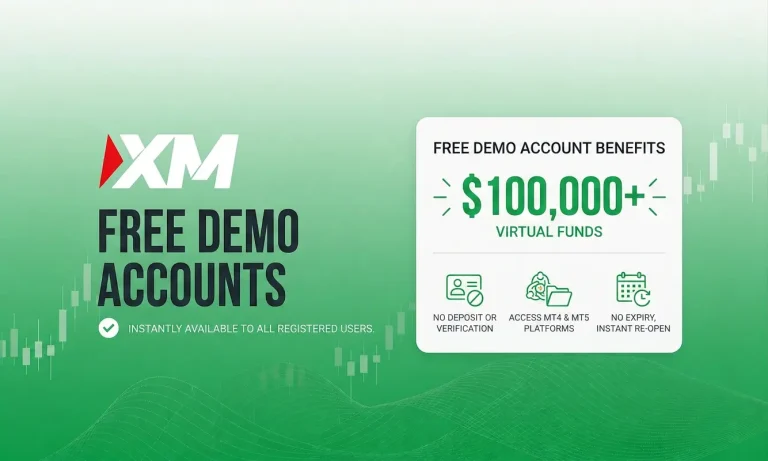
All retail accounts except Shares support swap-free (Islamic) trading on select instruments through the Ultra Low account type. The demo account is free, unlimited, and comes with $100,000 in virtual funds. Both MT4 and MT5 are supported across all account types. For details on how leverage tiers work across entities and instruments, see our XM leverage breakdown.
Are There Any Red Flags?
FX Recap believes in giving the full picture. Here are the areas where XM raises questions.
Most traders land on the Belize entity. The CySEC and ASIC licenses are legitimate and strong. But they serve a limited audience. If you live outside the EU and Australia, your account sits under Independent broker review websites generally classify the Belize regulator as an offshore regulator with lower investor protection than CySEC or ASIC. Investor compensation does not apply. Segregation requirements are not enforced at the same standard. This does not mean XM is unsafe, but it does mean your regulatory backstop is weaker.
Standard Account pricing is above average. A 1.6 pip EUR/USD spread is nearly double the industry average. Competing brokers like Exness, IC Markets, and Pepperstone offer Standard accounts with tighter pricing. XM compensates with education and accessibility, but the cost matters for anyone trading more than a handful of times per week.
Zero Account restricted to EU clients. The Zero Account is XM’s most competitive product (0.0 pip spreads, $3.50/lot/side). But it is only available under the CySEC entity. International traders under IFSC cannot access it. This limits XM’s competitiveness for cost-sensitive traders outside Europe.
Bonus culture. XM aggressively promotes deposit bonuses and no-deposit bonuses in eligible regions (not available under CySEC or DFSA). While the bonus terms are transparent, bonus-driven trading can encourage overtrading and poor risk management. New traders should be cautious about making deposit decisions based on bonus offers rather than actual trading conditions.
No proprietary desktop platform. XM relies entirely on MetaTrader 4 and MetaTrader 5 for desktop and web trading. While MT4/MT5 are solid platforms, the lack of an in-house alternative puts XM behind brokers like IG, cTrader-supported brokers, and others that offer TradingView integration at the platform level.
Who Is XM Best Suited For?
XM’s strongest demographic is new traders who value education and accessibility over pricing. The $5 entry point, micro-lot trading, free demo with no expiry, and daily live webinars in 27+ languages create one of the most beginner-friendly environments in the industry. If you are starting from zero and want to learn while you trade, XM is hard to beat.
EU-based traders who can access the Zero Account also benefit from genuinely competitive raw-spread pricing. The $3.50 per-lot commission combined with 0.0 pip spreads puts XM in line with institutional-grade offerings from Pepperstone and ThinkMarkets.
Where XM falls short: experienced traders outside the EU who want the tightest possible pricing. The Ultra Low Account at 0.6 pips is decent but not exceptional. Scalpers and EA traders who need raw spreads will find better options at brokers that offer commission-based accounts globally. The 1,400+ instrument count is strong, but stock CFDs are limited to around 87 options, and real share trading via the Shares Account requires a $10,000 deposit.
How Does XM Compare to Exness?
These two brokers attract similar audiences but approach the market differently. Here is a direct comparison on the points that matter most.
| Feature | XM | Exness |
| Founded | 2009 | 2008 |
| Clients | 15 million+ | 800,000+ active |
| Instruments | 1,400+ | 250+ |
| Min Deposit | $5 | $10 |
| EUR/USD Spread (Standard) | 1.6 pips | 1.0 pip |
| Raw Spread Account | Zero (EU only) | Raw Spread (global) |
| Withdrawal Speed | Same day (e-wallets) | Instant (e-wallets) |
| Education | Excellent (daily webinars, 27 languages) | Basic |
| Monthly Volume | Not publicly disclosed | $4.5 trillion+ |
XM wins on education, instrument range, and accessibility. Exness wins on pricing, withdrawal speed, and raw-spread availability for international traders. For beginners, XM is the stronger choice. For cost-conscious active traders, Exness generally delivers lower all-in costs.
Most Common Question About XM
Is XM a scam?
No. XM has operated since 2009 with active licenses from CySEC, ASIC, DFSA, IFSC, FSCA, CMA, and FSC. It has a clean regulatory history, no major fraud findings, and serves over 15 million registered clients. Individual complaints exist, as they do with every large broker, but there is no systemic evidence of dishonest behavior.
Is XM regulated by the FCA?
Not directly under the XM brand. XM’s parent group operates Trading.com, which holds FCA authorization (FRN 705428). However, xm.com itself does not onboard retail clients through the FCA entity. The strongest direct licenses under the XM brand are CySEC and ASIC.
Can I lose more than my deposit?
Under CySEC and ASIC regulation, no. Negative balance protection is a regulatory mandate for retail clients. Under the IFSC entity, XM states that negative balance protection applies, but the legal enforcement is weaker because the regulator does not mandate it with the same rigor.
How fast are withdrawals?
E-wallet withdrawals (Skrill, Neteller) typically process within 24 hours, often same-day. Bank card and wire transfers take 1 to 5 business days. XM does not charge withdrawal fees. Third-party providers may apply their own charges. We test actual processing times in our XM withdrawal guide.
Does XM accept traders from the USA?
No. XM does not hold CFTC or NFA registration and does not accept US-based clients.
What is the minimum deposit?
$5 for Micro, Standard, Ultra Low, and Zero accounts. The Shares Account requires a $10,000 minimum. These are among the lowest in the industry.
Does XM charge inactivity fees?
Yes. A $15 fee is applied after a period of account dormancy. If you plan to stop trading for a while, withdraw your funds first.
Is XM good for beginners?
For learning and starting out, XM is one of the best options available. The $5 deposit, micro-lot trading, free demo, and daily live webinars create an entry-level experience that few brokers match. The trade-off is wider spreads on the Standard Account. Once you are past the learning stage and trading actively, you may want to move to a broker with tighter pricing. Our step-by-step XM account opening guide covers the registration process.
Does XM offer a demo account?
Yes. Free, unlimited, and loaded with $100,000 in virtual funds. No expiry date. Available on both MT4 and MT5. Our XM demo account guide walks through the setup.
FX Recap’s Final Verdict
XM is a legitimate, well-regulated broker that has earned its position through accessibility, education, and a 16-year track record. The CySEC and ASIC licenses are genuine Tier-1 credentials. The $5 entry point and micro-lot trading remove financial barriers for new traders. And the educational content is the strongest free offering available in retail forex.
The honest caveat is about cost and entity. Standard Account spreads are above average, and the Zero Account with competitive raw pricing is locked behind the CySEC entity, making it unavailable to most international traders. If you are outside the EU and need tight spreads, XM is not the cheapest option. And if you are trading under the IFSC Belize entity, your regulatory protection is meaningfully weaker than what CySEC or ASIC provide. None of this makes XM unsafe. But it means you should go in knowing exactly where your account sits and what that does (and does not) protect you from.

FX Recap helps you find a trusted forex broker that keeps your trades secure and guides you through everything you need to know about FX instruments.

Ranjan Niskrity is a seasoned Crypto and Forex expert at FX Recap with over a decade of market experience. He specialises in verifying broker data, regulatory frameworks, and cryptocurrency trading insights. His rigorous fact-checking ensures every article meets the highest standards of accuracy.
Related Articles
 Brokers
9 min read
Brokers
9 min read

 Brokers
10 min read
Brokers
10 min read
 Brokers
14 min read
Brokers
14 min read
