 IC Markets























XM Account Types Explained
XM offers four main trading accounts (Micro, Standard, Ultra Low, and Zero) plus a dedicated Shares account. Micro and Standard use spread-only pricing from 1.0 to 1.6 pips with no commission. Ultra Low tightens spreads to 0.6 pips, still commission-free. Zero delivers raw 0.0 pip spreads with a $3.50/lot/side commission but is currently restricted to EU (CySEC) clients. All four CFD accounts accept a $5 minimum deposit. The right choice depends on your experience level, how often you trade, and which regulatory entity your account sits under.




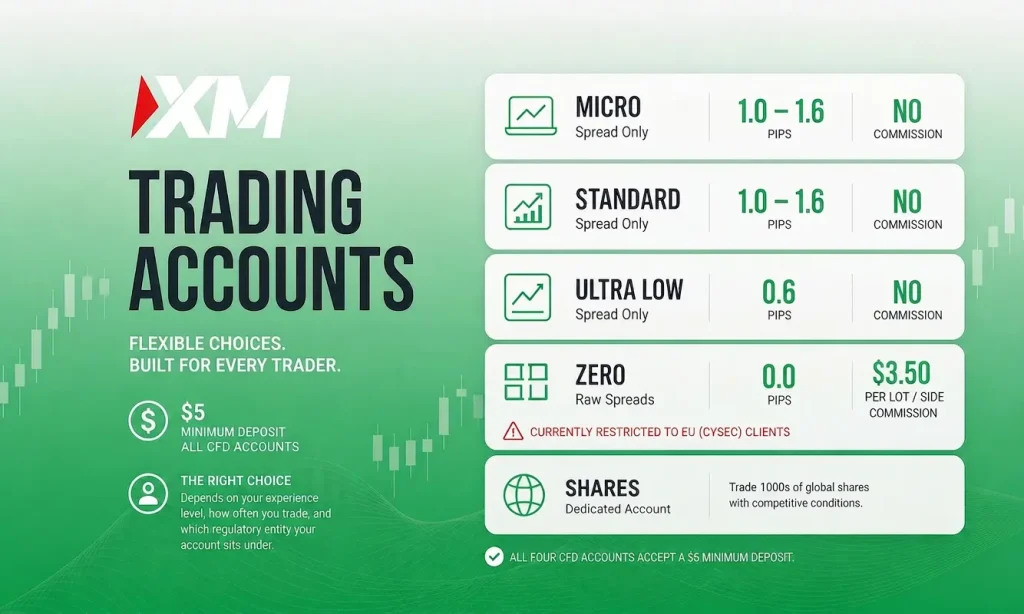
XM groups its accounts into two tiers: spread-only (Micro, Standard, Ultra Low) and commission-based (Zero). Each tier targets a different type of trader, and the pricing gap between them is significant enough to affect your profitability over time. Below is a breakdown of each account, the real cost differences most articles gloss over, and a clear recommendation based on your trading style. For a broader look at the broker, see our XM safety and legitimacy review.
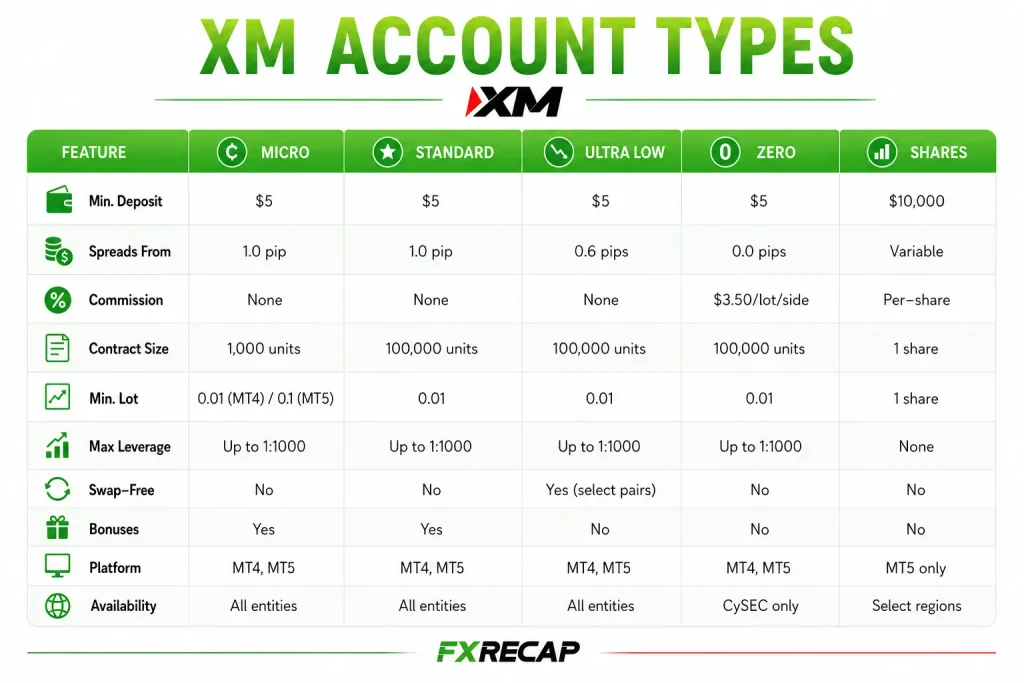
Side-by-Side Comparison
| Feature | Micro | Standard | Ultra Low | Zero | Shares |
| Min. Deposit | $5 | $5 | $5 | $5 | $10,000 |
| Spreads From | 1.0 pip | 1.0 pip | 0.6 pips | 0.0 pips | Variable |
| Commission | None | None | None | $3.50/lot/side | Per-share |
| Contract Size | 1,000 units | 100,000 units | 100,000 units | 100,000 units | 1 share |
| Min. Lot | 0.01 (MT4) / 0.1 (MT5) | 0.01 | 0.01 | 0.01 | 1 share |
| Max Leverage | Up to 1:1000 | Up to 1:1000 | Up to 1:1000 | Up to 1:1000 | None |
| Swap-Free | No | No | Yes (select pairs) | No | No |
| Bonuses | Yes | Yes | No | No | No |
| Platform | MT4, MT5 | MT4, MT5 | MT4, MT5 | MT4, MT5 | MT5 only |
| Availability | All entities | All entities | All entities | CySEC only | Select regions |
Note: Leverage caps depend on your regulatory entity. EU clients under CySEC are capped at 1:30 on major forex pairs. International clients under IFSC (Belize) can access up to 1:1000. The table above shows the maximum available under the least restrictive entity.
1. Micro Account
The Micro account is built for traders who want live market exposure with the smallest possible financial risk. The contract size is 1,000 units per lot instead of the standard 100,000. That means one pip on EUR/USD at 0.01 lots is worth about $0.01. Even a 100-pip adverse move costs only $1.
Spreads start from 1.0 pip (typical average around 1.6 pips on EUR/USD during normal sessions) with no commission. The $5 minimum deposit is among the lowest in the industry. On MT4, the minimum trade size is 0.01 micro lots (10 units). On MT5, the minimum is 0.1 micro lots (100 units), which is a detail many guides miss.
The Micro account is eligible for XM’s deposit bonuses and the $30 no-deposit trading bonus (in regions where bonuses are available). Swap charges apply on overnight positions. This account does not include swap-free (Islamic) trading.
Works well for: Complete beginners placing their first live trades, traders testing new strategies with real money, and anyone who wants to learn position sizing without meaningful financial risk.
2. Standard Account
The Standard account uses full-size contracts (100,000 units per lot). This means one pip on EUR/USD at 0.01 lots is worth about $0.10, and at 1.0 lot it is $10. The pricing structure is identical to the Micro account: spreads from 1.0 pip (average around 1.6 pips on EUR/USD), no commission, and a $5 minimum deposit.
The key difference from Micro is the contract size. The Standard account gives you access to the same instruments and platforms, but each position carries more weight. This matters once you are past the learning stage and trading with proper position sizing based on your account balance.
Like the Micro, the Standard account is eligible for bonuses and does not include swap-free conditions. It works on both MT4 and MT5.
Suits: Intermediate traders who are comfortable with standard lot sizing, traders who want bonus eligibility, and anyone who prefers a straightforward spread-only cost structure.
3. Ultra Low Account
The Ultra Low is where XM gets competitive on pricing. Spreads tighten to 0.6 pips on EUR/USD (roughly half of what Standard offers) with no commission. The trading cost is entirely built into the spread, just like Standard and Micro, but the spread itself is significantly narrower. We compare actual costs in our XM spreads guide.
XM offers two versions of Ultra Low: Ultra Low Standard (100,000 units per lot) and Ultra Low Micro (1,000 units per lot). This gives you the flexibility to choose your contract size while still getting the tighter pricing.
The Ultra Low stands out because it includes swap-free trading on major currency pairs, gold, and silver. Overnight positions on these instruments do not incur interest charges, making it the default choice for traders who hold positions for multiple days or follow Islamic trading principles. No additional application is needed for swap-free status on Ultra Low accounts.
The trade-off is that Ultra Low accounts are not eligible for XM’s deposit bonuses or the $30 no-deposit bonus. If bonus funds matter to your trading plan, you will need to weigh that against the spread savings.
Built for: Active day traders and scalpers who want tight spreads without commissions, swing traders who benefit from swap-free conditions, and EA operators who need predictable spread-only costs.
4. Zero Account
The Zero account delivers raw interbank spreads starting from 0.0 pips on major forex pairs. In exchange, XM charges a fixed commission of $3.50 per lot per side ($7 round trip). This is the tightest pricing XM offers and puts it in line with commission-based accounts from Pepperstone, IC Markets, and Exness.
Here is how the math works. On a 1 lot EUR/USD trade, the Standard account costs roughly $16 in spread (1.6 pips). The Zero account costs about $8 total ($1 in spread at 0.1 pip average + $7 in commission). That is a 50% cost reduction. Over 100 trades, the savings reach $800. For high-frequency traders and EA operators, this difference is substantial enough to separate a profitable year from an unprofitable one.
The Zero account covers approximately 56 forex pairs plus gold and silver. If you need access to stock CFDs, indices, or other instruments, you will need a separate Ultra Low or Standard account alongside it. XM allows multiple accounts under one profile, and internal transfers between them are instant and free.
Critical limitation: As of April 2026, the Zero account is only available to clients registered under XM’s CySEC (EU) entity. International traders under the IFSC (Belize) entity cannot open a Zero account. This is XM’s biggest competitive gap against brokers like Exness, which offer raw-spread accounts to all clients globally.
Ideal for: EU-based scalpers and day traders, EA operators who need precise entry points, and high-volume traders where per-trade savings compound into real profit differences.
5. Shares Account
The Shares account is fundamentally different from the other four. It provides direct access to real shares (not CFDs) on global stock exchanges. There is no leverage, no overnight swap, and no margin trading. You buy actual equity with full ownership exposure.
The minimum deposit is $10,000, and commissions are charged per share or per trade depending on the market (US, UK, German stocks have different commission structures). This account runs exclusively on MT5 and is available only in select regions.
Made for: Investors focused on equities who want real share ownership through their XM profile. Not suitable for forex or CFD traders.
What Does Each Account Actually Cost? A Real Trade Example
Marketing pages show minimum spreads. Real trading conditions are different. Here is what a single 1 standard lot EUR/USD trade costs you on each account type during a typical London session.
| Account | Avg Spread | Commission (RT) | Total Cost / Lot |
| Micro / Standard | 1.6 pips ($16) | $0 | $16.00 |
| Ultra Low | 0.8 pips ($8) | $0 | $8.00 |
| Zero | 0.1 pip ($1) | $7.00 | $8.00 |
Ultra Low and Zero end up at roughly the same total cost per trade during normal conditions. The difference shows up during volatile moments: Ultra Low spreads can widen more than Zero, where the commission stays fixed. For scalpers who trade during news events, the Zero’s fixed-commission model tends to be cheaper in real-world conditions.
How to Pick the Right One
| Your Situation | Best Match | Why |
| Brand new, small budget | Micro | Smallest risk per pip, $5 entry, bonus eligible |
| Comfortable with basics, wants simplicity | Standard | Full lot sizing, no commission, bonus eligible |
| Active trader, wants lower costs | Ultra Low | Half the spread of Standard, swap-free on majors |
| EU-based scalper or EA trader | Zero | 0.0 pip spreads, lowest all-in cost for forex |
| Long-term stock investor | Shares | Real equity ownership, no leverage risk |
Details That Most Guides Leave Out
You Can Run Multiple Accounts
XM allows several trading accounts under a single verified profile. Many experienced traders maintain a Zero account for forex and gold scalping alongside an Ultra Low account for indices and stock CFDs. Internal transfers between accounts are instant and free.
Swap-Free Is Only on Ultra Low
Only the Ultra Low account type (both Standard and Micro versions) includes swap-free trading as a default feature. Micro, Standard, and Zero accounts charge overnight swaps. If avoiding interest is a priority, Ultra Low is your only option within XM.
Bonus Eligibility Varies
XM’s deposit bonuses and $30 no-deposit bonus are available on Micro and Standard accounts only (in eligible regions, not under CySEC or DFSA). Ultra Low and Zero accounts are excluded from all bonus programs. Traders who rely on bonus equity for margin should factor this into their account selection.
MT4 vs MT5 Lot Minimums Differ on Micro
On a Micro account, the minimum trade on MT4 is 0.01 micro lots (10 units). On MT5, the minimum jumps to 0.1 micro lots (100 units). This is a platform-level restriction, not an account-level one. If you want the absolute smallest position sizes, use MT4 with the Micro account.
Zero Account Instrument Range Is Limited
The Zero account covers approximately 56 forex pairs plus gold and silver. It does not include stock CFDs, indices, energies, or cryptocurrencies. If you need these instruments, open a second account (Ultra Low or Standard) alongside your Zero.
How Leverage Differs by Account and Entity
All four CFD account types offer the same maximum leverage, but the actual cap depends on your regulatory entity. CySEC (EU) clients are limited to 1:30 on major forex pairs under ESMA rules. IFSC (Belize) clients can access up to 1:1000. DFSA (Dubai) caps leverage at 1:500 on certain instruments. You can adjust your leverage from the Members Area at any time (with no open positions). For a full breakdown, see our XM leverage guide.
Start with a Demo First
XM provides a free demo account with $100,000 in virtual funds, no expiry, and access to both MT4 and MT5. You can open demo versions of Micro, Standard, and Ultra Low accounts to compare how spreads and execution feel before committing real money. Our XM demo account guide walks through the setup.
Most Common Question About XM
Which XM account has the lowest trading cost?
Ultra Low and Zero have similar all-in costs during normal conditions (roughly $8 per standard lot on EUR/USD). Zero is slightly cheaper during volatile sessions because the commission stays fixed while Ultra Low spreads can widen.
Can I switch my account to a different type?
No. You cannot convert an existing account. But you can open a new account of any available type from your Members Area at any time. Your original account stays active.
Why can I not see the Zero account during registration?
The Zero account is currently available only to CySEC-regulated clients. If you are registering from outside the EU, the Zero option will not appear. The Ultra Low is your best alternative for tight spreads.
Do all accounts support the same instruments?
Micro, Standard, and Ultra Low give access to over 1,400 instruments (forex, stocks, indices, commodities, crypto). The Zero account is limited to approximately 56 forex pairs plus gold and silver. The Shares account is equity-only.
Is the $30 no-deposit bonus available on all accounts?
No. It is only available on Micro and Standard accounts in eligible regions. Ultra Low, Zero, and Shares accounts are excluded.
How fast can I open an account?
Registration takes about 5 minutes. Verification typically completes within 24 hours. Our step-by-step XM account opening guide covers the full process.
How do withdrawals work?
XM charges no withdrawal fees. E-wallet methods process within 24 hours, bank cards and wire transfers take 1 to 5 business days. Details are in our XM withdrawal guide.
Final Word from FX Recap
There is no single “best” XM account. The Micro is for learning. The Standard is for growing. The Ultra Low is for cutting costs. And the Zero is for squeezing every fraction of a pip out of your forex trades, if you are based in the EU.
The one decision that matters most is not which account to open first. It is understanding the cost difference between them. Going from Standard to Ultra Low cuts your per-trade cost nearly in half. Going from Standard to Zero (if available) cuts it by about the same margin. Over hundreds of trades, that compounding difference separates breakeven traders from profitable ones. Pick the account that matches where you are now, and upgrade as your results justify it.


Ranjan Niskrity is a seasoned Crypto and Forex expert at FX Recap with over a decade of market experience. He specialises in verifying broker data, regulatory frameworks, and cryptocurrency trading insights. His rigorous fact-checking ensures every article meets the highest standards of accuracy.
Related Articles
 Brokers
11 min read
Brokers
11 min read

 Brokers
12 min read
Brokers
12 min read
 Brokers
10 min read
Brokers
10 min read
 Brokers
12 min read
Brokers
12 min read