

 EUR/USD
  GBP/USD
  USD/ZAR
  EUR/INR
  EUR/GBP
  XAU/USD (Gold)
  XAG/USD (Silver)
  XM Global
  AvaTrade
  RoboForex
  IC Markets
  LiteFinance
  IUX Markets
  FP Markets
  South Africa
  Thailand
  Singapore
  Japan
Japan  Pakistan
  Malaysia
  Philippines
  Brazil
  Bangladesh
  Vietnam
  India
India 
Exness Account Types 2026
Exness offers five account types divided into Standard and Professional categories. Standard and Standard Cent accounts offer lower minimum deposits and commission-free trading. Pro, Raw Spread, and Zero accounts offer different spread, execution, and commission models for experienced traders. The most suitable account depends on your trading experience, strategy, and available capital.




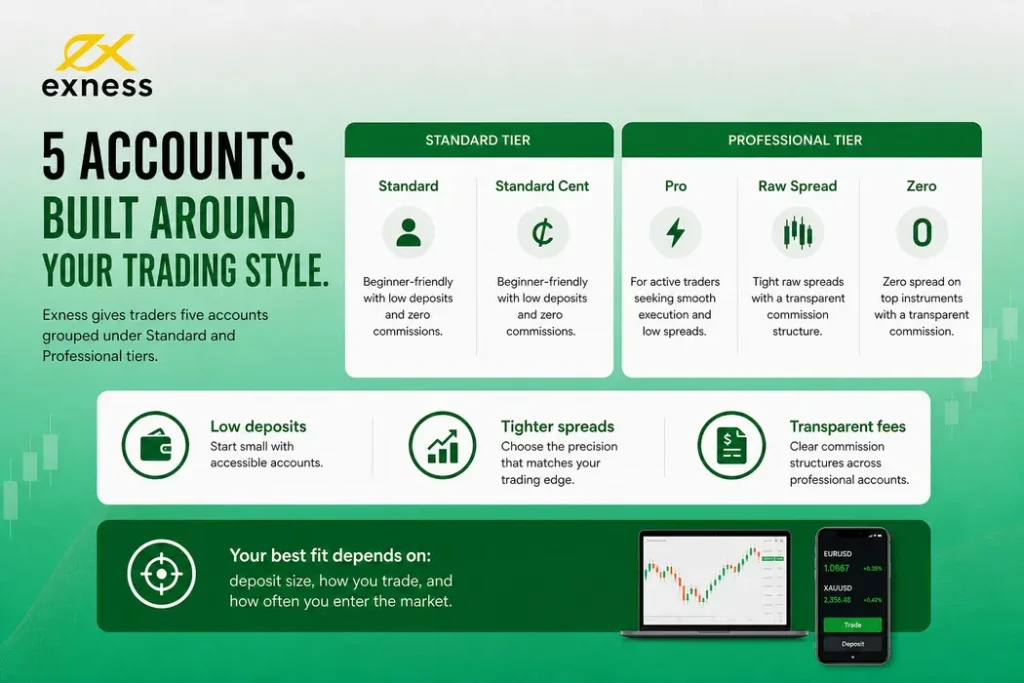
Exness organizes its accounts into two tiers: Standard and Professional. The Standard tier is designed for people early in their trading journey or those who prefer simplicity. The Professional tier is designed for traders looking for different pricing and execution options.
Each account type has its own spread model, execution type, commission structure, and minimum deposit requirement. That means the one you pick will directly affect how much you pay per trade and how your orders get processed. The information below is based on the latest details published by Exness at the time of writing. For a broader look at the broker itself, see our full Exness review.
Side-by-Side Comparison
| Feature | Standard | Standard Cent | Pro | Raw Spread | Zero |
| Min. Deposit | $10 | $10 | $200 | $200 | $200 |
| Spreads From | 0.3 pips | 0.3 pips | 0.1 pips | 0.0 pips | 0.0 pips |
| Commission | None | None | None | varies by instrument and may be up to $3.5 per lot per side. | From $0.2/lot/side |
| Execution | Market | Market | Instant | Market | Market |
| Instruments | Access to a broad range of trading instruments. | 37+ | Access to a broad range of trading instruments. | Access to a broad range of trading instruments. | 120+ |
| Platform | MT4, MT5 | MT4 only | MT4, MT5 | MT4, MT5 | MT4, MT5 |
| Best For | Beginners, day traders | New traders, testing | Swing traders, manual | Scalpers, EA users | News traders, scalpers |
Note: Deposit thresholds can shift depending on your region and payment method. These numbers reflect the most common requirements. For a detailed breakdown, check our guide on Exness minimum deposit.
1. Standard Account
The Standard Account is one of the most commonly used account types offered by Exness. The Standard Account does not charge a separate trading commission. Spreads start from 0.3 pips and vary according to market conditions, and you get access to Access to a wide range of trading instruments covering forex pairs, metals, energies, indices, stocks, and crypto. We break down actual spread data across all tiers in our Exness spreads guide.
Orders use Market Execution, so requotes do not apply, although slippage may occur. Your trade goes through at the current market price. The minimum first deposit is typically $10, depending on your region and payment method (depending on how you fund), and the account works on MT4 and MT5. Eligible traders can apply for a swap-free (Islamic) account. Islamic account status is also available for those who need it.
Works well for: Beginners moving beyond demo, day traders who prefer simple cost structures, and anyone who wants broad instrument access without worrying about separate fees.
2. Standard Cent Account
The Cent account is built for traders who want live market exposure with the lower financial exposure than a standard account. Your account balance is displayed in cents instead of the base currency unit. For example, a $10 deposit is displayed as 1,000 cents. A Cent lot represents a much smaller trade size than a standard lot, meaning each position represents only 1,000 units.
Spread conditions mirror the Standard option (from 0.3 pips, No trading commission applies, while spreads remain part of trading costs.). The difference is a narrower instrument selection, Offers a smaller selection of instruments than the Standard Account, plus platform access is limited to MT4 and the Exness Trader App. Supported on MT4 and the Exness Trader App only, according to Exness.
Commonly used by traders who want to practice live trading with smaller position sizes, people testing fresh strategies under real conditions, and anyone with a small starting balance who wants to limit downside while still trading with real money.
3. Pro Account
The Pro Account is part of the Professional tier but uses a different pricing and execution model from the Raw Spread and Zero accounts. The Pro Account does not charge a separate trading commission, as The Pro Account does not charge a separate commission, while spreads start from 0.1 pips., which starts from 0.1 pips on major pairs like EUR/USD. There is no separate commission.
One of the main differences is the execution method. For forex, metals, and energies, the Pro fills orders instantly at the price you see on screen. If the price shifts before the order processes, With Instant Execution, a requote may occur if the quoted price changes before execution. Execution methods vary depending on the trading instrument available on the platform. Avoid making a blanket statement unless specifically documented to accommodate higher volatility.
You need $200 to open this one, and it runs on MetaTrader 4 and 5. Access to a broad range of trading instruments, depending on platform and regulatory entity, spanning forex, commodities, indices, equities, and digital assets. If gold is part of your strategy, our guide to trading gold on Exness covers the specifics.
Often chosen by clients who prefer commission-free pricing with tighter spreads. EA operators who benefit from instant fills, and anyone looking for tight pricing without calculating separate lot-based fees.
4. Raw Spread Account
The Raw Spread Account offers spreads sourced from Exness pricing with minimal markup with zero markup on the spread. Spreads can start from 0.0 pips under normal market conditions on major pairs during liquid sessions.
The trade-off is a flat commission of up to $3.5 per lot per side ($7 round trip). For scalpers and algorithmic systems that open and close dozens of positions daily, Depending on trading volume and strategy, this pricing model may reduce trading costs than paying through wider spreads on a commission-free setup. Trades execute at the going market rate without requotes, and Exness states that orders are executed quickly, although execution speed may vary depending on market conditions on this tier.
The entry requirement is $200, and the account is compatible with MetaTrader 4 and 5, including full EA support.
Suitable for users who prefer raw spreads with transparent commissions, high-frequency and algorithmic traders, EA developers, and anyone who prioritizes raw pricing and does not mind a transparent commission on each trade.
5. Zero Account
The Zero Account offers spreads from 0.0 pips on selected instruments for most of the trading day. on 30 of the most traded instruments for Exness states that 0.0 pip spreads are available on selected instruments for up to 95% of the trading day. That covers major forex pairs (EUR/USD, GBP/USD) and gold (XAU/USD). During the remaining 5%, typically around major news releases, spreads may open up slightly. For a deeper look at how this account performs in real conditions, see our Exness zero spread account breakdown.
Instead of a spread markup, there is a commission that varies by instrument, starting from $0.2 per side per lot. On some assets, this can climb to $3.5 or higher per side. Your orders go straight to the market with no requotes. The deposit floor is $200, and the account runs on MT4 and MT5 with Islamic account availability.
Ideal for: News event clients who need consistent low spreads during volatile windows, scalpers focused on majors, and clients who prefer knowing the spread is starts from 0.0 pips on eligible instruments while managing a commission that varies by instrument.
How to Pick the Right One
Choosing the right account mainly depends on three factors: how much capital you are starting with, your preferred trading strategy, and whether you prefer paying trading costs through spreads or through a separate trading commission
| Your Situation | Best Match | Reason |
| Users with limited live trading experience, small budget | Standard Cent | Smallest risk, real market feel |
| Users looking for a standard live trading account, low capital | Standard | No fees, low entry, full instrument range |
| Experienced, trades manually | Pro | Tight pricing, no commission, instant fills |
| Scalps or runs automated systems | Raw Spread | Tightest raw pricing, fast fills |
| Clients focusing on high-volatility market events or volatility | Zero | Locked zero spreads on top 30 pairs most of the day |
Details That Most Guides Leave Out
Running More Than One Account
Exness allows multiple accounts under a single profile. You could run a Raw Spread setup for scalping and a Pro setup for longer-term trades at the same time. Many traders choose to use multiple accounts to separate different trading strategies to Keep but avoid unsupported popularity claims and track performance independently. If you have not set up your first one yet, our step-by-step guide to opening an Exness account walks through the process.
Demo Access Across All Tiers
Demo accounts are available for all supported account types. On registration, Exness provides a demo account with virtual funds when you register for its web platform. Beyond that, you can set State only if confirmed in the current Exness Help Centre. each on MT4 and MT5, and Demo account availability is subject to Exness policies. This allows you to test different trading approaches before using real funds to test any account setup before trading with a live account. We cover the full setup process in our Exness demo account guide.
Swap-Free (Islamic) Status
Eligible Exness accounts can be enabled to swap-free (Islamic) status, subject to Exness eligibility requirements. Swap-free availability depends on the account type, trading instrument, and your registered region and is designed for users following Sharia-compliant principles. Our detailed Exness Islamic account guide explains how activation works and which instruments are covered.
Leverage and Stop Out Levels
Eligible traders may qualify for leverage Available only for eligible traders who meet Exness requirements, subject to Exness eligibility requirements for verified users who meet certain conditions, such as Eligibility depends on several conditions published by Exness. Default options are more conservative and vary by region and regulatory entity.Stop Out levels vary depending on the account type, trading instrument, and trading conditions, though it Certain trading conditions may temporarily change Stop Out levels for specific instruments. For the full eligibility criteria, read our Exness unlimited leverage breakdown.
Funding and Withdrawals
Exness does not charge deposit or withdrawal fees, although third-party payment providers may apply their own charges for deposits or withdrawals on its end. Supported methods include bank cards (Visa, MasterCard), e-wallets like Skrill, Neteller, and Perfect Money, cryptocurrency, and local bank transfers.Many withdrawal requests are processed automatically, although processing times depend on the payment method, a This can be an advantage for traders who require faster access to their funds that hold funds for days. We test actual withdrawal speeds in our Exness instant withdrawal review.
Regulation: Where Your Account Actually Sits
Exness holds licenses from the FCA (UK), CySEC (Cyprus), FSA (Seychelles), and FSCA (South Africa). Exness holds licences from several financial regulators, but The regulatory entity serving your account depends on your country of residence under the Seychelles or South Africa entities. The FCA and CySEC licenses primarily serve institutional clients. We dig into what this means for your funds in our is Exness a legit broker analysis.
This matters because Seychelles regulation Investor protection measures differ between regulatory jurisdictions than the European or UK frameworks. Negative balance protection applies across all Exness accounts regardless of entity, but compensation schemes and dispute resolution options differ. Verify which entity you are registered under before depositing.
FAQs
How many accounts does Exness offer?
Five: Standard, Standard Cent, Pro, Raw Spread, and Zero.
What is the smallest deposit to get started?
Standard and Cent tiers accept as little as $10 depending on your payment method. The Professional tier (Pro, Raw Spread, Zero) requires $200.
Which account may have lower trading costs?
That depends on volume. Low-volume clients often save more on the Pro (no commission, 0.1 pip spreads). High-volume and scalping traders tend to pay less through Raw Spread (0.0 pip spreads plus a flat commission).
Can I change my account to a different type?
You cannot convert an existing setup. However, you can open a new one of any type at any time through the Exness Personal Area.
Does Exness provide ECN accounts?
No. Exness has officially confirmed it does not offer ECN accounts. The Raw Spread option comes closest to ECN-style conditions, but it is not classified as one.
Is the Cent tier supported on MT5?
No. It is only accessible through MT4 and the Exness Trader App.
Do any accounts produce requotes?
Only the Pro, which fills orders instantly. If the price moves before your order processes, the broker sends a requote. The other four tiers operate on market-based fills, so requotes do not apply, though slippage remains possible.
Does Exness support social or copy trading?
Yes. Exness has a social trading platform where you can follow and copy strategies from other traders. It operates separately from the five main account types discussed here. We cover how it works in our Exness social trading guide.
Should beginners open a Professional tier account?
Beginners may prefer starting with a Standard or Standard Cent account before moving to Professional accounts to build comfort on Standard or Cent first. The Professional tier assumes familiarity with fee structures, leverage settings, and how different execution models affect your trades.
Final Word from FX Recap
There is no single “best” account on Exness. The right pick lines up with where you are right now: your capital, your skill level, and the strategy you are running. If you are still learning, Standard or Cent keeps the experience simple and the costs low. If you trade actively and every fraction of a pip counts, Pro, Raw Spread, or Zero gives you the pricing and execution precision that directly impacts your results.
Start with a demo. Run your strategy on it. See how it feels under that specific set of conditions. Then fund a live account once you are confident in the fit.

FX Recap helps you find a trusted forex broker that keeps your trades secure and guides you through everything you need to know about FX instruments.

Ranjan Niskrity is a seasoned Crypto and Forex expert at FX Recap with over a decade of market experience. He specialises in verifying broker data, regulatory frameworks, and cryptocurrency trading insights. His rigorous fact-checking ensures every article meets the highest standards of accuracy.
Related Articles
 Brokers
15 min read
Brokers
15 min read

 Brokers
10 min read
Brokers
10 min read
