Social Trading is available only in supported jurisdictions and account types. Exness does not charge a platform subscription fee for Social Trading. Strategy Providers set their own performance fee within the limits allowed by Exness. The applicable fee is shown before you invest.

For beginners or investors with limited time, Social Trading offers an alternative to placing trades manually. After selecting a strategy and investing funds, eligible trades are copied automatically. Your balance moves with the same entries, exits, and sizes, scaled to your capital.

Exness operates through multiple regulated entities, with the applicable regulator depending on your country of residence. Regulatory oversight can help investors evaluate a broker’s credibility and operating standards.

This guide explains how the service works, its costs, available features, and the potential risks.

What Is Exness Social Trading?

Exness Social Trading is a copy trading service available within the Exness platform. There are two participant roles: Strategy Providers and Investors.

Once you invest in a strategy, every position they open or close gets replicated on your side automatically. Trade sizes are adjusted automatically according to Exness’ investment allocation model.

Exness does not charge a platform fee for Social Trading, although normal trading charges still apply where applicable. Investors pay a performance fee to the Strategy Provider when the applicable conditions are met. They lock in that rate when creating their strategy, and the maximum performance fee is determined by Exness and displayed when selecting a strategy. If a billing cycle ends with no profit on your side, you owe nothing.

You can access Social Trading through supported versions of the Exness app and your Personal Area.

How Does the Copying Process Work?

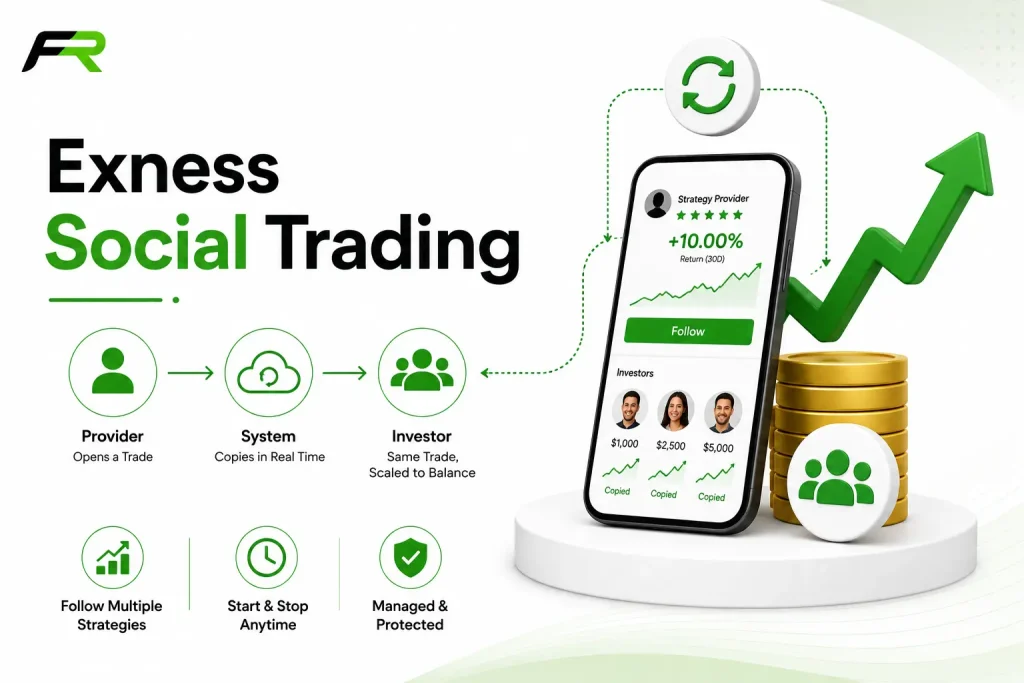
The copy trading process follows a straightforward workflow. A provider operates on their own account with their own capital. When an investor follows that strategy, the system replicates each trade on the investor’s side, scaled to their balance.

Example: if the provider opens a buy on EUR/USD, your account opens the same position at the same moment. The lot size adjusts based on how much you’ve put in versus their equity. For example, if a provider earns a 10% return, your investment may generate a similar percentage return before applicable fees, subject to copying conditions.

You can follow multiple strategies at once, and each one runs independently. Starting and stopping is possible even outside market hours. Ending an investment closes copied positions according to market availability and execution conditions. Copied positions are managed according to Exness Social Trading rules rather than individually through the investment. If their positions hit stop out, your investment closes as well. And if anything goes negative, balances are automatically reset to zero.

How to Start Using Exness Social Trading

The setup takes a few minutes. First, open an Exness account at exness.com and complete the identity verification (KYC). You’ll need a valid ID and proof of address. Once that’s done, download the Copy Trading app from Google Play or the Apple App Store and sign in with your Exness login.

Next, fund your investment wallet. The minimum deposit starts from $10, though certain strategies may need a larger amount. From there, browse the available strategies. You can filter by return, risk level, fee rate, and trading style. Review the provider’s trading history, risk level, fees, and performance before investing.

When you’re ready, pick a strategy and enter your amount. Confirm your investment to begin copying the selected strategy. After that, just keep an eye on things. Track results from your phone or web dashboard, pause if needed, or pull out profits whenever you want.

Exness Social Trading Fees

There is no platform fee, management fee, or subscription. The primary service fee is the Strategy Provider’s performance fee, although normal trading costs may also apply. That rate gets locked in the moment you start following them. If they adjust it later, the new number only applies to people who join after the change.

Billing cycles end on the last Friday of each month, between 23:50 and 23:59:59 UTC. A fresh cycle begins right after. If there’s no profit during that period, no fee gets deducted. If you exit before the cycle ends, the fee is calculated at that point, assuming there’s a gain to charge against. And after a losing stretch, you won’t owe anything again until your investment recovers that loss and moves into fresh profit.

Since August 2025, earned fees go into the trader’s Performance Fee Wallet, which they can use for trading, internal transfers, or withdrawals.

In addition, copied trades remain subject to normal trading costs where applicable. Regular trading costs like spreads, commissions on certain account types, and overnight swap fees still apply to copied trades, just like they would on any standard Exness position.

How to Pick the Right Trader to Follow

Choosing the right Strategy Provider is one of the most important investment decisions. Rushing into a decision here is one of the biggest mistakes new investors make.

Trading Reliability Level (TRL)

According to Exness, each Strategy Provider receives a Trading Reliability Level (TRL) score ranging from 0 to 100. It blends two components: the VaR (Value at Risk) score, which reflects how well someone manages loss periods, and the Safety score, which gauges the chance of losing all capital. A higher number means they’ve handled risk more responsibly over time. Exness classifies TRL scores using its current scoring model available in the platform.

Keep in mind: TRL is calculated using historical trading performance and risk metrics. It cannot predict what happens next. But it’s still one useful indicator for separating serious providers from reckless ones.

Other Signals to Pay Attention To

Look at returns spread over months, not a single good week. Short-term spikes are often misleading. Review the drawdown carefully alongside historical returns. Someone with 80% returns and 60% drawdown carries a very different risk profile than a provider with 30% returns and 10% drawdown. A lower figure usually signals better discipline.

Open up the actual trade records. Are position sizes reasonable? Is there consistency, or do you see wild swings? Also, compare the expected return with the performance fee. A 50% cut on a strategy earning 10% monthly leaves you with 5%. Investors should evaluate whether the potential return justifies the performance fee, but you should know the number before you commit.

A high follower count can signal trust, but don’t use it as your only filter. Verify the data yourself. And be cautious with strategies that have only a couple of weeks of history. Three to six months of consistent results gives you a more meaningful performance history to assess.

Who Can Use Exness Social Trading?

Eligible clients with supported Exness accounts can access Social Trading where the service is available, and no prior market experience or technical skills are required. It The service is designed for investors with different levels of trading experience who want forex exposure without learning to trade manually, working professionals who don’t have time to watch charts every day, and part-time traders who want to diversify by adding copied strategies alongside their own positions. Skilled traders can also flip the model and earn extra income by sharing their setups as a provider.

Availability depends on your country, and some regions do have restrictions. Check your Exness dashboard to confirm access.

Exness Social Trading App Features

The Exness app supports Social Trading features on Android and iOS, depending on your region and app version. You can also manage your investments through your Exness Personal Area on the web.

From the app, you can browse providers and filter by returns, risk, fees, and other metrics. Available performance statistics depend on the current version of the Exness platform. The app can send notifications about investment activity and account updates. You can manage deposits, withdrawals, and investments through the mobile app, and pause or exit any strategy on your own terms.

How to Become an Exness Strategy Provider?

Experienced traders can become Strategy Providers and allow other investors to copy their trades. Strategy Providers create eligible trading accounts supported by Exness Social Trading.

To create a strategy, log in to your Personal Area and open the Copy Trading section. Go to “My copy strategies,” tap “Get started,” and pick between a Standard or Pro account. Next, choose your account settings, including the performance fee and trading platform. Add a name, description, and profile picture, then set the strategy Providers choose a minimum investment within the limits permitted by Exness.

Your strategy becomes publicly available only after meeting Exness’ visibility requirements until you meet visibility requirements, including a  strategy becomes visible after meeting Exness’ current publication requirements. These requirements help maintain the quality of publicly available strategies.

Risks of Exness Social Trading

Like any form of investing, Social Trading involves both opportunities and risks. because a lot of content out there glosses over the downsides. Copy trading does not guarantee profits.

If the Strategy Provider makes a losing trade, your investment may also lose value, your balance takes a proportional hit. That’s how it works. Past numbers don’t promise future ones either. Someone who returned 20% monthly for six months straight can still blow up tomorrow. Past performance does not guarantee future results.

A high win rate should not be the only factor when evaluating a strategy. Some providers hold losing positions open for weeks to avoid locking in a loss. Performance statistics should always be considered alongside drawdown and risk management, but the hidden exposure is dangerous. Always check drawdown. During fast-moving markets, your entry or exit could also land at a slightly different price than theirs, so keep that in mind.

Your results depend on another person. If they trade emotionally or recklessly one day, your investment may also be affected. And there’s no partial exit option. You can’t close one copied trade on its own. The only way out is to disconnect from the strategy entirely, which closes everything at once.

Tips for Using Exness Social Trading

The following practices may help investors manage risk more effectively.

Start with a small amount. Try $10 to $50 spread across two or three strategies instead of investing your entire balance in a single Strategy Provider. Diversifying across several strategies may help reduce concentration risk. Pay attention to drawdown numbers and aim for providers whose drawdown stays below 30% to 40%. A high figure means a higher chance of steep losses.

Review your profits regularly and decide whether to withdraw part of your gains. Withdraw a portion and secure what you’ve earned. Check in weekly rather than treating it like a savings account. Review results regularly and be ready to pull out if a provider’s behavior shifts. And above all, only risk what you’re comfortable losing. This is real market trading. Only invest money you can afford to lose.

Frequently Asked Questions

Is the social trading feature on Exness really free?

Yes. There’s no platform or subscription cost. The only expense is a fee decided by the provider, and it only applies when you’re in profit.

What’s the minimum amount to get started?

It varies by strategy. Some accept as little as $10, while others need $200 or more. The provider decides the minimum for their strategy.

Can I stop following a trader whenever I want?

Yes. You can stop following a strategy whenever you choose, subject to market conditions. All open positions tied to that strategy close right away. If there was a profit, the fee is deducted before funds return to your wallet.

Do I need to install MT4 or MT5?

Not as an investor. Everything runs through the mobile app or the web-based Personal Area. Only providers who create strategies use MT4 or MT5 on their end.

Can I follow more than one strategy simultaneously?

Absolutely. You can invest in several at the same time. They run separately and don’t affect each other.

Is Exness regulated?

Yes. Exness operates through several regulated entities. The regulator that applies depends on your country of residence.

What if the person I’m following loses money?

Your investment reflects the proportional performance of the copied strategy. If a position goes south, your balance reflects it. Negative balance protection applies according to Exness’ trading conditions.

Is this available in every country?

Not everywhere. Certain regions have restrictions. Log in to your account to check availability.

Final Verdict

As a copy trading platform, Exness offers a structured Social Trading service for investors who prefer copying experienced traders instead of trading manually. Exness does not charge a platform fee for Social Trading, while Strategy Providers may charge a performance fee under Exness’ rules. The platform provides detailed strategy statistics and several tools for evaluating Strategy Providers.

However, Social Trading does not eliminate investment risk. You’re still putting real money into real markets. How well you do comes down to which providers you choose and how carefully you manage your capital. Investors should monitor their investments regularly and choose strategies carefully.

If you’re just getting started, New investors may consider starting with a modest investment and diversifying across suitable strategies, and pay close attention to the trades being mirrored into your account. Regular monitoring can help investors better understand how copied strategies perform over time.