
 XM Global
  AvaTrade
  RoboForex
  IC Markets
  LiteFinance
  IUX Markets
  FP Markets
  South Africa
  Thailand
  Singapore
  Japan
Japan  Pakistan
  Malaysia
  Philippines
  Brazil
  Bangladesh
  Vietnam
  India
India Risk
What is Stop loss and take profit and How to use it

 EUR/USD
 GBP/USD
 USD/ZAR
 EUR/INR
 EUR/GBP
 XAU/USD (Gold)
 XAG/USD (Silver)
 Forex risk management is what separates traders who last from those who blow their accounts in months. This guide covers stop-loss placement, position sizing, leverage control, and the emotional traps that silently destroy trading capital. Learn the exact rules professional traders use to stay in the game long enough to become consistently profitable.




The first time Smith blew his trading account, he was not a reckless trader. He had opened a position in EUR/USD after reading a market forecast on social media. When price moved forty pips against him, he held the trade, convinced it would reverse. When it dropped another forty pips, he added more positions. He had lost nearly half his account before closing everything. It took less than fifteen minutes.
Almost every trader learns this same painful lesson eventually: you cannot grow in forex without first learning how to protect what you have.
Risk management is not a backup plan. It is the main plan. Without it, even the most technically sound strategy will eventually destroy an account. With it, a simple approach can compound steadily over months and years.
This article covers every core aspect of forex risk management: how it works, why it matters, and how professional traders actually apply it. You will find real numbers, honest analysis, and practical steps you can act on today.
Forex risk management is the set of rules and habits that keep your losses small enough to survive. It is not about avoiding all losing trades. Losing trades are unavoidable. It is about making sure that no single loss, or string of losses, is large enough to end your trading career.
Capital is the foundation of everything. Without it, no strategy, tool, or insight means anything. Once your account reaches zero, the game is over. Every dollar saved during a losing period is a dollar available to recover with when conditions improve.
This is why experienced traders talk about protecting capital before anything else. Not because they are fearful, but because they are realistic. Markets are unpredictable. News events can reverse a perfectly valid setup in seconds. No system has a 100% win rate. A trader who understands this builds a plan that survives imperfection.
A solid risk plan removes the most destructive element in trading: reactive decisions. When you know in advance exactly how much you are willing to lose on a trade, where your stop-loss sits, and how large your position is, you do not need to think in the moment. The decision is already made.
This matters enormously during live trading, where emotions run high. Traders who operate without a plan often move their stop-losses, hold losers too long, or chase entries out of fear of missing out. A written risk framework eliminates most of this behavior.
After blowing half his account, Smith stepped away for two weeks. When he returned, he set one rule: never risk more than 1% per trade or more than 5% in a single week. He tracked every trade and held himself to it strictly.
Three months later, his equity curve had stabilized. He was still losing trades, more often than he was winning. But his losses were small and predictable. His wins were steady. His confidence came back gradually, built on evidence rather than hope.
“I stopped trying to win big. I started trying not to lose big.”
This shift in thinking is what separates traders who last from traders who disappear. Trading psychologist Dr. Brett Steenbarger has written extensively on this: sustainable growth begins when a trader controls the downside.
Before getting into the mechanics, three principles deserve to be stated clearly. They sound simple. Most traders know them in theory. Very few apply them consistently.
Chasing large returns on individual trades is one of the fastest ways to blow an account. A 10% monthly gain held consistently over a year produces extraordinary results. A single reckless trade attempting a 30% gain in one shot typically ends in a significant loss. Consistent, manageable returns compound. One-shot big trades do not.
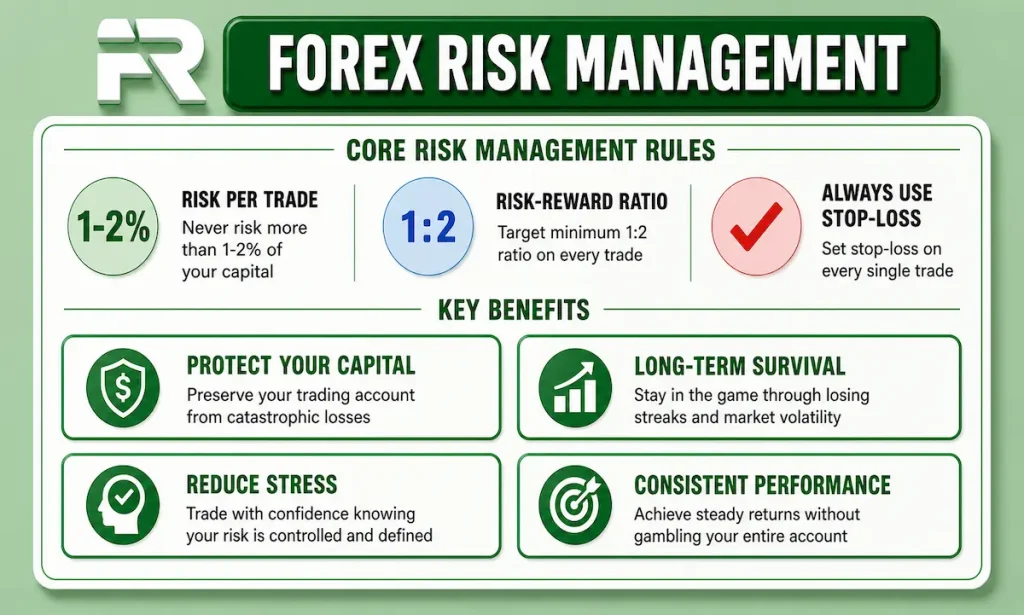
A trader with a 40% win rate can still be profitable if the average winner is significantly larger than the average loser. A 1:2 or 1:3 risk-to-reward ratio makes this possible. Without a favorable ratio, even a 60% win rate can lose money over time if losses are larger than wins.
The difference between a trader who lasts one year and one who lasts ten years is not superior analysis. It is the ability to lose small, recover, and stay in the game. Every professional trader has gone through losing streaks. What separates them from beginners is that their risk rules prevented those streaks from becoming fatal.
Risk management is practical. It is built from specific tools applied in a disciplined way. Here are the ones that matter most.
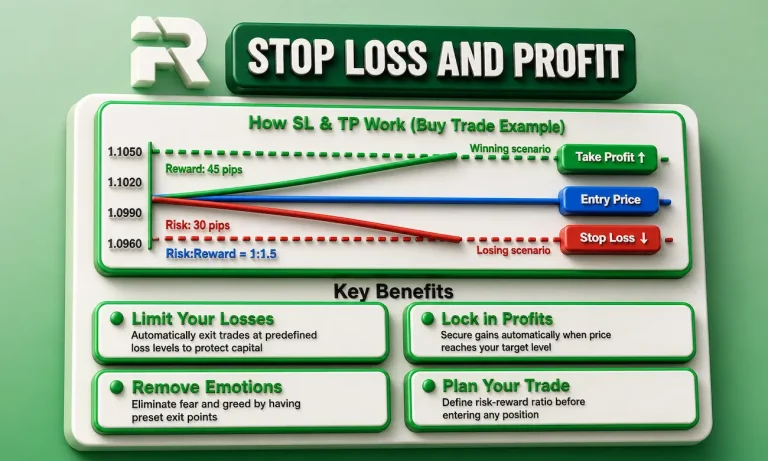
A stop-loss is an instruction to close a trade automatically when price reaches a specified level. It is the most fundamental risk tool in forex. Without one, a trade has no defined exit point, meaning losses can grow without limit. For a deeper look at how to set these effectively, FXRecap’s guide on stop-loss and take-profit covers the mechanics in full.
Where you place the stop matters as much as whether you use one. Stops placed too close to entry get hit by normal market noise. Stops placed too far away risk more capital than the trade warrants. The correct placement is based on market structure: support and resistance levels, recent swing highs or lows, and the natural volatility of the currency pair being traded.
Position sizing determines how many units you trade. It is directly linked to how much you are willing to lose. The standard professional approach is to risk no more than 1% to 2% of your account on any single trade. If your account holds $5,000 and you risk 1%, your maximum loss on that trade is $50. You then calculate your position size backward from that number. FXRecap’s article on lot size in forex explains exactly how this calculation works.
Larger accounts sometimes allow slightly higher percentages per trade, but the principle remains the same. No single trade should be large enough to materially damage your account.
Leverage multiplies both gains and losses. A position opened at 1:100 leverage means a 1% move in price results in a 100% gain or loss on your margin. Most retail traders use far more leverage than they need. A sensible starting point is 1:10 or 1:20, even when your broker offers 1:100 or more. FXRecap has a full explanation of what is forex leverage and how it affects your real exposure.
Trading multiple currency pairs can reduce exposure to any single pair’s volatility. However, it introduces correlation risk. EUR/USD and GBP/USD often move in the same direction. Taking large positions in both simultaneously is not real diversification. It is doubling a single bet. Knowing how major currency pairs behave relative to each other is essential for genuine diversification.
Every risk management framework requires a written plan. Not a mental note. A document that specifies your entry criteria, stop-loss rules, maximum daily loss, maximum weekly loss, and position sizing formula. When the market moves fast and emotions spike, the written plan is what keeps decision-making rational.
The risk-to-reward ratio answers one question: for every dollar risked, how many dollars can you potentially earn? It is how you evaluate whether a trade is worth taking.
Here is a concrete example. A trader risks $10 to potentially earn $30. That is a 1:3 ratio. Now apply it across ten trades with a 40% win rate:
The trader lost more trades than they won and still made money. This is the power of a favorable ratio.
Now reverse the math. A trader risks $50 to earn $10. That is a 5:1 ratio in the wrong direction. Even with a 70% win rate:
This is one of the most common traps in forex. Traders target small, easy-looking wins while their stop-losses sit far away. The trade feels safe because the target is conservative. Mathematically, it is a guaranteed way to lose money over time.
Professional traders think in multiples of risk. Before entering any trade, they identify the target and the stop, calculate the ratio, and only proceed if the potential reward is at least twice the risk. Many require 1:3 as a minimum.
Position sizing is arguably the most overlooked risk tool. Most traders focus on entry and exit signals. Far fewer spend equal time determining the correct size for each trade.
The formula is straightforward. Decide your maximum loss in dollar terms. Divide that by the number of pips to your stop-loss. Then convert to lot size using the pip value for that pair.
Example: Account is $10,000. Risk 1% = $100 maximum loss. Stop-loss is 50 pips. For EUR/USD with a standard lot, each pip is worth $10. So $100 divided by $10 equals 10 pips of equivalent exposure, which means trading 0.2 lots.
This calculation changes with every trade because stop distances vary. A trade with a 20-pip stop uses a larger position than a trade with an 80-pip stop, given the same dollar risk. FXRecap’s guide on what is a pip in forex explains pip values across different pairs so you can apply this accurately.
The 1% rule is a starting point. Some traders use 0.5% for higher-risk environments. Others increase to 2% for high-conviction setups. The key is that it is pre-decided and consistent. Adjusting position size based on how confident you feel in the moment is emotional trading, not disciplined risk management.
A stop-loss does not protect you if it is placed arbitrarily. Putting a stop 20 pips away because that is what you can afford is backwards logic. The stop should be placed where the trade idea is no longer valid, and then position size should be adjusted to make that risk acceptable.
Market structure is the correct reference point. A stop below a recent swing low in a long trade. A stop above a recent swing high in a short trade. The logic is that if price moves to that level, the structure that justified the trade has been broken. The trade is wrong. Exit.
Stops placed too close, driven by a desire to limit loss rather than by structure, get hit constantly by normal market noise. A 5-pip stop on EUR/USD will be triggered dozens of times in a single session by nothing more than the bid-ask spread moving. This creates a losing record even when the overall trade direction was correct.
Spreads matter in stop placement. If the forex spread on a pair widens during news events, a stop that looks safe at 10 pips might get triggered immediately. This is particularly common around major economic releases.
Forex markets do not behave the same way in January and July. Economic data releases, central bank decisions, geopolitical events, and seasonal liquidity patterns all affect how much prices move and how quickly they move.
A breakout strategy that performs well during high-volatility periods, such as rate decision months or major employment reports, may fail completely during quiet summer sessions when prices grind sideways. A range-trading approach that works during low-volatility periods will get repeatedly stopped out during news-heavy weeks.
The Bank for International Settlements noted in 2024 that intraday volatility in major forex pairs has increased, with institutional order flows arriving faster due to algorithmic trading. This means retail traders face sharper and less predictable short-term moves than they did five years ago.
Practical adaptation looks like this: before every trade, check whether there are major news events scheduled. Check the economic calendar. Look at whether spreads have widened. Review recent average true range data to understand current volatility levels. If volatility is elevated, widen your stop. If it is compressed, reduce position size to account for the risk that a sudden move could spike through your level.
FXRecap’s guide on forex market hours explains how liquidity changes throughout the day and why that affects your risk at different times.
Your risk rules need to adapt to the environment you are trading in, not stay fixed because that is how they were set up six months ago.
Leverage allows you to control a position larger than your actual deposit. At 1:100, a $1,000 account controls $100,000 in currency. The appeal is obvious. So is the danger.
At 1:100 leverage, a 1% adverse price move wipes out your entire margin on that position. That is not an extreme scenario. In EUR/USD, a 100-pip move happens regularly during volatile sessions. With high leverage, those moves can erase accounts before a stop-loss even triggers, particularly if the market gaps over the stop level.
Here is a comparison. You open 0.1 lot EUR/USD with 1:100 leverage. Required margin is approximately $100. A 50-pip adverse move costs $50, which is half your margin. With 1:20 leverage, the margin requirement is higher but the position behaves identically. The difference is that your overall exposure to the account is smaller because you are forced to use more capital as margin.
Regulators in the EU and UK now cap leverage for retail traders at 1:30 for major pairs and lower for minors and exotics. This is not coincidental. The data showed that traders using high leverage lost money at significantly higher rates than those using conservative leverage.
For a full breakdown of how margin interacts with leverage and position size, FXRecap’s articles on what is forex margin are worth reading before you adjust any leverage settings.
The practical rule: use the minimum leverage necessary for your strategy. If your system works at 1:10, there is no good reason to run it at 1:50.
Poor strategies do not destroy most accounts. Emotions do. A technically flawed strategy followed consistently will produce predictable results. A sound strategy executed erratically due to emotional interference will produce unpredictable, often catastrophic, results.
The most common emotional traps in trading:
Dr. Van Tharp, who has worked with hundreds of professional traders, argues that mastering yourself consistently precedes mastering the market. Emotional discipline is not a personality trait that some traders are born with. It is a skill developed through practice, self-awareness, and having rules that remove the need for in-the-moment decisions.
A useful discipline: before entering any trade, ask two questions. What is the worst-case outcome, and am I genuinely comfortable with that loss? If the honest answer is no, the position is too large or the trade should not be taken.
Risk management and psychology are not separate disciplines. They reinforce each other. When your position size is appropriate and your maximum loss is pre-defined, you trade in a calmer mental state. A calmer mental state produces better decisions. Better decisions lead to better results, which builds genuine confidence.
Compare two traders. The first risks 0.5% per trade. A losing day costs 1% to 2% of the account. It hurts, but it does not change the trader’s life. He can look at the market clearly, follow his plan, and wait for the next setup.
The second risks 10% per trade. Each pip feels significant. A losing trade triggers anxiety. He might move the stop further away to avoid the loss. He might overtrade to recover it. Every decision is distorted by the emotional weight of the risk.
The first trader is building. The second trader is gambling.
This is why professional traders do not optimize for excitement. They optimize for consistency and mental stability. Your risk rules protect your account. They also protect your judgment, which is the tool your account depends on.
Most risk failures come from a small number of recurring mistakes. Recognizing them in advance is the most direct way to avoid them.
Once a stop is set, it should only ever be moved to lock in profit, never to avoid a loss. Moving a stop further away when a trade moves against you is not risk management. It is hope management. The original stop was set because that level invalidated the trade idea. If price reaches that level, the trade is wrong. Accept it.
Opening large positions in EUR/USD and GBP/USD simultaneously is effectively doubling a single position. Both pairs respond heavily to USD news and often move together. If the USD strengthens sharply, both trades lose at the same time. This is a correlation risk that many retail traders ignore entirely.
A winning streak feels like a signal to trade larger. It is not. It is a statistical pattern that will eventually reverse. Increasing position size significantly after wins is one of the most reliable ways to give back profits in a single large loss.
A per-trade risk rule of 1% still allows a trader to open twenty trades in a day and lose 20% of their account. A weekly maximum loss limit of 5% to 10% prevents this. If the limit is hit, trading stops for the week. This removes the possibility of compounding losses in a bad session into something account-threatening.
Swap rates, the interest paid or earned for holding positions overnight, add up over days and weeks. On a large position held for several days, swap costs can materially affect profitability. FXRecap’s article on forex quotes covers how overnight rates appear in broker pricing and what they mean for your trade.
Forex markets are changing. Algorithmic trading now accounts for a large share of daily volume in major pairs. Economic data hits order books faster than any human can react. Liquidity can vanish for seconds during surprise events and then return, leaving retail traders caught on the wrong side of a gap.
AI-based tools are beginning to appear in retail trading: sentiment analysis indicators, volatility prediction models, and automated risk calculators. These will become more accessible over the next five years. Some brokers are already offering dynamic margin requirements that adjust based on current volatility.
What this means practically is that static risk rules designed for calmer markets may not be sufficient. Stop-losses that were adequate two years ago may need to be wider to account for current intraday volatility ranges. Position sizes may need to shrink during high-uncertainty periods even if the trade setup looks strong.
The broader principle remains unchanged: discipline outlasts prediction. The traders who build robust, adaptable risk frameworks will outlast those who rely on identifying perfect entries. Uncertainty is a permanent feature of forex. How you respond to it determines your longevity.
Every point in this article returns to the same foundation: protecting capital is the precondition for everything else. Not strategy. Not indicators. Not analysis. Capital protection is what allows a trader enough time to improve, adapt, and eventually reach consistent profitability.
Forex risk management stabilizes your decision-making when markets are chaotic. It limits the damage when conditions turn against you. It keeps losses small enough that the next winning period can actually recover them. And it allows you to stay in the game long enough to gain the experience that no course or article can fully replace.
The steps are concrete. Set a maximum per-trade risk, starting at 1% or less. Define a weekly maximum loss. Calculate position size before every trade, not after. Place stop-losses based on market structure, not on how much you can afford to lose. Review your rules regularly and hold yourself to them.
FXRecap covers these topics in detail across the full education library, including forex trading strategies, stop-loss and take-profit mechanics, and the practical side of starting forex trading as a beginner.
The decision to manage your capital carefully is not a concession to caution. It is the defining quality of every trader who has lasted long enough to become consistently profitable. Each small loss kept small extends your trading life. Each week that ends within your loss limits keeps you in position to take advantage of what comes next.
Protect the capital. The opportunities will still be there.

FX Recap helps you find a trusted forex broker that keeps your trades secure and guides you through everything you need to know about FX instruments.

Ranjan Niskrity is a seasoned Crypto and Forex expert at FX Recap with over a decade of market experience. He specialises in verifying broker data, regulatory frameworks, and cryptocurrency trading insights. His rigorous fact-checking ensures every article meets the highest standards of accuracy.
 Education
15 min read
Education
15 min read
 Education
24 min read
Education
24 min read Education
10 min read
Education
10 min read